July 12, 2026
AI in Revenue Forecasting: A Finance Pro's 2026 Guide
Discover what is AI in revenue forecasting and how it enhances accuracy, transforming financial planning for businesses. Learn more now!

AI in Revenue Forecasting: A Finance Pro’s 2026 Guide
TL;DR:
- AI enhances revenue forecasting accuracy by analyzing real-time data and replacing manual estimates with dynamic models. It provides near-term forecasts within 1 to 4 weeks, reducing bias and increasing efficiency across finance teams. Successful deployment depends on clean data, phased adoption, and integrating human judgment into the process.
AI in revenue forecasting is the application of machine learning algorithms to historical and real-time business data to predict future revenue outcomes with greater accuracy than traditional methods allow. The industry term for this practice is predictive revenue forecasting, and it represents a fundamental shift in how finance teams plan and allocate resources. The scale of the problem it solves is significant: only 15% of companies achieve forecast accuracy within 5% of actual results. That means 85% of organizations are making capital allocation decisions on numbers they know are probably wrong. AI changes that equation by replacing static, manually updated spreadsheets with models that learn continuously from new data and update forecasts automatically.
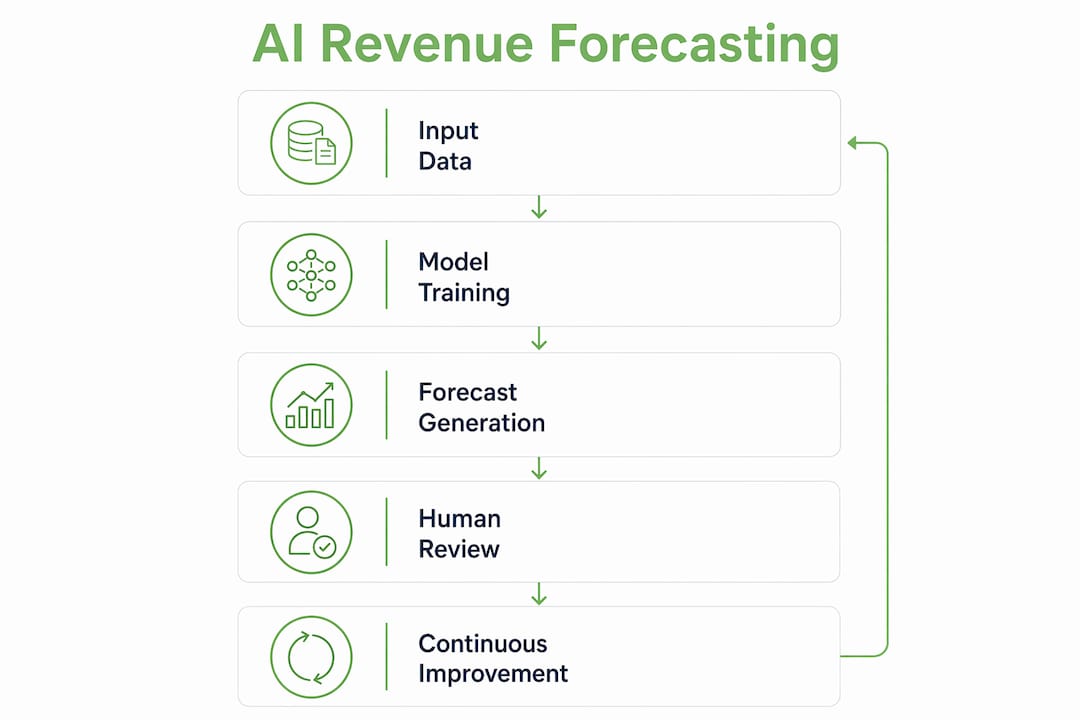
What is AI in revenue forecasting, and how do the models work?
AI revenue forecasting works by recognizing patterns in large datasets and assigning probabilistic scores to future outcomes. Traditional forecasting relies on pipeline stage weighting, where a deal at the proposal stage might be assigned a fixed 40% close probability regardless of its actual characteristics. AI replaces that fixed weight with a dynamic score based on dozens of signals: deal size, sales cycle length, stakeholder engagement, historical win rates for similar deals, and seasonal patterns.

AI models assign probability scores to every open deal and then compute aggregate expected revenue as a weighted sum of deal values by probability. The result is a forecast that reflects real deal behavior rather than a manager’s best guess. Common model types used in this work include gradient boosting trees, Long Short-Term Memory networks (LSTM), ARIMA, and ensemble methods that combine multiple models to reduce error.
These models require specific data inputs to function well. Closed deal histories from your CRM, ERP transaction records, stakeholder engagement signals, and seasonality data all feed the training process. The more complete and consistent that data is, the more reliable the output. AI models also retrain continuously as new deals close, which means the forecast improves over time rather than staying frozen at the last manual update.
| Dimension | Traditional forecasting | AI forecasting |
|---|---|---|
| Probability assignment | Fixed by pipeline stage | Dynamic, based on deal signals |
| Update frequency | Manual, periodic | Continuous, automated |
| Data inputs | Sales rep estimates | CRM, ERP, engagement data |
| Bias exposure | High (human judgment) | Lower (pattern-based) |
| Accuracy trend | Static | Improves with more data |
Pro Tip: Connect your CRM directly to your AI forecasting model. Gaps between CRM data and actual deal activity are the single biggest source of forecast error in most organizations.
What business benefits does AI bring to revenue forecasting?
The accuracy gains from AI forecasting are real and measurable. Mature AI deployments achieve 20–50% improvement in forecasting accuracy in stable operational domains like sales pipeline conversions and working capital projections. That improvement is contingent on rich, high-frequency datasets, but for organizations with solid CRM and ERP hygiene, the gains arrive quickly.
Efficiency is the second major benefit. Automation saves approximately 125 hours annually in financial planning and demand forecasting functions. That is roughly three full work weeks returned to your finance team every year, time that shifts from data wrangling to analysis and decision support.
The practical benefits for finance teams and business analysts include:
- Faster close cycles on planning: AI generates draft forecasts in minutes rather than days, compressing the monthly planning cycle.
- Scenario analysis at scale: AI models run stress tests across dozens of revenue scenarios simultaneously, something that takes weeks manually.
- Reduced forecast bias: Removing human stage weighting eliminates the optimism bias that inflates most sales pipelines.
- Working capital visibility: AI cash flow forecasting gives treasury teams earlier signals on liquidity gaps and surpluses.
- Integration with EPM systems: AI forecasting connects directly to Enterprise Performance Management platforms, feeding updated revenue projections into budgeting and headcount models automatically.
For finance professionals in large organizations, the integration point with EPM systems is particularly valuable. Revenue forecasts no longer live in a separate spreadsheet. They flow directly into the financial model, reducing reconciliation time and improving the accuracy of downstream planning.
Pro Tip: Start your AI forecasting pilot in the business unit with the cleanest CRM data. A successful pilot in one unit builds the internal credibility needed to scale across the organization. Swipecredit’s enterprise revenue intelligence platform is built to support exactly this kind of phased rollout.
What are the limitations of AI revenue forecasting?
AI forecasting performs best in a specific window. AI tools are most effective in near-term horizons of 1–4 weeks, outperforming manual methods clearly in that range. Efficacy tapers in the medium term (5–13 weeks), and in long-term forecasts of six months or more, AI shows no significant advantage over well-constructed human models.
The reason is structural. AI excels in stable, short-horizon domains but underperforms when the past stops predicting the future well. A major product pivot, a new competitor entering the market, or a macroeconomic shock all create conditions where historical patterns mislead rather than guide. In those situations, human causal judgment is not optional. It is the only reliable input.
Data quality is the other hard constraint. Clean, harmonized data across ERP and CRM systems is the single most critical prerequisite for successful AI forecasting. Organizations that train AI models on dirty data get confidently wrong forecasts, which is worse than no forecast at all. Legacy systems and inconsistent data standards are the most common sources of this problem.
Prerequisites for successful AI revenue forecasting:
- Audit your data first. Map every data source feeding your forecast: CRM, ERP, billing systems, and external market data. Identify gaps and inconsistencies before touching an AI model.
- Harmonize data standards. Establish consistent field definitions across systems. A “closed deal” must mean the same thing in Salesforce as it does in your ERP.
- Digitize manual processes. Any deal data still living in spreadsheets or email must move into a structured system before AI can use it.
- Define governance protocols. Establish who owns data quality, how often models retrain, and who reviews AI outputs before they enter planning cycles.
- Plan for human oversight. AI forecasts are baselines, not decisions. Finance leaders must review outputs and apply contextual judgment, especially for strategic or long-horizon planning.
Understanding AI dataset quality requirements before implementation prevents the most common and costly mistakes in AI forecasting adoption.
How can finance teams practically adopt AI revenue forecasting?
Successful AI forecasting adoption follows a phased approach often described as “crawl, walk, run.” Organizations that try to deploy AI forecasting enterprise-wide in a single rollout consistently struggle with data inconsistencies, change management friction, and governance gaps. Starting small is not a compromise. It is the proven path.
A common misconception is that AI requires a large-scale implementation from day one. Building an AI-ready data foundation first is the critical step that most organizations skip, and it is the reason many AI forecasting projects stall after the pilot phase.
Practical steps for finance teams and business analysts:
- Select a pilot unit with clean data. Choose a business unit or product line where CRM and deal data are complete and consistent. Run the AI model alongside your existing forecast for one quarter and compare results.
- Define success metrics upfront. Set a clear accuracy target before the pilot begins. A 10% improvement in forecast error is a reasonable starting benchmark for a first deployment.
- Involve analytics, finance, and operations together. AI forecasting sits at the intersection of these three functions. Decisions about model inputs, retraining schedules, and output review belong to a cross-functional team, not a single department.
- Establish a retraining cadence. AI models degrade when business conditions change and the model does not update. Monthly retraining is a reasonable default for most sales forecasting applications.
- Document the governance framework. Define who can override AI outputs, under what conditions, and how those overrides are recorded. Auditability matters for finance functions subject to regulatory review.
Leading organizations pilot AI forecasting in selected units, define clear governance frameworks, and scale progressively to build trust and maintain auditability. That pattern holds across industries and organization sizes.
Real-world applications of AI revenue forecasting
AI revenue forecasting shows up across multiple finance functions, each with distinct data inputs and output requirements. In sales pipeline forecasting, AI analyzes deal-level signals to produce a probability-weighted revenue number that replaces the traditional stage-based rollup. Finance teams use this output to set quarterly revenue guidance with greater confidence.
In cash flow forecasting, AI models analyze accounts receivable aging, payment behavior patterns, and seasonal cash cycles to predict liquidity positions days or weeks in advance. This gives treasury teams time to act on shortfalls before they become crises. The role of AI in cash flow forecasting is particularly strong in the 1–4 week horizon, where pattern recognition in payment data is highly reliable.
Demand sensing is another high-value application. AI models ingest point-of-sale data, web traffic signals, and external market indicators to predict near-term demand shifts. That output feeds directly into working capital projections and inventory decisions. For finance professionals supporting supply chain functions, demand sensing closes the gap between sales forecasts and operational planning. Explore AI-powered revenue growth strategies to see how these applications connect to broader business performance.
Scenario analysis and stress testing represent the most strategic application. AI generates multiple revenue scenarios simultaneously, each reflecting different assumptions about deal close rates, market conditions, or customer churn. Finance leaders use these scenarios to rehearse decisions before committing capital, which is a qualitatively different kind of planning than the single-point forecast most organizations still rely on.
Key Takeaways
AI revenue forecasting delivers its strongest results in near-term horizons with clean data, human oversight, and a phased implementation approach that builds governance before scale.
| Point | Details |
|---|---|
| Accuracy gap is real | Only 15% of companies forecast within 5% of actual results; AI directly addresses this failure rate. |
| Near-term is the sweet spot | AI outperforms manual methods in 1–4 week horizons; long-term forecasts still require human judgment. |
| Data quality determines outcomes | Harmonized CRM and ERP data is the prerequisite; dirty data produces confidently wrong forecasts. |
| Phased adoption works best | Pilot in one business unit, prove accuracy, then scale with governance protocols in place. |
| AI amplifies, not replaces | Finance teams that treat AI outputs as baselines for human review get better results than those that automate blindly. |
Why I think most organizations are asking the wrong question about AI forecasting
The question I hear most often is “How accurate is AI forecasting?” That is the wrong starting point. The better question is “What decisions will we make differently if our forecast is 30% more accurate?” Most finance teams cannot answer that question clearly, which is why so many AI forecasting pilots produce impressive accuracy metrics and zero change in business behavior.
AI is a partnership tool. It amplifies human judgment in forecasting, especially for scenario analysis and stress testing, rather than replacing the analyst who interprets the output. The organizations I have seen get the most value from AI forecasting are the ones that use it to run more scenarios, not fewer. They treat the AI model as a way to expand the range of futures they can rehearse, not as an oracle that tells them what will happen.
The other thing I would push back on is the idea that AI forecasting is primarily a technology problem. It is a data governance problem first, a change management problem second, and a technology problem third. Organizations that invest in data harmonization and cross-functional alignment before selecting a platform consistently outperform those that lead with the technology decision. Get your data house in order, define who owns the forecast, and then pick the tool.
— Kevin
How Swipecredit helps finance teams forecast with confidence
Finance teams that are ready to move beyond spreadsheet-based forecasting need a platform built for enterprise data complexity and governance requirements.
Swipe Credit AI helps teams reveal valuable business opportunities, act with greater clarity, and measure outcomes while keeping people in control.
FAQ
What is AI in revenue forecasting?
AI in revenue forecasting is the use of machine learning algorithms to analyze historical deal data, CRM records, and real-time business signals to produce probability-weighted revenue predictions. It replaces static, manually updated forecasts with models that learn and update continuously.
How accurate is AI revenue forecasting?
Mature AI deployments achieve 20–50% improvement in accuracy in stable domains like sales pipeline and working capital forecasting, provided the underlying data is clean and high-frequency.
What data does AI need for revenue forecasting?
AI forecasting requires closed deal histories, CRM pipeline data, ERP transaction records, stakeholder engagement signals, and seasonality data. Data must be harmonized across systems before model training begins.
Does AI replace finance analysts in forecasting?
AI does not replace finance analysts. It produces baseline forecasts that analysts review, interpret, and adjust using contextual judgment, particularly for long-term or strategically complex scenarios where historical patterns are unreliable.
How long does it take to implement AI revenue forecasting?
Implementation timelines vary by data readiness, but a phased approach starting with a single business unit pilot typically produces usable results within one quarter. Organizations that skip the data harmonization step consistently experience longer timelines and lower accuracy.