August 2, 2026
Prior Authorization Automation for SMBs and Enterprises
Discover how prior authorization automation accelerates approvals, reduces processing time, and ensures compliance with CMS regulations. Act now!

Prior Authorization Automation for SMBs and Enterprises
TL;DR:
- Prior authorization automation reduces approval times by turning documentation into first-time-complete submissions.
- Supporting FHIR APIs and audit trails are essential for compliance with upcoming CMS deadlines and regulations.
Prior authorization automation cuts manual approval time and prevents rework by turning documentation into a first-time-complete submission. Automated systems have reduced median processing time per request for in-scope medication approvals from over 71 minutes to as little as 18 seconds, according to Surescripts benchmarks. With the CMS-0057-F Final Rule requiring FHIR-based APIs by January 1, 2027, the window to get ahead of this shift is narrowing fast.
Three things to insist on before you shortlist any vendor:
- FHIR PAS support with a documented CMS-0057-F readiness roadmap
- An audit trail that links every recommendation to a codified policy rule
- EHR or ERP connectors that work with your existing systems, not a rip-and-replace
The core principle: AI in authorization workflows works best as a documentation assistant that compiles and surfaces required evidence at the point of decision. It does not make final coverage determinations. That separation is what keeps you compliant and auditable.
Pro Tip: Before you demo any platform, map your current approval workflow end-to-end. Vendors who can’t show you exactly where their tool fits into that map are not ready for your environment.
Table of Contents
- What is prior authorization automation and why does it matter?
- What CMS-0057-F and FHIR mean for your vendor contracts
- Core capabilities to require from any enterprise solution
- Implementation checklist: from pilot to scale
- AI governance, auditability, and security: what to demand contractually
- How to evaluate vendors and the right questions to ask
- Swipecredit makes enterprise approval automation practical
- Key Takeaways
- The real risk is waiting too long
- Useful sources for procurement and technical teams
- FAQ
What is prior authorization automation and why does it matter?
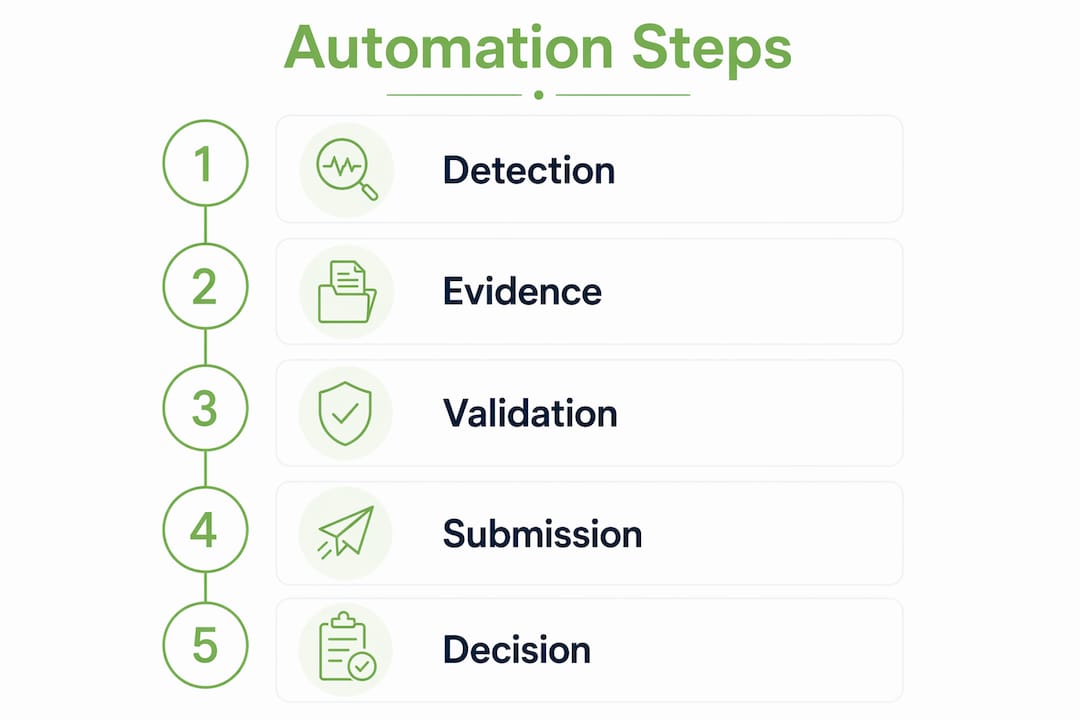
Authorization automation follows a repeatable pattern: detect that approval is needed, assemble supporting evidence, validate it against policy rules, submit the request, and track the decision. Each step that used to require a staff member manually pulling records, filling forms, and following up by phone can now run with minimal human touch.
For SMBs, the payoff is straightforward. Fewer staff hours spent on paperwork means more time on revenue-generating work. For enterprises, the math scales: cutting even a few minutes per request across thousands of monthly submissions reclaims significant capacity.
The business benefits go beyond speed:
- Fewer re-submissions. Evidence assembled correctly the first time means fewer denials caused by missing documentation.
- Lower administrative headcount pressure. Clinicians and operations staff spend substantial weekly hours on authorization paperwork; automation reclaims that time.
- Faster revenue realization. Shorter authorization lead times mean treatments or services start sooner, which tightens the gap between service delivery and payment.
- Better customer and patient experience. Faster decisions reduce abandonment and frustration on both sides of the transaction.
AI operates at the point of documentation, flagging likely authorization requirements while the clinical note or order is still being created. That upstream catch prevents the downstream rework that drives most of the cost.
Pro Tip: Treat automation as a documentation-first workflow. The goal is a complete, policy-aligned submission on the first attempt, not just a faster fax.
What CMS-0057-F and FHIR mean for your vendor contracts
The CMS-0057-F Final Rule sets a hard deadline: January 1, 2027. By that date, CMS-regulated payers, including Medicare Advantage organizations, state Medicaid and CHIP programs, and qualified health plan issuers on the Federal Facilitated Exchanges, must support three FHIR-based APIs.
| API | What it does | Why it matters to buyers |
|---|---|---|
| Coverage Requirements Discovery (CRD) | Surfaces payer coverage criteria inside the provider’s EHR at the point of ordering | Prevents incomplete submissions before they happen |
| Documentation Templates and Rules (DTR) | Delivers payer-specific questionnaires and pre-populates answers from clinical data | Reduces manual data entry and missing-information denials |
| Prior Authorization Support (PAS) | Handles electronic submission and real-time status tracking | Replaces fax and portal-based workflows with standards-based automation |
These three APIs work as a chain. CRD tells you what’s needed, DTR collects it, and PAS submits it. A vendor that supports only one or two of them leaves gaps your staff will fill manually.
What to require in vendor contracts before 2027:
- Written confirmation of CMS-0057-F compliance by the January 1, 2027 deadline, with a milestone schedule.
- API versioning policy: how the vendor handles FHIR spec updates without breaking your integration.
- Fallback channels (portal, X12 transaction) documented in the SLA for payers that are not yet API-enabled.
- Connectivity SLAs with sub-five-second response time targets for CRD queries.
- Reporting dashboards that capture CMS-mandated metrics: approval and denial rates, time-to-decision, and appeals outcomes.
Core capabilities to require from any enterprise solution
Not all prior authorization software is built the same. These are the capabilities that separate a real enterprise platform from a point solution that will create new bottlenecks.
- EHR and ERP connectors. Native integrations with Epic, Cerner, athenahealth, and your core business systems. Middleware workarounds add latency and failure points.
- FHIR PAS support. Full CRD, DTR, and PAS implementation, not just a roadmap promise.
- Rules and template engine. Configurable policy logic that your team can update without vendor involvement when payer requirements change.
- Vision and layout-aware document extraction. Real-world forms include checkboxes, handwritten notes, and state-specific templates. Basic OCR fails on mixed-form content; you need intelligent document processing with confidence scoring.
- Evidence compilation. Automated assembly of clinical documentation reduces re-submissions by ensuring the first packet is complete.
- Audit trail and explainability. Every recommendation must trace back to codified policy and source evidence. Black-box outputs are a compliance liability.
- Monitoring and analytics. Real-time dashboards tracking denial rates, processing time, and staff workload so you can prove ROI and catch drift early.
| Capability | Business outcome |
|---|---|
| Evidence compilation | Fewer re-submissions, lower denial rate |
| FHIR PAS support | CMS-0057-F compliance, faster decisions |
| Audit trail | Auditability, nondiscrimination controls |
| Vision/IDP extraction | Accurate data from complex forms |
| Analytics dashboard | Measurable ROI, SLA monitoring |
In your demo, ask the vendor to walk through an end-to-end request: order creation, CRD check, DTR questionnaire completion, PAS submission, and decision return. Then ask them to show you what happens when extraction confidence is low.

Implementation checklist: from pilot to scale
AI agent orchestration can compress end-to-end authorization workflows from days to under 10 minutes when integrated properly. Getting there takes a structured pilot.
Step-by-step checklist:
- Discovery. Map your current workflow, volume, and denial reasons. Identify the highest-volume, lowest-complexity request type for your pilot.
- Pilot scoping. Define a single use case, a success KPI (e.g., reduce processing time by 50%), and a 6–8 week timeline.
- Data access and connectors. Confirm EHR or ERP API access, test data mapping, and validate extraction accuracy on a sample of real forms.
- Model and rule configuration. Load payer-specific policy rules and questionnaire templates. Test against historical cases.
- Clinician and admin review loop. Run parallel processing: automation drafts, humans approve. Measure agreement rate and flag edge cases.
- Go-live. Activate for the pilot use case with monitoring dashboards live from day one.
- Scale and monitoring. Expand to additional request types and payers based on pilot KPI results.
| Phase | SMB pilot | Enterprise pilot |
|---|---|---|
| Discovery and scoping | 1–2 weeks | 2–4 weeks |
| Configuration and testing | 2–3 weeks | 4–6 weeks |
| Go-live | Week 6–8 | Week 8–12 |
| Scale decision | Week 10–12 | Week 14–20 |
ROI metrics to track during your pilot: time per request, authorization lead time, first-pass approval rate, denial rate, staff hours reclaimed per week, and revenue realization lag.
AI governance, auditability, and security: what to demand contractually
Governance is not a checkbox. It is the difference between an AI tool you can defend to a regulator and one that creates liability.
Traceability in practice means every recommendation the system surfaces links back to a specific policy rule or clinical evidence item. Recommendation engines that gather evidence and surface policy-aligned suggestions are distinct from decisioning engines where humans make the final coverage call. That separation must be engineered into the platform, not assumed.
Automation platforms can draft appeals and assemble evidence bundles for denials, but clinical review is required before any appeal is submitted. Automation assists; it does not decide.
Security and privacy must-haves:
- Data encrypted in transit (TLS 1.2 or higher) and at rest (AES-256)
- HIPAA Business Associate Agreements (BAAs) executed before any PHI touches the platform
- Role-based access controls with least-privilege defaults
- Audit log retention for a minimum of six years per HIPAA requirements
Contractual protections to require: SLAs with uptime and response-time commitments; audit rights allowing your team to inspect model logic and logs; data portability clauses so you can exit without losing your data; incident response SLAs (notification within 72 hours of a breach); and documented third-party subprocessor controls.
Pro Tip: Ask every vendor for a copy of their most recent SOC 2 Type II report before you sign. If they hesitate, that tells you everything you need to know about their security posture.
Swipe Credit AI helps teams reveal valuable business opportunities, act with greater clarity, and measure outcomes while keeping people in control.
How to evaluate vendors and the right questions to ask
Procurement questions that separate real platforms from demos:
- Which FHIR APIs do you support today, and what is your documented CMS-0057-F compliance timeline?
- How does your system handle payers that are not yet API-enabled?
- Can you show us the audit trail for a sample recommendation, including the policy rule it maps to?
- What is your data ownership policy if we terminate the contract?
- What does onboarding look like, and who owns the integration work?
- How is your pricing structured: per-transaction, per-seat, or platform subscription?
Demo checklist:
- End-to-end flow from order creation through decision return
- Error handling when a required field is missing or extraction confidence is low
- Audit trail view showing recommendation-to-policy linkage
- Sample evidence bundle for a denial appeal
- Reporting dashboard with denial rate and processing time metrics
Red flags to walk away from:
- No documented FHIR PAS support or a vague “coming soon” answer
- Recommendations that cannot be traced to a specific policy rule (black-box outputs)
- No named implementation partners or SI relationships
- Unclear data ownership terms or SLAs that exclude uptime guarantees
- Pricing that scales unpredictably with volume
Swipecredit makes enterprise approval automation practical
Cutting authorization cycle times is only half the problem. The other half is deploying AI your compliance team can actually stand behind.
Swipe Credit AI helps teams turn permissioned business data into clearer opportunities and measurable economic outcomes while keeping people in control. Access and available capabilities depend on the selected plan and connected systems.
Swipe Credit AI helps teams turn permissioned business data into clearer opportunities and measurable economic outcomes while keeping people in control. Access and available capabilities depend on the selected plan and connected systems.
Start your enterprise pilot or review Swipecredit’s full service offerings to scope the right engagement for your organization.
Key Takeaways
Prior authorization automation delivers the fastest, most defensible ROI when AI handles documentation assembly and evidence compilation while humans retain final decision authority.
| Point | Details |
|---|---|
| Speed gains are real | Automated systems have reduced median processing time per request for in-scope medication approvals from over 71 minutes to as little as 18 seconds, according to Surescripts benchmarks. |
| CMS-0057-F is a hard deadline | January 1, 2027 requires FHIR-based CRD, DTR, and PAS APIs from CMS-regulated payers; vendor contracts must reflect this. |
| Governance is non-optional | Every AI recommendation must trace to a codified policy rule; black-box outputs create compliance and audit liability. |
| Pilot before you scale | A 6–8 week pilot with one defined KPI is the lowest-risk path to an enterprise business case. |
| Swipecredit fits this model | Swipecredit’s governance-first AI platform delivers connectors, audit trails, and analytics for enterprise approval workflows. |
Your one action this week: Identify your highest-volume, lowest-complexity authorization request type and scope a 6–8 week pilot with a single KPI. That one decision moves you from evaluation to evidence.
The real risk is waiting too long
The January 2027 deadline gets most of the attention, but the actual risk for decision-makers is subtler. Organizations that wait until late 2026 to evaluate vendors will be competing for implementation capacity at exactly the moment every health plan and hospital system is scrambling to comply. Pilots that start now have time to fail gracefully, adjust, and still hit the deadline with a working system.
There is also a governance trap worth naming. Many teams assume that buying a well-known platform handles the compliance question. It does not. The platform provides the capability; your organization is still responsible for configuring policy rules correctly, maintaining audit logs, and ensuring that AI recommendations stay in the assistant lane rather than the decision lane. That distinction matters most when a denial gets appealed or a regulator asks for documentation.
The teams that get this right treat the pilot not as a technology test but as an organizational readiness test. They learn where their data is messy, where their staff needs training, and where their payer relationships require manual fallback. That knowledge is worth more than any vendor demo.
Useful sources for procurement and technical teams
Short annotated links for teams doing deeper due diligence:
- CMS-0057-F Final Rule — Primary source for the January 1, 2027 FHIR API mandate; read this before finalizing any vendor contract.
- Surescripts Prior Authorization Automation — Detailed breakdown of the recommendation-vs-decision engine distinction and processing time benchmarks.
- AWS Industries: AI Agents for Prior Authorization — Technical walkthrough of multi-agent orchestration patterns for end-to-end authorization workflows.
- Extend AI Prior Auth Guide — Practical guidance on intelligent document processing for mixed-form content.
- Swipe Credit AI — clearer business opportunities, governed support, and measurable outcomes with human control.
| Source | Best for |
|---|---|
| CMS.gov Final Rule | Regulatory compliance and contract language |
| Surescripts | Benchmarking processing time and understanding automation scope |
| AWS Industries blog | Technical architecture and agent orchestration patterns |
| Extend AI guide | Document extraction requirements and IDP evaluation |
| Swipecredit | Enterprise pilot scoping and governance-first deployment |
FAQ
What does prior authorization automation actually do?
It detects when approval is needed, assembles supporting documentation from clinical or business records, validates the submission against policy rules, and submits electronically. AI handles the documentation work; humans make the final coverage or approval decision.
Does AI make the final authorization decision?
No. Automation drafts submissions and evidence bundles, but final decisions remain with clinicians or authorized reviewers. The system is an assistant, not a decision-maker.
When does CMS-0057-F take effect?
The January 1, 2027 deadline applies to CMS-regulated payers. Vendor contracts signed today should include a written compliance milestone schedule tied to that date.
What pricing models are typical for prior authorization software?
Most platforms use per-transaction, per-seat, or platform subscription pricing. Enterprise buyers should clarify how costs scale with volume and whether implementation and integration work is included or billed separately.
How long does a typical implementation take?
SMB pilots typically run 6–8 weeks from scoping to go-live. Enterprise deployments with complex EHR integrations and multi-payer configurations generally take 8–12 weeks for a pilot and 14–20 weeks to reach full scale.