July 29, 2026
AI-Powered Spend Analysis: A Practical Guide for SMBs
Discover what is AI-powered spend analysis. Achieve faster, more accurate insights and cost savings in your SMB's spending data today!

AI-Powered Spend Analysis: A Practical Guide for SMBs
TL;DR:
- AI-powered spend analysis automates data collection, classification, and anomaly detection, enabling faster and more accurate insights. It delivers 6–12% annual cost savings and improves decision-making for SMBs and MBEs by providing real-time visibility into spending patterns. Implementing it gradually and with proper governance helps organizations maximize benefits while maintaining data security.
AI-powered spend analysis uses machine learning, natural language processing, and predictive analytics to automatically collect, clean, classify, and continuously analyze your business spending data — replacing the slow, error-prone spreadsheet reviews most small businesses still rely on. For SMBs and minority-owned enterprises, the payoff is direct.
- Faster decisions: Analysis cycle time is cut by over 50% compared to manual methods.
- Higher accuracy: AI classification engines typically reach 95–99% accuracy, well above what a human reviewer can sustain.
- Real savings: Businesses can achieve 6–12% annual procurement cost savings after full adoption.
Finance leads, founders, procurement managers, and operations teams all benefit. If your business spends money with suppliers, vendors, or contractors, this technology is built for you.
Table of Contents
- How does AI-powered spend analysis actually work?
- What concrete benefits do SMBs and MBEs actually see?
- How is this different from traditional spend analysis?
- What technology and data sources power AI spend analysis?
- How a governance-first platform helps SMBs get started faster
- How do you implement AI spend analysis step by step?
- What governance and security controls should you require?
- Which KPIs should you track to measure ROI?
- What mistakes do SMBs make when adopting AI spend analysis?
- Key Takeaways
- The part most guides skip over
- Swipecredit helps SMBs turn spend data into real savings
- Useful sources
- FAQ
How does AI-powered spend analysis actually work?
The system runs a continuous pipeline, not a monthly report. Here is what happens at each stage.

Data ingestion pulls transactions automatically from your ERP, accounts payable system, corporate card feeds, purchase orders, and expense reports. Nothing sits in a folder waiting for someone to upload it.
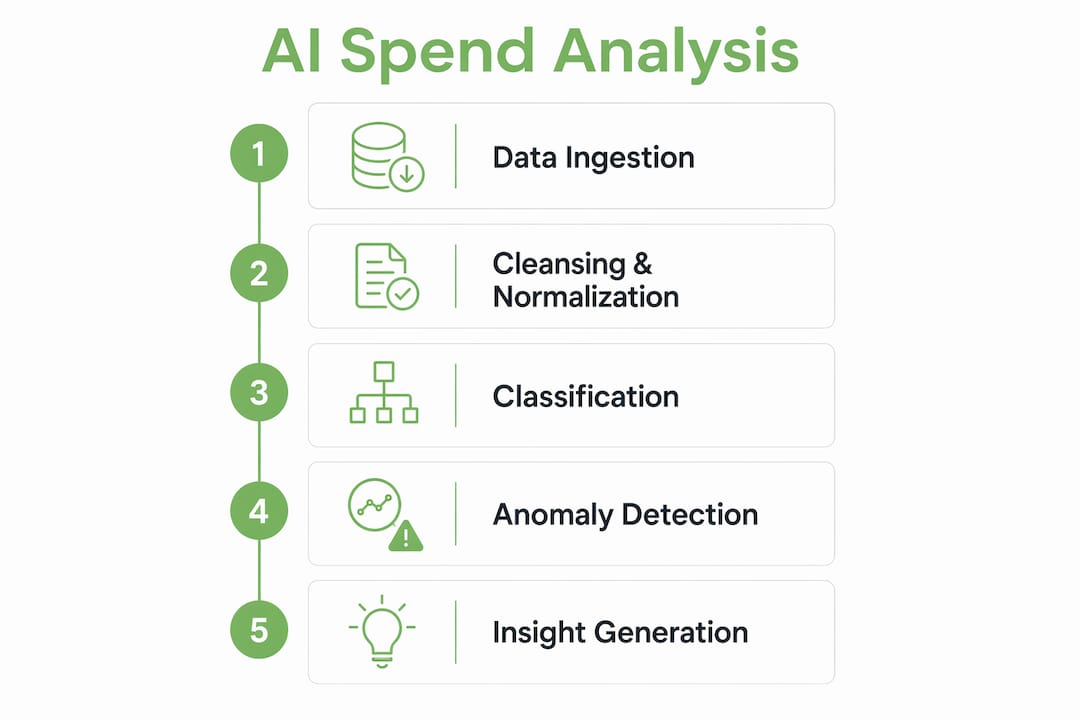
Automated cleansing and normalization fixes the messy stuff: duplicate supplier entries, mismatched invoice amounts, missing cost codes. The platform standardizes supplier information and maps every transaction to a consistent format before analysis begins.
Classification assigns each transaction to a spend category using a taxonomy like UNSPSC or a custom internal hierarchy. Supervised ML models, including gradient boosting and random forest methods, handle this automatically and reach 90–95% accuracy early, improving to 97–99% as the model trains on your data.
Anomaly detection flags outliers in real time: a duplicate invoice, an off-contract purchase, a vendor charge that spiked without a corresponding PO. These alerts surface while there is still time to act.
Insight generation turns classified data into interactive dashboards that link directly to the underlying transactions. The goal is not just reporting what happened, but explaining why spend changed by connecting transactions to business activities.
What concrete benefits do SMBs and MBEs actually see?
AI-driven expense management shifts your finance team from reactive cleanup to proactive control. The most immediate wins tend to cluster around three areas.
Speed and accuracy. Cutting analysis cycle time by over 50% means your team gets answers in days, not weeks. Classification accuracy at 95–99% means the numbers you act on are actually right.
Cost savings and negotiating power. AI surfaces hidden spend patterns and consolidation opportunities your team would never find manually, enabling 6–12% annual procurement cost savings. When you can see that you have seven vendors supplying the same category, you have leverage to negotiate.
Swipe Credit AI helps teams reveal valuable business opportunities, act with greater clarity, and measure outcomes while keeping people in control.
Additional business impacts worth tracking:
- Cash flow visibility: Know exactly where money is going before the month closes.
- Supplier diversity tracking: MBEs can monitor certified diverse supplier spend against contract commitments automatically.
- Compliance support: Continuous monitoring flags policy violations as they happen, not during an annual audit.
- Contract leverage: Consolidated spend data shows which supplier relationships deserve renegotiation.
| Benefit | What it means for your business |
|---|---|
| faster analysis | Finance team answers questions in days, not weeks |
| high classification accuracy | Reliable data for sourcing and budget decisions (95–99% accuracy with AI) |
| procurement savings | Direct cost reduction from consolidation and negotiation, typically 6–12% annual savings |
| Real-time anomaly alerts | Fraud and duplicate payments caught early |
| Supplier diversity reporting | MBEs track diverse spend automatically |
How is this different from traditional spend analysis?
Traditional spend analysis is periodic and manual. Someone exports data from the ERP, cleans it in Excel, builds a pivot table, and shares a report two weeks after the period closed. By then, the off-contract purchase already happened, the duplicate invoice already paid.
AI-powered analysis runs continuously. The differences are significant:
- Frequency: Manual is monthly or quarterly; AI runs in real time.
- Accuracy: Spreadsheet categorization is inconsistent and error-prone; AI classification is consistent and self-improving.
- Anomaly detection: Manual review catches problems after the fact; AI flags them as they occur.
- Scalability: A human analyst hits a ceiling at a few thousand transactions; AI handles millions without slowing down.
- Human effort: Traditional analysis consumes analyst hours on data prep; AI frees those hours for supplier relationships and strategy.
The practical contrast: a finance manager spending two days building a monthly spend report versus receiving an automated dashboard every morning with flagged anomalies already highlighted. The shift from reactive to proactive spend control is the core value proposition.
What technology and data sources power AI spend analysis?
Common data sources to connect:
- ERP systems (QuickBooks, NetSuite, SAP, Microsoft Dynamics)
- Accounts payable and invoice management platforms
- Corporate card and p-card feeds
- Purchase order systems and P2P platforms
- Employee expense reports
Core ML and NLP methods:
- Supervised learning (gradient boosting, random forest): classifies transactions into spend categories with high accuracy.
- NLP for invoice parsing: extracts vendor names, line items, and amounts from unstructured invoice text.
- Time-series forecasting: predicts future spend trends and flags budget variances before they hit.
- Anomaly detection: identifies statistical outliers in transaction patterns.
Integration readiness checklist:
- Consistent vendor IDs and PO numbers across systems
- At least 12 months of historical transaction data for model training
- A defined spend taxonomy (UNSPSC or internal)
- Clean supplier master data with no major duplicates
| Data source | Why it matters |
|---|---|
| ERP transactions | Core spend history for classification |
| Invoice feeds | Line-item detail for NLP parsing |
| Card feeds | Captures tail spend outside PO process |
| Expense reports | Employee spend visibility |
How a governance-first platform helps SMBs get started faster
Adopting AI spend analysis does not require replacing your accounting system. The practical path is to layer AI on top of existing systems rather than ripping out what works. A governance-first platform connects to your current ERP and invoice tools, applies classification and anomaly detection on top of your existing data, and surfaces insights through dashboards your team already knows how to use.
Swipe Credit AI helps teams turn permissioned business data into clearer opportunities and measurable economic outcomes while keeping people in control. Access and available capabilities depend on the selected plan and connected systems.
- Pre-built integrations with common ERP and AP platforms
- Role-based access controls and full audit logs
- Model explainability so your team understands why a transaction was flagged
- SMB and MBE-specific use cases including supplier diversity tracking
Pro Tip: Before your first demo, pull 90 days of transaction data from your ERP and check whether vendor names are consistent. Clean supplier master data is the single biggest factor in how fast your first model reaches useful accuracy.
Take the 60-second AI assessment to see where your business stands before committing to a full pilot.
How do you implement AI spend analysis step by step?
Start small and layer AI on top of your current systems. A three-phase approach keeps risk low and shows results fast.
-
Phase 1: Data mapping. Owner: Finance lead. Map all spend data sources, identify gaps in vendor IDs or cost codes, and export a clean transaction file. Define your spend taxonomy.
-
Phase 2: Pilot and validation. Owner: Finance lead plus IT or vendor. Connect one or two data sources, run classification on a single spend category, and validate accuracy against known transactions. Track time-to-insight and classification rate.
-
Phase 3: Scale and governance. Owner: Founder or CFO plus Finance. Expand to all spend categories, add anomaly detection alerts, and establish governance controls (access roles, audit logs, model review cadence).
Cost factors to estimate: implementation effort (internal hours plus vendor onboarding), license model (per-user or transaction-volume tiers), and integration work (API connections vs. file uploads). A simple ROI estimate: multiply your annual procurement spend by 6–12% (the typical range for AI-driven savings) and compare that to total first-year platform cost.
What governance and security controls should you require?
A governance-first adoption model protects your financial data and keeps your AI trustworthy over time. Before signing with any vendor, verify these controls are in place:
- Data encryption in transit and at rest
- Role-based access controls limiting who sees sensitive spend data
- Full audit logs tracking every classification decision and data change
- Model explainability so your team can see why a transaction was flagged or categorized
- Data lineage tracking showing where every number originated
Vendor questions worth asking: How does your model handle a misclassification I dispute? Can I export a full audit trail for an external review? What happens to my data if I cancel?
Pro Tip: Tie your governance checklist to your next contract review or audit cycle. If your business undergoes supplier audits or government contract reviews, a documented AI governance framework is an asset, not just a compliance checkbox.
Which KPIs should you track to measure ROI?
| KPI | Definition | Early-stage target |
|---|---|---|
| Savings realized | Documented cost reductions from consolidation and negotiation | A significant share of addressable spend in year one |
| % automated classification | Share of transactions classified without human review | Majority within 60 days of pilot |
| Time-to-insight | Days from period close to actionable spend report | A short time period appropriate for actionable reporting |
| Maverick spend rate | % of purchases outside approved contracts | Intended to be reduced significantly in early months |
| Duplicate payment rate | Duplicate invoices caught before payment | Minimized with real-time alerts active |
For MBEs, add a diverse supplier spend percentage KPI that tracks certified diverse vendor spend as a share of total addressable spend. This metric directly supports contract compliance and supplier diversity reporting requirements.
Baseline every KPI during your pilot phase before scaling. The delta between pilot baseline and 90-day post-launch performance is your proof of value for internal stakeholders.
What mistakes do SMBs make when adopting AI spend analysis?
- Starting with dirty data. Mitigation: spend two weeks cleaning vendor master data before connecting any platform. Garbage in, garbage out applies here more than anywhere.
- Expecting perfect accuracy on day one. Models start at 90–95% and improve with training. Set realistic expectations with your team and plan a 30-day validation sprint.
- Treating AI as a replacement for your finance team. AI flags anomalies and classifies transactions; your people decide what to do about them. The human last-mile interpretation is where the real value gets captured.
- Trying to connect every data source at once. Pick one category, one data source, and one clear success metric for your pilot. Scope creep kills more AI pilots than bad technology.
- No cross-functional sponsor. Finance, procurement, and operations all touch spend data. Without a shared owner, the project stalls when data access questions arise.
The single most effective tactic: run a four-to-six-week pilot on one spend category with a named owner and a pre-agreed success metric. That structure alone eliminates most of the common failure modes.
Key Takeaways
AI-powered spend analysis gives SMBs and MBEs continuous, accurate visibility into spending, replacing periodic manual reviews with real-time classification, anomaly detection, and measurable cost savings.
| Point | Details |
|---|---|
| Start with clean data | Spend two weeks normalizing vendor master data before connecting any AI platform. |
| Expect 95–99% accuracy | AI classification engines reach this range with training, far above manual methods. |
| Pilot one category first | A 4–8 week single-category pilot reduces risk and produces fast, defensible wins. |
| Procurement savings | Typical cost reduction of 6–12% annually with full AI adoption. |
| Measure five core KPIs | Track savings realized, % automated classification, time-to-insight, maverick spend, and duplicate payment rate. |
| Swipecredit for SMBs and MBEs | Swipecredit offers governance-first AI spend analysis with ERP integrations and supplier diversity tracking built for smaller businesses. |
The part most guides skip over
Most AI spend analysis content focuses on the technology. The harder problem is organizational. The businesses that get the most out of these tools are not the ones with the cleanest data or the biggest budgets. They are the ones where a founder or CFO decided that finance, procurement, and operations would share a single version of the numbers.
That cross-functional alignment is the actual prerequisite. Without it, even a well-configured AI platform produces insights that each department disputes. With it, the platform becomes the trusted source everyone pulls from, and the savings follow naturally.
For minority-owned businesses specifically, there is an underappreciated angle: supplier diversity data. MBEs that track their own diverse supplier spend with AI have a concrete, audit-ready record when pursuing government contracts or corporate supplier diversity programs. That is a competitive advantage most MBEs are leaving on the table.
My practical recommendation: before evaluating any platform, get your finance lead and one operations manager in the same room and agree on a single spend taxonomy. That 90-minute conversation will do more for your AI adoption than any software feature.
Swipecredit helps SMBs turn spend data into real savings
Swipe Credit AI helps teams turn permissioned business data into clearer opportunities and measurable economic outcomes while keeping people in control. Access and available capabilities depend on the selected plan and connected systems.
The platform connects to the ERP and AP systems you already use, classifies transactions automatically, and surfaces anomalies before they become problems. For minority-owned businesses, supplier diversity tracking is built in, not bolted on. Pilots are designed to show measurable results within 60 days, with no requirement to replace your existing tech stack.
Ready to see what your spend data is actually telling you? Start your pilot or explore SMB-specific use cases to see how businesses like yours are using AI to find hidden savings and move faster.
Useful sources
- GEP: How AI Enhances Spend Analysis for Cost Savings and Accuracy — covers cross-functional data consolidation and the shift to explanatory analytics.
- The AI Journal: Artificial Intelligence in Spend Analytics 2026 Guide — source for cycle-time reduction, classification accuracy benchmarks, and ML model types.
- SAP: The Ultimate Guide to Spend Analysis — authoritative overview of spend analysis process stages and AI-driven capabilities.
- ScienceDirect: AI Meets Spend Classification — peer-reviewed research on information processing theory applied to AI spend classification.
- Mekari: AI Spend Analysis — practical coverage of proactive spend control and time-to-insight improvements.
FAQ
What is AI-powered spend analysis in simple terms?
It is an automated system that collects, cleans, categorizes, and continuously monitors your business spending using machine learning and NLP, replacing manual spreadsheet reviews with real-time insights.
How accurate is AI spend classification compared to manual methods?
AI classification engines typically reach 90–95% accuracy early in deployment and improve to 97–99% with continued training, well above the consistency a human reviewer can sustain across thousands of transactions.
How long does it take to see results from an AI spend analysis pilot?
Most SMBs see measurable results within 4–8 weeks of a focused single-category pilot, with automated classification rates of 90–95% achievable early and improving with continued training.
Can Swipecredit help minority-owned businesses track supplier diversity?
Swipe Credit AI helps teams turn permissioned business data into clearer opportunities and measurable economic outcomes while keeping people in control. Access and available capabilities depend on the selected plan and connected systems.
Do you need to replace your existing accounting software to use AI spend analysis?
No. The recommended approach is to layer AI on top of your current ERP or accounting system rather than replacing it, which reduces implementation time and preserves your existing workflows.