July 5, 2026
Small Business AI Decision Making: Your 2026 Guide
Unlock the power of small business AI decision making. Discover tools and frameworks to expedite decision-making and drive success.

Small Business AI Decision Making: Your 2026 Guide
Small business AI decision making is the practice of using artificial intelligence to make faster, more accurate, and data-driven business decisions that drive growth and efficiency. Research shows AI decision engines can cut strategic timelines from 60+ days down to 10–14 days. That same research flags a sobering reality: over 60% of AI projects fail due to vendor mismatch or wrong use case selection. The difference between success and failure almost always comes down to choosing the right tools, in the right order, with the right governance in place. This guide gives you the exact framework to get that right.
What types of AI tools work best for small business decision making?
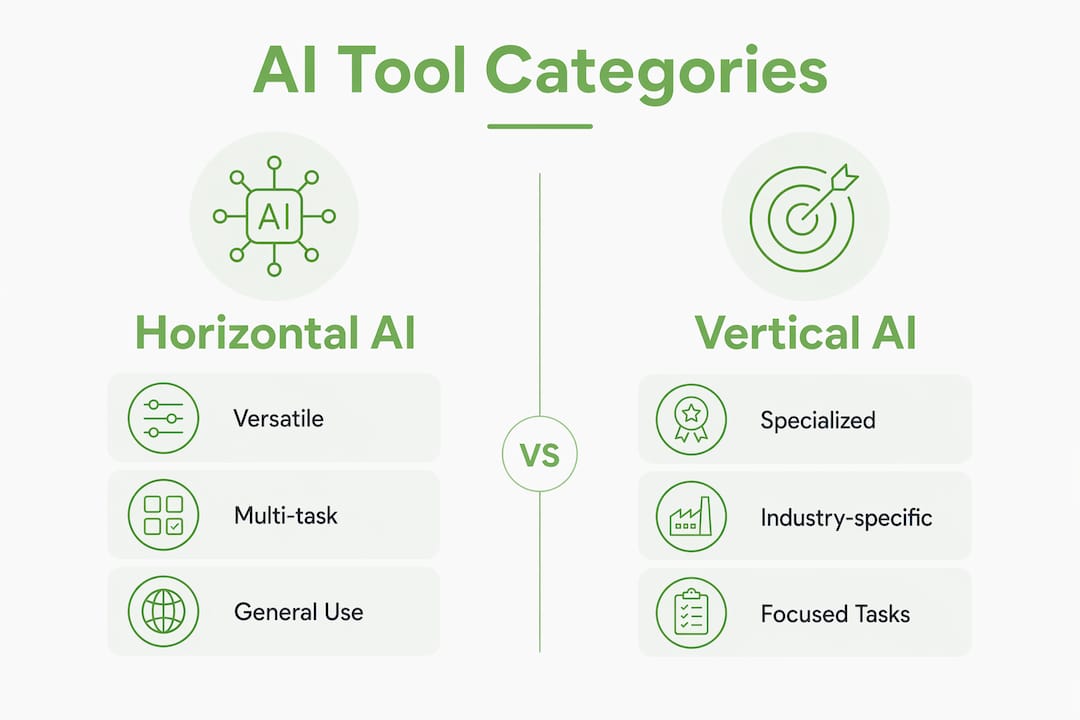
The industry distinguishes between two categories of AI tools: horizontal and vertical. Knowing the difference saves you money and months of wasted effort.
Horizontal AI tools work like a Swiss Army knife. They handle a broad range of tasks, from drafting emails to summarizing reports, and they integrate across your existing workflows. General-purpose writing assistants fall into this category. They are the right starting point for most small businesses because they deliver fast, visible time savings with minimal setup.

Vertical AI tools are built for a specific function. Finance AI reads your cash flow patterns and flags anomalies. CRM AI scores your leads and predicts churn. Marketing automation AI runs and adjusts campaigns without manual input. These tools take longer to show results, but their ROI is deeper once they are calibrated to your data.
The key principle here is that success comes from identifying 3–5 high-friction processes in your business, not from accumulating tools. The businesses that get the most from AI pick a focused set of use cases and go deep, rather than spreading thin across a dozen platforms.
The five highest-impact use cases for small businesses are:
- Customer support automation: Chatbots handle tier-one questions around the clock, freeing your team for complex issues.
- Sales outreach: AI drafts personalized follow-up sequences and flags the best time to contact each lead.
- Internal workflow automation: Repetitive data entry, scheduling, and reporting tasks get handled without human input.
- Financial monitoring: AI flags unusual spending, late payments, and cash flow gaps before they become problems.
- Marketing content: AI generates first drafts of ads, social posts, and email campaigns at a fraction of the time cost.
Pro Tip: Start with customer support chatbots and writing AI. These tools deliver measurable time savings within the first few weeks. CRM and financial AI need 2–3 months to reach accuracy, so sequence your budget accordingly.
How to select the right AI vendor for your small business
Vendor selection is where most small businesses lose. They pick a tool based on a demo, skip due diligence, and end up locked into a contract that does not fit their workflows. A structured vendor selection process takes 6–12 weeks and includes a bounded 30-day pilot before any long-term commitment. That timeline feels slow. It saves you from a much more expensive mistake.
Follow this sequence:
- Define your measurable outcome first. Before you talk to any vendor, write down the specific business result you want. “Reduce customer response time by 40%” is a real outcome. “Use AI to improve operations” is not.
- Pre-screen vendors on data security. Ask every vendor three questions upfront: Where does my data live? Do you use my data to train your models? What happens to my data when the contract ends? Vendors who cannot answer clearly are not ready for your business.
- Require a Data Processing Agreement. A DPA must prohibit the vendor from using your business data to train their models and must require data deletion at contract end. No DPA means no deal.
- Shortlist exactly three vendors. Use a 4x20 evaluation grid scoring each vendor on outcomes fit, security, integration, and support. Three vendors give you real comparison without decision fatigue.
- Run a bounded paid pilot. A 30-day pilot with defined KPIs tells you whether the tool actually works in your environment. Free pilots often come with limited features or support. Pay for the real product.
- Watch for red flags. Vendor responses taking more than 5 working days on due diligence questions signal poor support culture. Vague security claims and missing DPAs are automatic disqualifiers.
Pro Tip: Treat AI vendor APIs the same way you treat privileged user accounts. Require written confirmation that your data will not be used for model training and that deletion is guaranteed at contract end.
Verifying vendor security claims against recognized standards like NCSC guidance reduces your operational risk significantly. Do not take a vendor’s word for it. Ask for documentation.
How to implement AI decision making in your business workflows
Implementation fails when businesses skip the mapping step. Before you install any tool, spend one week documenting your daily workflows and identifying where time and money disappear. The processes that cost you the most hours are your first AI targets.
A practical implementation sequence looks like this:
- Map your top five time-cost workflows. Track where your team spends the most hours each week. These are your highest-leverage targets.
- Deploy horizontal AI first. A general-purpose writing assistant reduces the time cost of emails, reports, and proposals immediately. This builds internal confidence in AI before you tackle more complex tools.
- Add customer support automation second. A chatbot handling tier-one questions delivers fast, visible ROI and frees your team for revenue-generating work.
- Layer in marketing automation third. Once your customer-facing workflows are stable, AI-driven campaign tools extend your reach without adding headcount.
- Introduce financial AI last. Financial AI needs clean, consistent data to work well. Build that data foundation first through the earlier steps.
Allow 30–90 days per tool for adoption and ROI measurement. Rushing this timeline produces misleading results. Set clean, specific KPIs before you start each deployment so you know exactly what “working” looks like.
The operational leverage approach prioritizes use cases that convert one hour of human work into 10+ hours of AI-augmented output. That is the standard your tool selection should meet.
Pro Tip: Do not start an AI-native product build before your internal automations are running. Building AI products is expensive and slow. Automating existing workflows delivers faster returns and teaches you how AI behaves in your specific business context.
What challenges do small businesses face when adopting AI for decision making?
The most common failure mode is not technical. It is strategic. Most AI strategy failures for small businesses come from wrong use case order, no measurement, and tool sprawl. Each of these is avoidable with the right preparation.
The biggest pitfalls to watch for:
- Treating AI as a faster typewriter. Using AI only to write faster misses the real opportunity. The leverage comes from automating entire workflows, not just speeding up individual tasks.
- No measurement framework. Without defined KPIs, you cannot tell whether a tool is working. Budgets disappear into tools that feel useful but deliver no measurable return.
- Tool sprawl. Subscribing to eight AI platforms that partially overlap creates fragmented data, confused teams, and wasted spend. Pick fewer tools and use them fully.
- Skipping governance. Ungoverned AI use creates compliance risk. If your team is feeding customer data into public AI tools without a DPA, you have a liability problem.
- Unrealistic timelines. Expecting financial AI to deliver results in two weeks sets you up for disappointment. Different tool categories have different time-to-value windows.
The businesses that win with AI are not the ones with the most tools. They are the ones with the clearest use cases, the tightest measurement, and the discipline to say no to everything that does not fit their current stage.
Pro Tip: Set a go/no-go decision point at the end of every pilot. Define the minimum result the tool must deliver to earn continued investment. If it does not hit that number, cut it. No exceptions.
The 80% of SMBs planning to integrate chatbots by the end of 2026 will not all succeed. The ones that do will be the ones who picked one use case, measured it honestly, and built from there.
Key Takeaways
Effective AI adoption for small businesses requires choosing the right use cases in the right order, running structured vendor pilots, and measuring every tool against defined business outcomes.
| Point | Details |
|---|---|
| Start with horizontal AI | Deploy general-purpose writing tools first for fast, visible time savings before adding specialized tools. |
| Run a 30-day bounded pilot | Test every vendor with defined KPIs before committing to a long-term contract. |
| Require a DPA from every vendor | Mandate data deletion and a ban on model training with your business data in every contract. |
| Sequence your tool adoption | Add customer support, then marketing, then financial AI in that order to build on stable data. |
| Measure or cut | Set a go/no-go KPI threshold for every tool and enforce it at the end of each pilot period. |
What I’ve learned about AI adoption that most guides won’t tell you
Most articles on AI for small businesses focus on which tools to buy. That is the wrong question. The right question is which workflows to fix first.
I have seen business owners spend $2,000 a month on AI subscriptions and still make slower decisions than they did before. The problem was never the tools. It was that they adopted AI without a clear picture of where their time actually went. The mapping step is not optional. It is the whole game.
The other thing I would push back on is the idea that AI is primarily a cost-cutting tool. The real opportunity is on the revenue side. When your AI-powered analytics surface a customer segment you were not serving, or flag a pricing gap your competitors have not noticed, that is where the return compounds. Cost savings are linear. Revenue intelligence is exponential.
My honest advice: pick one vendor, run one pilot, measure one outcome. Do not let the breadth of available tools convince you that you need to move on multiple fronts at once. The businesses I have seen succeed with AI all started narrow and expanded deliberately. The ones that failed tried to do everything at once and measured nothing.
AI governance is also not a large-company problem. If you are a 10-person business feeding customer data into public AI tools without a DPA, you are carrying risk that your contracts probably do not cover. Fix that before you scale anything.
— Kevin
Swipecredit’s AI platform for small business growth
Small businesses that follow the frameworks in this article still need a platform that can execute at the speed their decisions require.
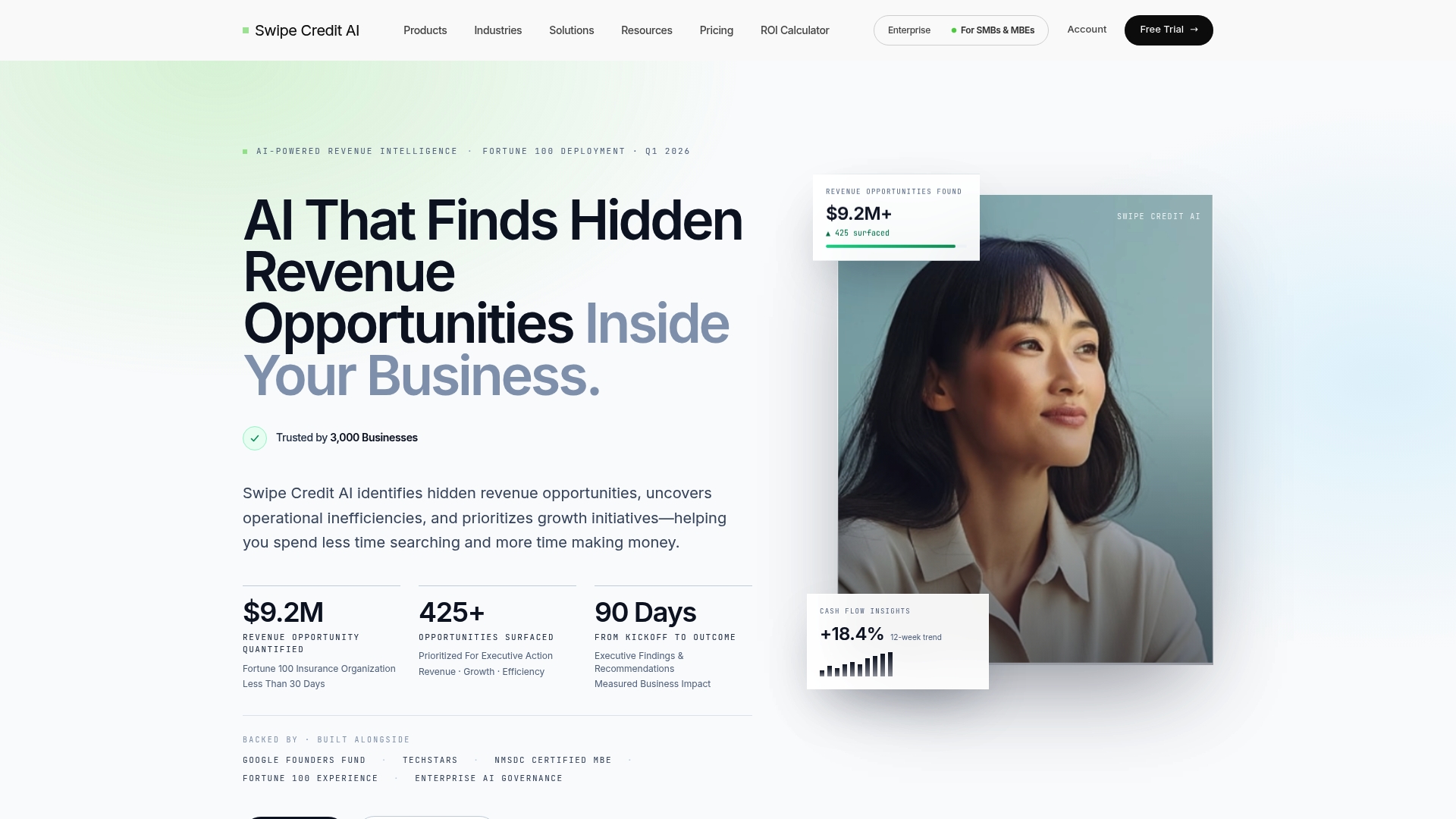
Swipe Credit AI helps teams reveal valuable business opportunities, act with greater clarity, and measure outcomes while keeping people in control.
FAQ
What is small business AI decision making?
Small business AI decision making is the use of artificial intelligence tools to analyze business data and support faster, more accurate decisions. AI decision engines can reduce strategic decision timelines from 60+ days to 10–14 days.
What types of AI tools should a small business start with?
Start with horizontal AI tools like general-purpose writing assistants, then add customer support chatbots. These deliver measurable time savings within the first few weeks, while CRM and financial AI need 2–3 months to calibrate.
How long does AI vendor selection take for a small business?
A structured AI vendor selection process takes 6–12 weeks and includes a 30-day bounded pilot with defined KPIs before any long-term commitment.
What should a small business require in an AI vendor contract?
Every AI vendor contract must include a Data Processing Agreement that prohibits the vendor from using your data for model training and requires data deletion when the contract ends.
Why do most small business AI projects fail?
Over 60% of AI projects fail due to vendor mismatch or wrong use case prioritization. The most common causes are adopting tools without defined KPIs, tool sprawl, and skipping the workflow mapping step before deployment.