July 5, 2026
The Role of AI in Customer Insights: 2026 Guide
Discover the pivotal role of AI in customer insights. Learn how AI transforms data into actionable intelligence for better decision-making.

The Role of AI in Customer Insights: 2026 Guide
The role of AI in customer insights is to convert complex customer data into precise, actionable intelligence that lets businesses anticipate needs, personalize experiences, and make faster decisions. As of mid-2026, 85% of companies use AI to understand customers, with personalization and feedback analysis each accounting for 45% of primary use cases. That adoption rate signals a fundamental shift: AI in customer analytics is no longer experimental. It is the operating standard for enterprises that want to move from reactive reporting to proactive, prescriptive decision-making.
How AI drives customer insights across the enterprise
AI transforms customer insights by processing data at a scale and speed no human team can match. Traditional research methods produce snapshots. AI produces a continuous feed of signals drawn from purchase history, support interactions, web behavior, and social sentiment. The industry term for this discipline is “customer intelligence,” and AI is now its primary engine.
The practical applications fall into three categories. First, AI identifies behavioral patterns that predict future actions, such as which customers are likely to churn or upgrade. Second, it personalizes outreach at scale, matching the right message to the right customer at the right moment. Third, it analyzes unstructured feedback, including survey text, call transcripts, and reviews, to surface themes that structured data misses entirely.
AI shifts enterprises from reactive reporting to proactive, prescriptive decision-making by flagging customer issues before churn occurs. That shift has direct revenue implications. When a model identifies a dissatisfied customer three weeks before they cancel, the business has time to intervene with a targeted offer or a service fix rather than a discount that erodes margin.
How does AI-powered predictive analytics reduce customer churn?
Churn prediction is one of the clearest proof points for AI in customer retention. A predictive churn model assigns each customer a risk score based on behavioral signals: declining login frequency, reduced purchase volume, increased support contacts, or negative sentiment in recent feedback. The model updates continuously as new data arrives, so the score reflects current behavior rather than last quarter’s report.
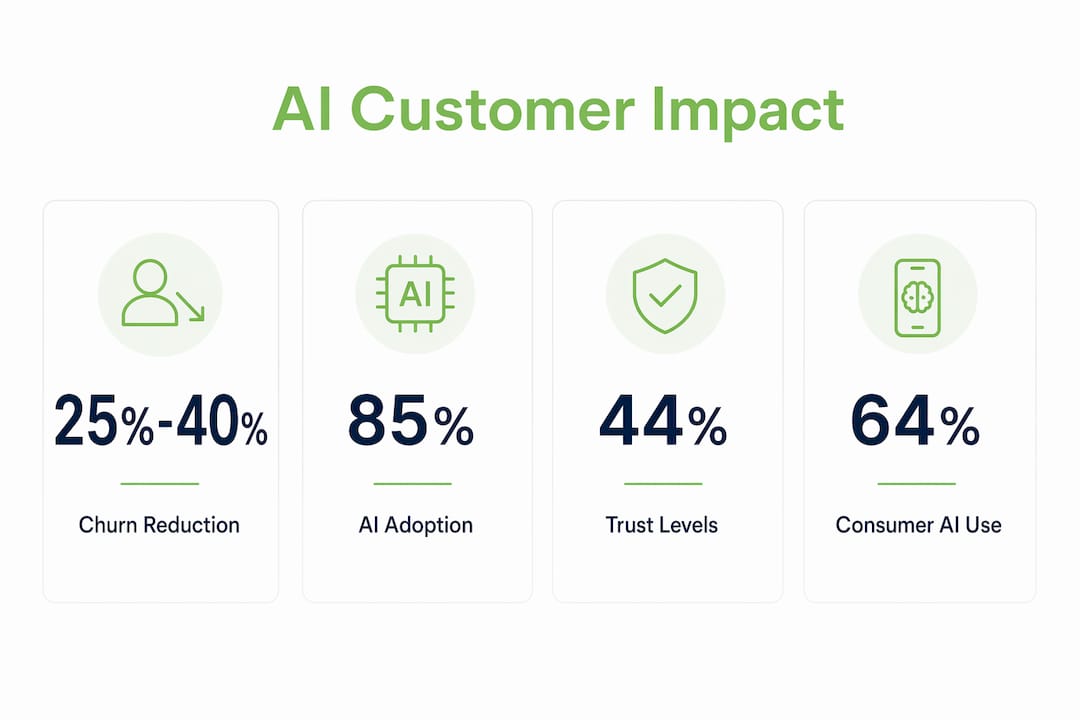
The business case is well documented. AI-driven predictive analytics can reduce churn by 25%–40% and increase customer lifetime value by 15%–25%. Those numbers reflect outcomes in subscription and e-commerce firms where retention economics are most visible, but the logic applies across banking, insurance, and healthcare as well.
The process follows three steps:
- Data collection. Consolidate transactional, behavioral, and support data into a single customer record. Incomplete or siloed data produces unreliable scores.
- Model training. Train a machine learning model on historical churn events to identify which signals preceded cancellation. Retrain the model quarterly as customer behavior evolves.
- Intervention design. Map each risk tier to a specific retention action. High-risk customers may receive a proactive call. Medium-risk customers may receive a personalized email with a relevant product recommendation.
Accurate AI personalization builds trust and reduces reliance on costly incentives by resolving the root cause of dissatisfaction rather than masking it with discounts. That distinction matters for margin-conscious enterprises.
Pro Tip: Before deploying a churn model, audit your customer data for completeness. A model trained on incomplete records will score customers incorrectly, and a wrong intervention can accelerate churn rather than prevent it.
What is AI’s impact on customer acquisition costs and targeting?
The role of AI in customer acquisition is to replace broad, expensive targeting with precise, data-driven selection. Machine learning ranks prospects by their likelihood to convert, so marketing spend concentrates on the accounts and individuals most likely to become customers. AI-powered acquisition flips traditional marketing by predicting prospect conversion likelihood and optimizing spend dynamically rather than waiting for campaign results to arrive post-flight.

The financial impact is significant. AI-driven approaches can cut customer acquisition costs by 20%–50% while improving conversion rates. That range reflects variation in implementation quality, data availability, and the specific acquisition channel being optimized.
Key applications include:
- Lead scoring. AI models rank inbound leads by fit and intent, so sales teams prioritize the highest-value conversations first.
- Campaign budget allocation. AI adjusts spend across channels in real time based on which sources are producing the lowest cost per acquisition at any given moment.
- Personalized outreach. AI generates message variants tailored to each prospect’s industry, role, and behavioral history, replacing generic sequences with relevant communication.
- Lookalike modeling. AI identifies prospects who share characteristics with your best existing customers, expanding the addressable market without sacrificing quality.
AI-generated search platforms create a new acquisition landscape where brands must optimize for machine audiences as well as human ones. That means structured data, clear value propositions, and content that AI systems can parse and cite when responding to buyer queries.
Pro Tip: Map your specific acquisition bottleneck before selecting an AI tool. If your problem is lead volume, invest in lookalike modeling. If your problem is conversion rate, invest in personalization and lead scoring. Generic AI tools applied to the wrong bottleneck produce generic results.
How does generative AI accelerate consumer research?
Generative AI compresses research timelines from months to days. Large language models can analyze thousands of open-ended survey responses, synthesize themes, and produce a structured findings report in hours. The same task using traditional qualitative coding methods takes weeks and a team of analysts.
The efficiency gains extend beyond speed. Generative AI is reshaping the marketing research function by allowing smaller teams to conduct larger, higher-quality studies more frequently. A team of three analysts can now run the volume of research that previously required ten, freeing senior researchers to focus on interpretation and strategy rather than data processing.
| Research method | Timeline | Cost profile | Scale |
|---|---|---|---|
| Traditional qualitative | 6–12 weeks | High | Limited sample |
| Traditional quantitative | 4–8 weeks | Moderate | Large sample |
| AI-assisted synthesis | 1–5 days | Low | Very large sample |
| Generative AI concept testing | Hours to days | Very low | Synthetic or real |
Consumer behavior data reinforces the urgency of this shift. 64% of US consumers are open to or have already used AI to complete purchases. Enterprises that understand how AI shapes consumer decisions gain a structural advantage in both research design and go-to-market execution.
The most effective application of generative AI in research pairs model speed with human judgment. Human oversight remains critical especially in the early stages of problem definition and research design. A model that analyzes the wrong question at high speed produces confident, well-formatted, and wrong conclusions.
How should enterprises balance AI insights with human expertise?
Trust is the central challenge in AI-driven customer research. 44% of professionals trust AI and direct research insights equally, while 38% trust direct research more and only 18% trust AI more. That distribution reflects a healthy skepticism, not a rejection of AI.
The risk is not distrust. The risk is the opposite: treating AI as a set-it-and-forget-it system that runs without oversight. Models drift as customer behavior changes. A churn model trained on 2024 data may misclassify customers in 2026 if the underlying behavior patterns have shifted. Without regular audits, the model produces stale scores that drive wrong interventions.
Best practices for maintaining the right balance include:
- Audit before deployment. Map specific business bottlenecks before selecting or configuring an AI tool. Tailored applications consistently outperform generic ones.
- Establish human review gates. Require a human analyst to review AI-generated findings before they inform a strategic decision, particularly in early-stage research.
- Monitor model performance monthly. Track the accuracy of predictions against actual outcomes and retrain models when performance degrades.
- Preserve direct research. Use surveys, interviews, and focus groups to validate AI-generated hypotheses. AI surfaces patterns; humans explain them.
Pro Tip: Build a short AI use case audit into your quarterly planning cycle. For each AI application, ask: Is this model still trained on relevant data? Are the outputs being reviewed by a qualified analyst? Is the intervention it drives producing the intended result?
Key Takeaways
AI-driven customer intelligence produces measurable business outcomes only when paired with clean data, human oversight, and use cases matched to specific business bottlenecks.
| Point | Details |
|---|---|
| AI adoption is near-universal | 85% of companies use AI for customer understanding, making it the baseline for competitive enterprises. |
| Predictive analytics cuts churn | AI churn models reduce customer loss by 25%–40% when built on complete, current data. |
| Acquisition costs drop significantly | AI-driven targeting reduces customer acquisition costs by 20%–50% through precise lead scoring and dynamic spend. |
| Generative AI compresses research | AI shrinks research timelines from weeks to days, letting smaller teams run more studies at lower cost. |
| Human oversight is non-negotiable | 38% of professionals still trust direct research more than AI, and regular model audits prevent costly drift. |
AI in customer insights: what I’ve learned from the enterprise floor
The most common mistake I see enterprises make is buying an AI platform before defining the problem it needs to solve. The platform arrives, the team runs a pilot, and six months later the results are underwhelming. The tool was not the problem. The problem was that no one mapped the specific gap in the customer insight process before selecting a solution.
AI works best as a force multiplier for analysts who already understand the business. A model that flags churn risk is only as useful as the analyst who knows whether the flagged customers are worth saving and what intervention will actually work. That judgment does not come from the model. It comes from years of knowing the customer base.
The enterprises I have seen get this right treat AI as a continuous process, not a project. They retrain models, review outputs, and update intervention playbooks on a regular cadence. They also maintain direct customer research programs alongside AI, because a model trained on historical behavior cannot tell you what a customer wants next. Only a conversation can do that.
The future of customer engagement will be shaped by AI, but the enterprises that win will be the ones that use AI to ask better questions, not the ones that let AI answer questions without asking whether those are the right ones.
— Kevin
Swipecredit’s AI platform for customer intelligence
Enterprises that want to move from data collection to decision-ready customer intelligence need more than a single AI tool. They need a platform that connects behavioral data, predictive models, and intervention workflows in one governed environment.
Swipecredit’s enterprise revenue intelligence platform does exactly that. It analyzes customer and operational data to surface retention risks, acquisition opportunities, and revenue gaps before they show up in a quarterly report. For banks, insurers, and Fortune 1000 companies, Swipecredit delivers AI-powered analytics built on a governance-first architecture that meets compliance requirements without slowing down decision-making. SMBs and minority-owned businesses access the same predictive capability through purpose-built tiers at Swipecredit SMB growth. The result is faster, more confident decisions grounded in real customer data.
FAQ
What is the role of AI in customer insights?
AI converts raw customer data, including behavioral, transactional, and feedback data, into predictive intelligence that helps businesses personalize experiences, reduce churn, and identify growth opportunities. It functions as the analytical engine behind modern customer intelligence programs.
How much can AI reduce customer churn?
AI-driven predictive analytics can reduce churn by 25%–40% in subscription and e-commerce environments. The reduction depends on data quality, model accuracy, and the effectiveness of the retention interventions the model triggers.
Does AI replace traditional customer research?
AI complements rather than replaces direct research methods. 44% of professionals trust AI and direct research equally, while 38% still trust direct research more, which means human-led interviews and surveys remain essential for validating AI-generated findings.
How does AI lower customer acquisition costs?
Machine learning models rank prospects by conversion likelihood and reallocate marketing spend toward the highest-value targets in real time. This precision reduces wasted spend and can cut customer acquisition costs by 20%–50% compared to broad-based targeting.
What is the biggest risk in deploying AI for customer analytics?
The biggest risk is model drift: a model trained on historical data that no longer reflects current customer behavior. Regular retraining, human review of outputs, and quarterly use case audits are the standard controls for managing this risk.