July 12, 2026
What Is AI Business Intelligence? A 2026 Guide
Discover what is AI business intelligence and how it transforms data analysis. Learn to forecast and shape your business's future strategy.

What Is AI Business Intelligence? A 2026 Guide
TL;DR:
- AI business intelligence combines machine learning, natural language processing, and predictive analytics to forecast future outcomes. It shifts from descriptive reporting to proactive decision support accessible to any team member, improving speed and accuracy. Success depends on clear business goals, mature data infrastructure, and maintaining human judgment in decision-making.
AI business intelligence is defined as the integration of machine learning, natural language processing, and predictive analytics into traditional BI platforms to shift data analysis from describing the past to forecasting and shaping the future. Where traditional BI answers “what happened,” AI BI answers “what will happen” and “what should we do.” That shift is not a minor upgrade. It changes who can use data, how fast insights arrive, and what decisions become possible. For business professionals, decision-makers, and analysts, understanding what is AI business intelligence is the first step toward using it as a real competitive tool.
What is AI business intelligence and how does it differ from traditional BI?
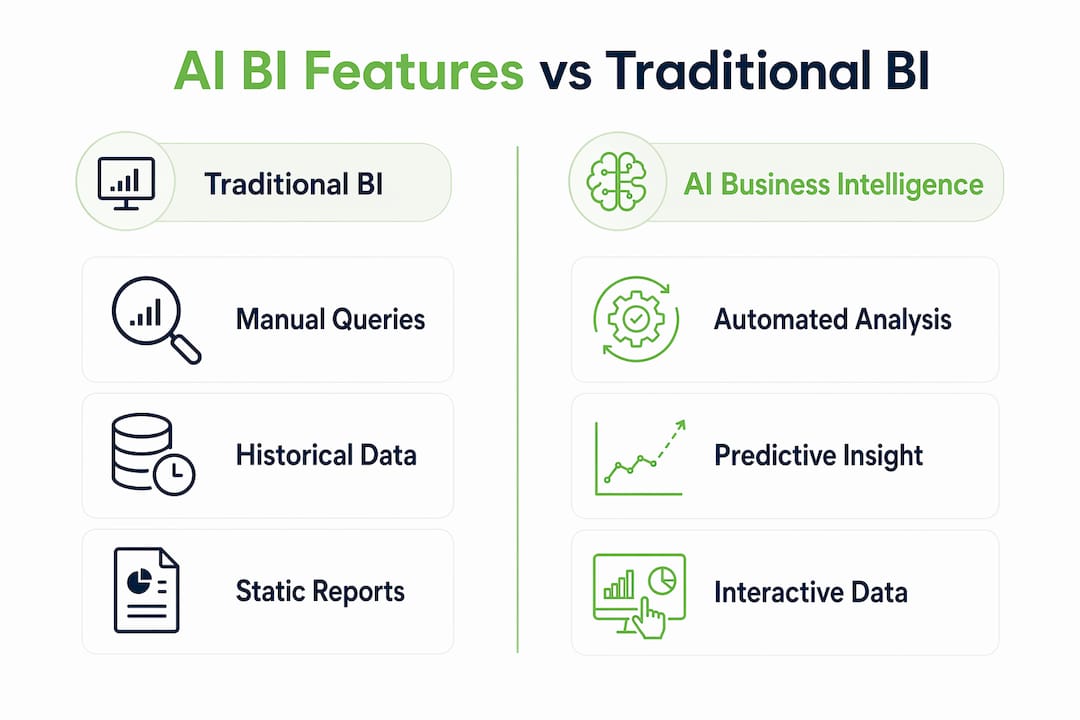
Traditional BI platforms are retrospective. They pull historical data, generate reports, and require a trained analyst to build queries and interpret results. The process is slow, and the insights arrive after the moment to act has often passed.
AI business intelligence changes that model entirely. AI BI makes data interactive, automated, and forward-looking rather than replacing traditional BI outright. It layers AI capabilities on top of existing data infrastructure so that the system surfaces insights proactively instead of waiting for someone to ask the right question.
The three core technologies driving this shift are machine learning, natural language processing (NLP), and predictive analytics. Machine learning finds patterns in large datasets that no human analyst would spot manually. NLP lets users ask questions in plain English instead of writing SQL queries. Predictive analytics projects future outcomes based on historical trends and live signals.

The ACE framework, which stands for Ingest, Analyze, Predict, Generate, and Execute, offers a practical way to think about how AI moves through a business workflow. Each stage builds on the last, turning raw data into a decision or an automated action.
| Feature | Traditional BI | AI Business Intelligence |
|---|---|---|
| Query method | Manual SQL or drag-and-drop | Natural language questions |
| Insight type | Descriptive (what happened) | Predictive and prescriptive |
| Speed | Hours to days | Real-time or near real-time |
| User requirement | Trained analyst | Any team member |
| Anomaly detection | Manual review | Automated alerts |
| Decision support | Reports for review | Recommendations with context |
Pro Tip: If your team spends more time building reports than acting on them, that is the clearest sign you are ready to move from traditional BI to an AI-powered model.
What are the practical applications and business benefits of AI BI?
The most immediate benefit of AI business intelligence is speed. AI BI reduces time between data collection and decision-making by surfacing insights without requiring a custom analyst request. That means your team acts on fresh information instead of last month’s report.
Real-world applications include:
- Automated anomaly detection: The system flags unusual spikes in customer churn, expense overruns, or inventory shortfalls before they become crises.
- Real-time sales forecasting: AI models update pipeline projections daily based on deal velocity, seasonality, and market signals.
- Demand planning for SMBs: Small businesses can use AI BI to predict inventory needs without hiring a dedicated supply chain analyst. This is especially valuable for understanding what is AI in supply chain for SMBs.
- Natural language summaries: Instead of a 40-slide deck, executives receive a plain-English paragraph explaining what the data shows and what to do next.
- Customer analytics: AI BI identifies which customer segments are most likely to churn, upgrade, or refer new business.
For minority-owned businesses and SMBs, AI-driven business insights level the playing field. These organizations can now access the same quality of analysis that large enterprises pay data science teams to produce.
The business benefits stack up quickly. Accuracy improves because AI removes manual data handling errors. Analysis happens faster because the system works continuously. More team members can participate in data-driven decisions because the barrier to entry drops. Strategic planning improves because leaders see forward-looking projections, not just historical summaries.
Pro Tip: Start by identifying the one business question your team asks most often but takes the longest to answer. That question is your highest-value AI BI use case.
How can organizations measure AI BI success and avoid common pitfalls?
The biggest mistake organizations make with AI business intelligence is selecting a platform before defining what success looks like. Companies lacking defined outcomes before technology selection face higher project failure rates and underperform on ROI. The technology is not the strategy. The outcome is.
The distinction between outputs and outcomes matters here. An output is a technical result: the model runs at 94% accuracy, the dashboard loads in two seconds, the report generates automatically. An outcome is a business result: revenue grew by a measurable amount, customer churn dropped, a supply chain disruption was caught three weeks early. Measuring AI value requires focus on effectiveness, meaning doing the right things, not merely efficiency or hours saved.
Follow these steps to define and measure AI BI success correctly:
- Define the business outcome first. Write it in one sentence: “We want to reduce customer churn by identifying at-risk accounts 30 days earlier.”
- Identify the data required. Map what data you already have and what gaps exist before evaluating any platform.
- Set a baseline. Measure current performance so you have a real comparison point after deployment.
- Choose a cost-per-outcome metric. Tracking cost per outcome helps organizations invest more in reasoning and richer context when it increases business outcome value, rather than cutting costs on inputs that matter.
- Review outcomes quarterly. Adjust the model, the data inputs, or the workflow based on what the numbers show.
AI BI success depends more on data infrastructure maturity and workflow redesign than on platform acquisition alone. Treating AI as a plug-in without governed, accessible data causes integration failures that no software vendor can fix for you.
Pro Tip: Before signing any AI BI contract, write down three specific business outcomes you expect within 12 months. If you cannot name them, you are not ready to buy.
What role does human judgment play alongside AI in business intelligence?
AI business intelligence works best as a partner to human judgment, not a replacement for it. The winning model is human plus machine, where AI handles research and routine synthesis while humans lead high-trust, contextual decisions. That division of labor is not a compromise. It is the design.
AI is excellent at processing large volumes of data, spotting patterns, and generating options. It is not equipped to weigh political context, read a client relationship, or make a judgment call that requires ethical reasoning. Those tasks belong to people.
The risks of overreliance are real. Teams that accept AI outputs without applying human context can act on technically accurate but situationally wrong recommendations. A model might flag a long-term customer as a churn risk based on reduced purchase frequency, while a sales rep knows that customer is simply between budget cycles. The rep’s context changes the right action entirely.
Practical ways to keep human judgment central:
- Require a human review step before any AI recommendation triggers a customer-facing action.
- Train team members to question AI outputs, not just accept them.
- Use AI to prepare the analysis and humans to make the final call on strategy and relationships.
- Build feedback loops so that human corrections improve the model over time.
AI accelerates business development workflows by enhancing lead identification, research, and outreach with automation. The human role shifts from data gathering to relationship building and strategic judgment, which is where people create the most value anyway.
Pro Tip: Treat AI BI outputs as a well-researched first draft, not a final answer. Your team’s job is to edit, challenge, and decide.
For a broader view of how to build an AI business strategy that keeps humans in the loop, the frameworks available from AI consulting practitioners offer practical starting points.
Key Takeaways
AI business intelligence delivers the most value when organizations define business outcomes first, build on mature data infrastructure, and keep human judgment at the center of every consequential decision.
| Point | Details |
|---|---|
| AI BI shifts from descriptive to prescriptive | Traditional BI reports the past; AI BI forecasts outcomes and recommends actions. |
| Natural language access democratizes data | Any team member can query data in plain English, removing the analyst bottleneck. |
| Outcomes beat outputs as success metrics | Measure revenue growth and churn reduction, not model accuracy or hours saved. |
| Data readiness precedes platform selection | Governed, accessible data infrastructure determines AI BI success more than software choice. |
| Human judgment remains non-negotiable | AI handles synthesis and pattern detection; humans lead strategy, relationships, and final decisions. |
Why most AI BI projects fail before they start
The pattern I see most often is this: a leadership team gets excited about AI business intelligence, picks a platform, and then spends six months trying to figure out what problem they are actually solving. The technology is not the hard part. Knowing what you want it to do is.
The organizations that get real results from AI-driven business insights do one thing differently. They start with a business problem so specific that they could explain it to a new employee in two sentences. “We lose 15% of our customers in the first 90 days and we do not know why until it is too late.” That is a problem AI BI can attack directly. “We want to be more data-driven” is not.
Data readiness is the other issue nobody wants to talk about. I have watched companies spend significant budget on AI BI platforms only to discover their data is siloed, inconsistent, or simply not captured in a usable format. The AI has nothing to work with. The fix is not more software. It is cleaning up the data foundation first, which is unglamorous work that pays off enormously.
My honest advice: treat your first AI BI project as a learning investment, not a transformation. Pick one high-value use case, define the outcome clearly, measure it rigorously, and build from there. The organizations that win with AI BI are the ones that start small, prove value fast, and expand with confidence.
— Kevin
How Swipecredit helps you turn data into revenue
Business professionals who want to move from raw data to real decisions need more than a dashboard. They need a platform built around business outcomes.
Swipecredit’s AI-powered revenue intelligence platform is built for SMBs, MBEs, and enterprise teams that want AI BI to do real work, not just look impressive in a demo. Swipecredit automates data analysis, surfaces revenue opportunities, and delivers plain-English recommendations your team can act on today. For minority-owned businesses, Swipecredit’s MBE growth tools bring enterprise-grade analytics within reach without the enterprise price tag. For larger organizations, enterprise revenue intelligence uncovers opportunities hidden inside your existing data. The next step is straightforward: get started free and see what your data has been trying to tell you.
FAQ
What is AI business intelligence in simple terms?
AI business intelligence is the use of machine learning, natural language processing, and predictive analytics inside BI platforms to turn raw data into forward-looking recommendations. It answers not just what happened, but what will happen and what your team should do next.
How does AI improve business analytics for small businesses?
AI removes the need for a dedicated data analyst by letting any team member ask questions in plain English and receive instant, accurate answers. Small businesses gain access to real-time forecasting and anomaly detection that previously required expensive specialist teams.
What is the difference between AI outputs and AI outcomes?
An output is a technical result, such as a model accuracy score or a generated report. An outcome is a business result, such as reduced customer churn or increased revenue. Measuring outcomes rather than outputs is what separates successful AI BI deployments from ones that fail to deliver ROI.
How do I know if my business is ready for AI business intelligence?
Your business is ready when you have a specific, measurable problem you want to solve and data that is consistently captured and accessible. If your data is scattered across spreadsheets with no governance, fix that foundation before selecting any AI BI platform.
Does AI business intelligence replace human analysts?
AI business intelligence does not replace analysts. It shifts their role from building reports to interpreting AI-generated insights and making strategic decisions. The human-plus-machine model consistently outperforms either working alone.