July 27, 2026
Revenue Intelligence: What It Is and Why It Matters
Discover what revenue intelligence is and why it matters. Learn how it empowers teams with real-time data for better decision-making.

Revenue Intelligence: What It Is and Why It Matters
TL;DR:
- Swipe Credit AI — clearer business opportunities, governed support, and measurable outcomes with human control.
Revenue intelligence is the AI-powered process of collecting, analyzing, and acting on cross-functional data — from CRM activity and sales conversations to buyer intent signals and marketing engagement — to give your revenue teams a real-time, unified view of pipeline health and performance. Unlike static CRM reports that tell you what happened last quarter, revenue intelligence identifies risks and opportunities as they develop, so you can act before a deal slips or a forecast goes sideways.
Here is what it pulls together:
- CRM activity — contact history, deal stages, and engagement logs
- Sales conversations — call recordings, email threads, and meeting notes
- Buyer intent signals — website behavior, content downloads, and third-party intent data
- Marketing engagement — campaign responses, lead scoring, and attribution data
- Pipeline and forecast data — deal velocity, win/loss patterns, and quota attainment
The result is a single source of truth that lets sales leaders, RevOps teams, and executives make proactive decisions instead of reactive ones.
Table of Contents
- How revenue intelligence works as an AI-powered engine
- What are the real business benefits of revenue intelligence?
- Getting your team to actually use it
- How Swipecredit brings revenue intelligence to SMBs and enterprises
- Revenue intelligence vs. conversation intelligence: what’s the difference?
- What technologies power a revenue intelligence platform?
- Which industries are getting the most out of revenue intelligence?
- What KPIs does revenue intelligence actually track?
- Challenges and limitations you should know about
- Swipecredit puts revenue intelligence within reach
- Key Takeaways
- FAQ
How revenue intelligence works as an AI-powered engine
At its core, revenue intelligence integrates data from every system your revenue team touches, then uses AI and machine learning to find patterns a human analyst would miss or catch too late. Think of it as a continuous loop: data flows in, gets enriched and analyzed, and surfaces as prioritized recommendations.
The workflow looks like this:
- Data capture — automatic logging from CRM, email, calendar, call recordings, and marketing platforms
- Enrichment — filling gaps with third-party signals like firmographic data and buyer intent feeds
- Pattern detection — machine learning models flag stalled deals, at-risk accounts, and high-probability opportunities
- Forecasting — AI generates rolling predictions based on current pipeline signals, not just historical averages
- Recommendations — the platform surfaces next-best actions for reps and coaching cues for managers
The contrast with manual reporting is stark. A spreadsheet tells you the pipeline number; revenue intelligence tells you which deals in that pipeline are actually going to close and which ones need attention today.
Pro Tip: Connect your CRM to your sales automation workflows before deploying a revenue intelligence layer. Clean, structured pipeline data dramatically improves the accuracy of AI-generated forecasts.
What are the real business benefits of revenue intelligence?
The benefits of revenue intelligence go well beyond prettier dashboards. For SMBs and enterprises alike, the payoff shows up in three areas: forecasting accuracy, deal execution, and team performance.
Revenue intelligence helps teams identify deal risks early, prioritize the right opportunities, coach sales reps with real conversation data, and improve overall revenue growth and operational efficiency. Specifically:
- Accurate forecasting — AI models replace gut-feel estimates with data-backed projections, reducing forecast variance
- Deal risk alerts — the system flags disengaged buyers, stalled stages, and competitor mentions before a deal is lost
- Rep coaching — managers see exactly where conversations go wrong, not just final win/loss outcomes
- Pipeline transparency — every stakeholder sees the same live data, eliminating the “which number is right?” problem
- Faster decisions — leaders get answers in minutes, not after a two-day analyst sprint
For a founder running a small sales team, that early warning system is the difference between meeting quarterly goals and scrambling to explain a miss. For an enterprise VP of Sales managing a large team, it means coaching at scale without sitting in on every call.
Getting your team to actually use it

Technology is the easy part. The harder challenge is getting your sales team to trust it.
depends more on human buy-in than on technical deployment. Reps who feel surveilled rather than supported will find workarounds, and the data quality collapses with them.
A few things that actually move the needle:
- Lead with the “why” — show reps how the tool helps them hit quota, not just how it helps leadership see their activity
- Start with wins — identify one or two reps who embrace data-driven selling and let their results make the case
- Train on outputs, not features — teach the team to read a deal risk alert, not how to configure a dashboard
- Tie insights to coaching, not punishment — managers who use conversation data to develop reps build trust faster than those who use it to audit them
Pro Tip: Run a 30-day pilot with your top-performing team before a company-wide rollout. Their early wins create internal advocates who do the change management work for you.
As one implementation insight puts it, understanding the “why” behind automated, data-driven workflows is what separates teams that embrace revenue intelligence from those that ignore it.
How Swipecredit brings revenue intelligence to SMBs and enterprises
Swipecredit is built specifically for the organizations that need revenue intelligence most but often lack the internal data science teams to build it themselves: SMBs, minority-owned businesses, regional banks, insurers, and mid-market enterprises.
The platform connects to your existing business systems and deploys AI agents that handle the heavy lifting:
- AI opportunity discovery — surfaces hidden revenue in your existing customer base and pipeline
- Sales forecasting — rolling, data-backed projections that update as deals move
- Pipeline health monitoring — real-time alerts on at-risk deals and stalled accounts
- Workflow automation — AI agents handle repetitive tasks so your team focuses on selling
- Executive decision support — governance-first AI that gives leaders clear, auditable recommendations
Swipecredit’s AI-powered analytics are designed to work within your current stack, not replace it. Whether you’re running a 15-person sales team or a 500-person revenue operation, the platform scales to your data and your goals.
Revenue intelligence vs. conversation intelligence: what’s the difference?
These two terms get used interchangeably, but they solve different problems. Conversation intelligence focuses specifically on what happens inside sales calls and meetings — transcription, keyword tracking, talk-to-listen ratios, and coaching cues drawn from recorded conversations.
Revenue intelligence is broader. It encompasses the full revenue process: pipeline health, forecasting accuracy, billing data, contract signals, marketing attribution, and yes, conversation data too. Conversation intelligence is one input into a revenue intelligence platform, not a substitute for it. A team using only conversation intelligence knows how their reps talk; a team using revenue intelligence knows whether the business is going to hit its number.
What technologies power a revenue intelligence platform?
Several layers work together to make the system function:
- AI and machine learning — pattern recognition across large datasets, predictive scoring, and anomaly detection
- Natural language processing (NLP) — extracts meaning from emails, call transcripts, and chat logs
- Data integration layer — connects CRM, marketing automation, ERP, and communication tools into one unified feed
- Predictive analytics — models that forecast deal outcomes, churn risk, and revenue attainment
- Automation engines — trigger alerts, update records, and route tasks without manual input
The AI and machine learning layer is what separates revenue intelligence from traditional business intelligence. BI tools analyze historical data; revenue intelligence uses that history to predict and prescribe what happens next.
Which industries are getting the most out of revenue intelligence?
The technology applies wherever sales cycles are complex and data is scattered across systems:
- Financial services — banks and insurers use it to identify cross-sell opportunities and monitor relationship health across commercial accounts
- SaaS and technology — subscription businesses track expansion revenue, churn signals, and product usage alongside pipeline data
- Healthcare — provider networks and health tech companies monitor contract performance and patient acquisition pipelines
- Manufacturing and distribution — sales teams manage long cycles with multiple stakeholders, making pipeline visibility critical
- Professional services — firms track proposal-to-close ratios and client engagement signals to prioritize business development
Swipe Credit AI helps teams reveal valuable business opportunities, act with greater clarity, and measure outcomes while keeping people in control.
What KPIs does revenue intelligence actually track?
The metrics vary by role, but the most commonly monitored include:
| KPI | What it tells you |
|---|---|
| Pipeline coverage ratio | Whether you have enough deals to hit quota |
| Deal velocity | How fast opportunities move through each stage |
| Forecast accuracy | How close AI predictions are to actual closed revenue |
| Win rate by segment | Which customer types convert at the highest rate |
| Average deal size | Trends in contract value over time |
| Churn risk score | Accounts showing disengagement signals |
| Rep activity vs. outcomes | Whether activity levels correlate with results |
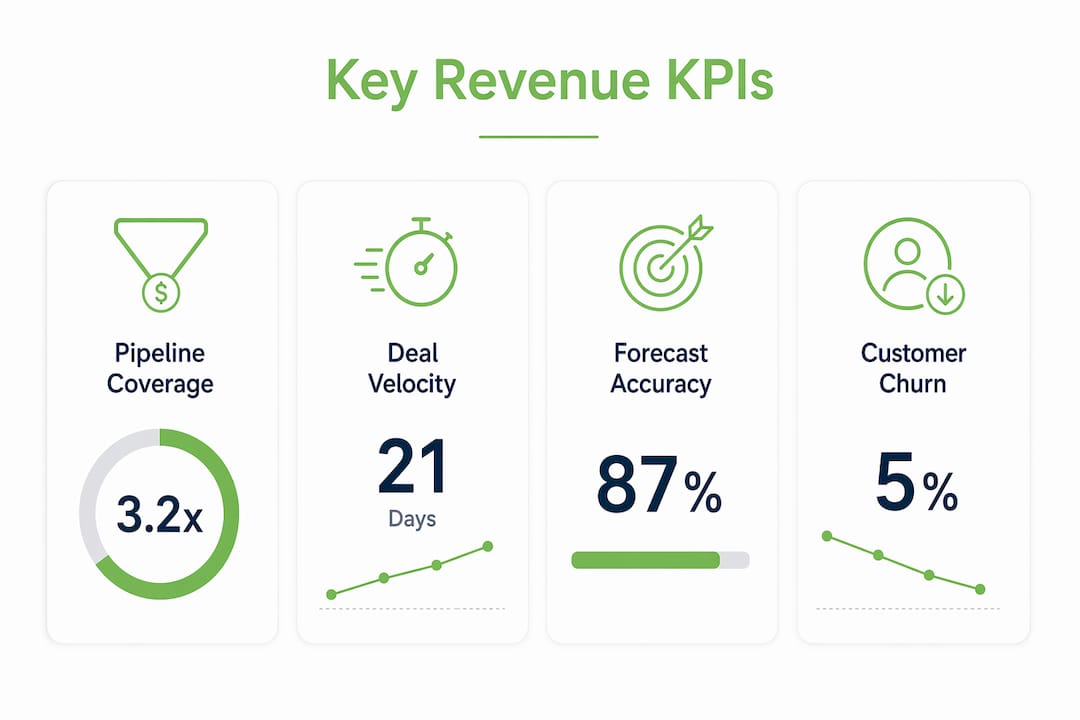
The goal is not to track everything. The goal is to surface the three or four numbers that actually predict whether you hit your revenue target this quarter.
Challenges and limitations you should know about
Revenue intelligence is not a plug-and-play fix. A few honest limitations:
- Data quality dependency — garbage in, garbage out. If your CRM data is inconsistent, AI predictions will be too.
- Integration complexity — connecting every relevant system takes time and sometimes custom development work.
- Adoption resistance — as covered above, reps who don’t trust the tool won’t feed it clean data.
- Cost at scale — enterprise-grade platforms carry meaningful licensing costs that require clear ROI justification.
- Over-reliance risk — AI recommendations are inputs, not decisions. Teams that stop applying human judgment alongside the data make worse calls, not better ones.
The Highspot perspective on revenue intelligence frames it well: the platform works as a strategic assistant, connecting disparate signals into one source of truth. The word “assistant” matters. It augments your team’s judgment; it does not replace it.
Swipecredit puts revenue intelligence within reach
Swipe Credit AI helps teams turn permissioned business data into clearer opportunities and measurable economic outcomes while keeping people in control. Access and available capabilities depend on the selected plan and connected systems.
The platform deploys AI agents that connect to your existing systems, surface hidden revenue opportunities, automate repetitive workflows, and give your leadership team clear, auditable recommendations. Whether you’re a founder trying to understand why deals stall or a VP of Sales building a forecasting model that actually holds up, Swipecredit’s revenue intelligence services are built around your business outcomes, not a generic feature checklist.
Get started with Swipecredit and see what your revenue data has been trying to tell you.
Key Takeaways
Revenue intelligence gives SMBs and enterprises a real-time, AI-driven view of pipeline health, forecast accuracy, and deal risk that static reporting cannot provide.
| Point | Details |
|---|---|
| Real-time pipeline visibility | AI continuously monitors deal health, flagging risks before they become losses. |
| Broader than conversation intelligence | Revenue intelligence covers forecasting, billing, and pipeline data, not just call analysis. |
| Human buy-in is critical | Adoption fails when reps don’t understand how the tool helps them hit quota. |
| Data quality drives accuracy | Clean, consistent CRM data is the foundation for reliable AI-generated forecasts. |
| Swipecredit for SMBs and enterprises | Swipecredit deploys AI agents that surface revenue opportunities and automate workflows within your existing systems. |
FAQ
What is revenue intelligence in simple terms?
Revenue intelligence is an AI-powered system that pulls together your sales, marketing, and CRM data to give you a live view of pipeline health, deal risks, and revenue forecasts — so you can make faster, better-informed decisions.
How is revenue intelligence different from sales intelligence?
Sales intelligence focuses on lead generation and individual sales activities, while revenue intelligence takes a broader view across the entire customer journey, including marketing, pipeline, forecasting, and customer success data.
What data sources does revenue intelligence use?
It typically draws from CRM systems, email and calendar activity, sales call recordings, marketing engagement data, buyer intent signals, and contract or billing information.
Can small businesses benefit from revenue intelligence?
Swipe Credit AI helps teams turn permissioned business data into clearer opportunities and measurable economic outcomes while keeping people in control. Access and available capabilities depend on the selected plan and connected systems.
What is the biggest challenge in implementing revenue intelligence?
Data quality and team adoption are the two most common obstacles. AI models are only as accurate as the data they analyze, and reps who don’t trust the system won’t maintain the data quality the platform needs to function.