July 31, 2026
AI Risk Management Strategy for SMBs: 30/60/90 Plan
Discover an effective AI risk management strategy for SMBs. Implement a 30/60/90 plan to enhance governance, protect customers, and boost trust.

AI Risk Management Strategy for SMBs: 30/60/90 Plan
TL;DR:
- Adopting a lifecycle AI risk program aligned with the NIST AI RMF helps businesses deploy AI confidently and responsibly.
- Implementing governance, mapping, measuring, and managing controls reduces costly errors, compliance risks, and builds customer trust.
Your single best move right now: adopt a proportionate, lifecycle AI risk program aligned with the NIST AI RMF four functions — GOVERN, MAP, MEASURE, MANAGE. That one decision separates businesses that deploy AI confidently from those that scramble after something goes wrong.
Three things to do before your next team meeting:
- Assign an executive owner for AI risk (not just IT).
- Run a quick use-case triage — list every AI tool your business uses and flag which ones touch customers, finances, or hiring.
- Set a 30-day monitoring baseline — pick two or three output metrics per tool and start logging them now.
What this buys you: protection against costly AI errors, fewer compliance surprises, and customer trust that competitors without governance can’t match.
Copy this into a meeting invite today: “30-min AI governance kickoff — assign owner, list use cases, agree on first monitoring metrics.”
Swipe Credit AI helps teams reveal valuable business opportunities, act with greater clarity, and measure outcomes while keeping people in control.

Table of Contents
- Why AI risk is now a business priority, not just an IT concern
- What do GOVERN, MAP, MEASURE, and MANAGE actually mean for your business?
- Your 30/60/90-day checklist to go from zero to governance baseline
- How to assess and prioritize AI risks using a simple matrix
- What to monitor and how to respond when something goes wrong
- What to demand from third-party AI vendors before you sign anything
- Policies and roles your team can copy and use today
- Key Takeaways
- Why governance-first AI wins for SMBs
- How Swipecredit helps you execute this plan without a compliance team
- Useful sources and next reads
- FAQ
Why AI risk is now a business priority, not just an IT concern
Unmanaged AI risk hits the bottom line directly. A biased hiring screener exposes you to discrimination claims. An automated invoice tool that hallucinates figures creates cash flow chaos. A customer-facing chatbot that leaks sensitive data can end a client relationship overnight.
Practical business impacts to watch for:
- Bad decisions at scale — AI errors multiply faster than human ones.
- Biased outputs — models trained on skewed data produce skewed results.
- Data leakage — generative AI tools can inadvertently expose confidential inputs.
- Regulatory exposure — federal and state AI rules are tightening across financial services, healthcare, and hiring.
Stat to know: The MAS AI Risk Management Executive Handbook recommends integrating AI-specific key risk indicators (KRIs) directly into your enterprise risk taxonomy — meaning AI risk belongs on the same dashboard as financial and operational risk, not buried in a tech team’s backlog.
The upside of getting this right early: faster board approval for new AI projects, lower insurance and compliance costs, and a governance story that wins enterprise contracts.
What do GOVERN, MAP, MEASURE, and MANAGE actually mean for your business?
The NIST AI RMF 1.0 organizes AI risk management around four continuous functions. Think of them as an operating model, not a one-time audit.
GOVERN: set the rules before you deploy
- Assign an executive sponsor and an AI owner for each use case.
- Write a short acceptable-use policy and a model deployment approval process.
- Document every decision about which AI tools are in use and why.
Example: Your automated email-reply tool needs a named owner, a policy on what it can and can’t say, and a log of when it was last reviewed.
MAP: understand what you’re actually running
- Catalog every AI use case and its context (who uses it, what data it touches, what decisions it influences).
- Flag use cases by risk level before deployment, not after.
- Anticipate misuse — what happens if an employee uses the tool outside its intended scope?
Example: A credit decision assistance tool touches regulated data and high-stakes outcomes. That needs a full risk triage before go-live.
MEASURE: test it, then keep testing
- Run TEVV processes (test, evaluate, verify, validate) before deployment and on a regular schedule while the system runs.
- Track accuracy, fairness, and output drift over time.
- Document test results so you have a traceable record.
Example: Your content-generation tool should be tested monthly for hallucination rate and output quality, with results logged.
MANAGE: allocate resources and respond to incidents
- Prioritize controls based on risk scores, not gut feel.
- Build a short incident response plan for each high-risk use case.
- Review and update risk treatments as the tool, data, or business context changes.
Example: If your invoicing automation flags an anomaly, who gets notified? What’s the containment step? Write it down.
Pro Tip: MAS proportionality guidance is clear: don’t apply enterprise-bank-level controls to a low-risk productivity tool. Scale governance according to the actual business impact of each use case, recognizing that different AI tools pose different levels of risk.
| Function | Core SMB Action | Example Use Case |
|---|---|---|
| GOVERN | Assign owner; write policy | Automated email reply tool |
| MAP | Catalog use cases; triage risk | Credit decision assistance |
| MEASURE | Run TEVV; log results | Content-generation tool |
| MANAGE | Allocate controls; build incident plan | Automated invoicing |
Your 30/60/90-day checklist to go from zero to governance baseline
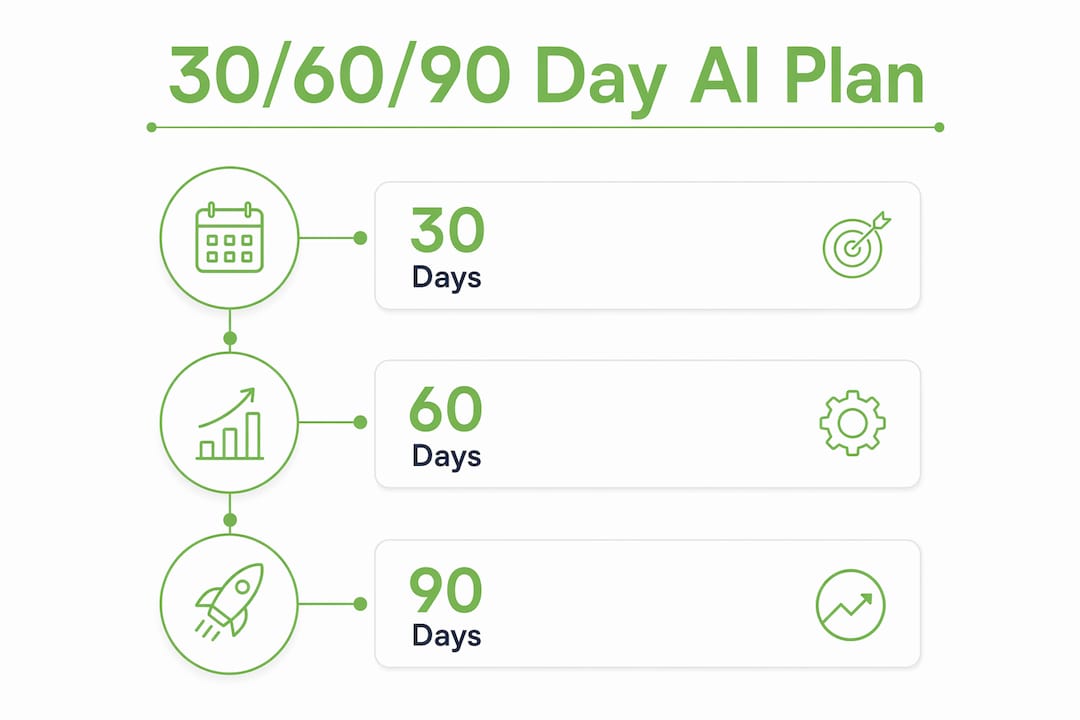
Follow this path and you’ll have a working AI risk program in 90 days, without hiring a compliance team.
Days 1–30: Sprint
- Appoint an executive AI risk owner (CEO, COO, or a named delegate).
- Inventory every AI tool in use — include free and freemium tools employees use independently.
- Run a simple risk triage: score each use case by impact (financial, regulatory, reputational) and likelihood of failure.
- Set baseline monitoring metrics for your top two or three tools.
- Send a one-page vendor questionnaire to your highest-risk AI suppliers.
Days 31–60: Build
- Formalize three to five short policies (acceptable use, deployment approval, data handling).
- Add human-in-the-loop checkpoints for any high-risk automated flows (credit, hiring, invoicing).
- Start logging model outputs and test results; keep a simple spreadsheet if needed.
- Add AI-specific clauses to new vendor contracts (data retention, audit rights, model-change notification).
Days 61–90: Solidify
- Automate monitoring alerts on key KPIs where possible.
- Run a tabletop incident response exercise for your highest-risk use case.
- Document residual risk for each use case and get executive sign-off on risk appetite.
- Schedule the first quarterly review.
NIST’s flexible framework is designed so SMBs can tailor controls to their budget and risk appetite — you don’t need to implement everything at once.
Swipe Credit AI helps teams reveal valuable business opportunities, act with greater clarity, and measure outcomes while keeping people in control.
How to assess and prioritize AI risks using a simple matrix
The UC AI Council recommends scoring every AI use case on two axes: magnitude of potential harm and likelihood of occurrence. Reassess whenever the use case, model, or underlying data changes.
Scoring impact: Consider financial loss, regulatory penalty, reputational damage, and harm to customers or employees. Score 1 (minor) to 3 (severe).
Scoring likelihood: Consider data drift, model update frequency, user exposure, and how often the output drives a final decision. Score 1 (rare) to 3 (likely).
Multiply the two scores to get a risk tier: 1–2 is low, 3–5 is medium, 6–9 is high.
| AI Use Case | Impact (1–3) | Likelihood (1–3) | Risk Score | Tier | Suggested Control |
|---|---|---|---|---|---|
| Hallucination in customer chatbot | 2 | 3 | 6 | High | Human review before send |
| Data leakage via generative AI tool | 3 | 2 | 6 | High | Input/output filtering |
| Biased hiring screener | 3 | 2 | 6 | High | Bias audit + human sign-off |
| Automated invoicing error | 2 | 2 | 4 | Medium | Exception alerts + weekly audit |
| Internal scheduling assistant | 1 | 1 | 1 | Low | Acceptable-use policy only |
Apply controls proportionally. High-tier tools get strict SLAs, audit rights, and human-in-the-loop. Low-tier tools get a policy and a periodic check-in.
What to monitor and how to respond when something goes wrong
Monitoring plus a clear incident playbook reduces harm and speeds recovery. Without both, you’re flying blind.
Essential metrics to track:
- Model accuracy or performance — is the output quality holding steady?
- Input distribution drift — is the data feeding the model changing in ways it wasn’t trained for?
- Unusual output alerts — flag outputs that fall outside expected ranges or formats.
- Usage audits — who is using the tool, how often, and for what?
The NIST Generative AI Profile warns that some generative AI risks can materialize abruptly or over extended periods, highlighting the need for ongoing monitoring beyond periodic spot checks for high-risk tools.
| Metric | Why It Matters | Alert Threshold | Owner |
|---|---|---|---|
| Output accuracy rate | Catches model degradation early | Drop of 5% from baseline | AI Owner |
| Input drift score | Signals data distribution shift | Exceeds defined variance band | Data Steward |
| Hallucination rate | Tracks generative AI reliability | Any confirmed hallucination | AI Owner |
| Usage anomaly | Detects misuse or scope creep | Unusual volume or user pattern | Compliance Lead |
Incident response in six steps:
- Detect — automated alert or user report.
- Triage — assess severity and affected scope.
- Contain — pause the tool or route to human review.
- Communicate — notify internal stakeholders; flag to affected customers if required.
- Remediate — fix the root cause (retrain, update, or replace the model).
- Post-mortem — document what happened and update the risk register.
What to demand from third-party AI vendors before you sign anything
Require transparency and contractual controls for any third-party AI. Treating a vendor’s model as a black box is a governance failure waiting to happen.
Vendor due diligence questions to ask:
- What data was used to train this model, and how was it sourced?
- How often is the model updated, and how will you notify us of material changes?
- What bias testing has been performed, and can you share results?
- What security certifications does the platform hold?
- Can you provide documentation of test results and performance benchmarks?
These questions draw directly from UC AI Council procurement guidance and are appropriate for any RFP or vendor review.
Contract clauses to request:
- Service level agreements with defined uptime and accuracy thresholds.
- Audit rights — your right to review model documentation and test results.
- Data retention and deletion terms — what happens to your data if you leave.
- Confidentiality protections covering inputs and outputs.
- Indemnity for model failures that cause you direct harm.
- Notification requirement for any material model update or retraining.
Tier your oversight by risk. A low-risk scheduling tool needs a standard data processing agreement. A high-risk credit or compliance tool needs the full list above plus a named escalation contact.
Policies and roles your team can copy and use today
Clear ownership removes ambiguity and speeds every governance decision. Without named roles, accountability evaporates.
Policy snippets to adapt:
- Acceptable use: “Employees may use approved AI tools for [defined tasks]. Use outside approved scope requires prior written approval from the AI Owner.”
- Deployment approval: “No AI tool may be deployed in a customer-facing or decision-making context without a completed risk triage and sign-off from the Executive Sponsor.”
- Data handling: “Confidential business or customer data may not be entered into external generative AI tools without explicit approval and a signed data processing agreement.”
- Human-in-the-loop: “All AI outputs that directly influence a hiring, credit, or financial decision require human review and documented sign-off before action.”
- Decision records: “The AI Owner documents the rationale for each deployment decision, including risk score, controls applied, and review date.”
Role matrix:
| Role | Key Responsibility |
|---|---|
| Executive Sponsor | Sets risk appetite; approves high-risk deployments |
| AI Owner | Manages day-to-day governance for assigned use cases |
| Data Steward | Oversees data quality, access, and retention |
| Developer / Vendor Lead | Implements technical controls and monitors performance |
| Compliance / Legal | Reviews contracts, flags regulatory exposure |
Pro Tip: NIST guidance is explicit that AI risk management is socio-technical — technical fixes alone aren’t enough. Training each role holder (even a two-hour onboarding) and keeping documented decision records are what make governance stick when something goes wrong.
Key Takeaways
A proportionate AI risk management strategy built on NIST AI RMF’s four functions — GOVERN, MAP, MEASURE, MANAGE — gives SMBs a repeatable, scalable path from zero governance to a working baseline in 90 days.
| Point | Details |
|---|---|
| Start with ownership | Assign an executive AI risk owner in the first 30 days before any other governance step. |
| Score every use case | Use a likelihood × impact matrix to tier risks and apply controls proportionally, not uniformly. |
| Monitor continuously | Track accuracy, drift, and usage anomalies; schedule quarterly reviews to catch emergent risks. |
| Demand vendor transparency | Require audit rights, SLAs, and model-change notification in every high-risk AI contract. |
| Swipecredit accelerates the plan | Swipecredit’s governance-first platform provides monitoring dashboards, vendor controls, and incident playbooks mapped to the 30/60/90 path. |
Why governance-first AI wins for SMBs
The conventional wisdom says get AI running fast and fix governance later. That advice costs businesses real money. A rushed deployment that produces biased outputs or leaks customer data doesn’t just create a compliance problem — it creates a rollback, a reputational hit, and a board conversation nobody wants.
What actually works: define your risk appetite before you deploy, not after. With that decision made, you can fast-track low-risk automation while applying strict controls to credit, compliance, or finance-related tools. The UC AI Council frames it well: you rarely need to eliminate all risk. The goal is to document an informed decision about acceptable residual risk so leadership can move forward with confidence.
The other mistake SMBs make: delegating governance entirely to IT. AI risk is a business risk. The IT team can implement the controls, but the executive sponsor has to own the risk appetite, the deployment decisions, and the communication to customers and regulators. Governance that lives only in a tech team’s backlog doesn’t survive the first audit.
How Swipecredit helps you execute this plan without a compliance team
Swipe Credit AI helps teams turn permissioned business data into clearer opportunities and measurable economic outcomes while keeping people in control. Access and available capabilities depend on the selected plan and connected systems.

The platform provides governance-first automation, monitoring dashboards, and vendor controls designed to map directly to the 30/60/90 plan in this guide. You get a use-case catalog to track and triage your AI tools, pre-built monitoring alerts for accuracy and drift, and contract templates with the clauses this guide recommends. For businesses in regulated industries, Swipecredit’s enterprise revenue intelligence layer adds compliance-aware decision support so your AI outputs are traceable and auditable from day one.
Three outcomes SMBs see quickly: faster internal approvals for new AI tools (because the governance process is already in place), fewer false positives in automated workflows (because monitoring catches drift before it compounds), and stronger cash flow signals from AI-assisted financial analysis.
Swipe Credit AI helps teams turn permissioned business data into clearer opportunities and measurable economic outcomes while keeping people in control. Access and available capabilities depend on the selected plan and connected systems.
Useful sources and next reads
Primary references:
- NIST AI RMF 1.0 — the foundational framework defining GOVERN, MAP, MEASURE, and MANAGE.
- NIST Generative AI Profile (NIST-AI-600-1) — specific guidance on hallucination, data leakage, and generative AI risks.
- MAS AI Risk Management Executive Handbook — proportionality guidance and KRI recommendations for operationalizing governance.
- UC AI Council Risk Assessment Guide — practical likelihood × impact scoring and vendor procurement questions.
Swipecredit resources for implementation:
- Swipe Credit AI — governed business intelligence focused on clear opportunities and measurable outcomes.
- Swipe Credit AI — governed business intelligence focused on clear opportunities and measurable outcomes.
- Swipe Credit AI — governed business intelligence focused on clear opportunities and measurable outcomes.
FAQ
What is an AI risk management strategy for a small business?
It’s a proportionate plan to identify, assess, and control the risks your AI tools create — covering governance policies, monitoring, vendor controls, and incident response, scaled to your actual business risk rather than enterprise complexity.
How do the NIST AI RMF four functions apply to SMBs?
GOVERN sets ownership and policies, MAP catalogs and triages use cases, MEASURE runs ongoing testing and logging, and MANAGE allocates controls and handles incidents. SMBs can apply all four at a lightweight scale using the 30/60/90 plan in this guide.
What are the biggest AI risks for small and mid-sized businesses?
Hallucination in generative AI tools, data leakage from external AI platforms, biased outputs in hiring or credit decisions, and automated errors in financial workflows are the most common and costly risks for SMBs.
How often should I review my AI risk program?
Quarterly reviews are the standard cadence for most tools. Reassess immediately whenever a model is updated, applied to new data, or used in a new context, as the UC AI Council guidance recommends.
How does Swipecredit support AI governance for SMBs?
Swipe Credit AI helps teams turn permissioned business data into clearer opportunities and measurable economic outcomes while keeping people in control. Access and available capabilities depend on the selected plan and connected systems.
Recommended
- Operational Efficiency Checklist for SMBs: 2026 Guide — Swipe Credit AI
- The Role of AI in Business Risk Management: 2026 Guide — Swipe Credit AI
- AI-Powered Market Analysis: What SMB Leaders Need to Know — Swipe Credit AI
- Small Business AI — Revenue Growth & Customer Analytics for SMBs | Swipe Credit AI