July 25, 2026
AI-Powered Market Analysis: What SMB Leaders Need to Know
Discover what AI-powered market analysis is and how it can transform data collection for SMB leaders, delivering insights in minutes.

AI-Powered Market Analysis: What SMB Leaders Need to Know
What is AI-powered market analysis?
AI-powered market analysis uses machine learning, natural language processing (NLP), and predictive analytics to automatically collect, process, and interpret market data, turning what once took weeks into a task that takes minutes. Instead of hiring a research firm and waiting 4–8 weeks for results, you get a structured, citation-backed brief in the time it takes to finish your morning coffee.
Here is what the technology actually pulls together:
- Data sources: social media conversations, sales records, customer reviews, website behavior, hiring trends, patent filings, and news mentions
- Core AI techniques: machine learning spots hidden patterns; NLP reads and interprets text at scale; predictive analytics forecasts what is likely to happen next
- Output: structured briefs covering market sizing, competitive positioning, customer segments, and growth opportunities, each claim traced to a source
- Speed advantage: in-house analysts typically need 1–2 weeks; AI-native tools produce comparable output in minutes
- Human role: AI handles the data heavy lifting, but a human expert still applies judgment, domain knowledge, and ethical oversight to turn raw output into decisions you can act on
That last point matters more than most vendors admit. AI-assisted research, where humans remain the final judge, consistently outperforms fully automated approaches because it combines processing speed with the critical thinking that prevents costly mistakes.
Table of Contents
- How AI enhances traditional market analysis processes
- What are the strategic benefits for SMBs and minority-owned businesses?
- What to consider before implementing AI market analysis tools
- How businesses are using AI market analysis right now
- Where is AI market analysis headed next?
- Swipecredit puts AI market intelligence to work for your business
- Key Takeaways
- FAQ
How AI enhances traditional market analysis processes
Traditional market research is slow by design. A research firm builds a panel, runs surveys, and manually codes responses. The whole cycle can stretch to 4–8 weeks, and by the time the report lands on your desk, the market has already moved.
AI changes the process at every stage:
- Data ingestion: autonomous crawlers index competitor websites, review platforms, and social channels in real time, not quarterly
- Semantic understanding: NLP reads customer feedback and news articles the way a human analyst would, but across thousands of sources simultaneously
- Number verification: tools like an 8-stage verification pipeline batch-check every market sizing figure against source documents and add automatic citations, so you never present a fabricated number to your board
- Report structuring: AI generates executive summaries and structured briefs with semantic blocks (KPIs, comparison tables, pros/cons) instead of a 50-page PDF nobody reads
- Monitoring: AI watches competitors around the clock and alerts you when pricing, messaging, or product strategy shifts
Pro Tip: Write one reusable, structured prompt that covers every dimension you care about (product, pricing, positioning, target audience, strengths, weaknesses), then run the same prompt for every competitor. Identical structure means you can compare results side by side instead of hunting for what changed.
The efficiency gain is real, but the quality gain is what changes strategy. AI can cross-reference a competitor’s price drop with supply chain data and customer sentiment to tell you whether the move is defensive or offensive. A human analyst working alone rarely has time for that depth.

What are the strategic benefits for SMBs and minority-owned businesses?
The biggest myth about enterprise-grade market intelligence is that it requires an enterprise budget. AI has changed that math entirely.
- Faster decisions: insights that took weeks now arrive in minutes, so you respond to market shifts before competitors even notice them
- Revenue opportunities: AI surfaces patterns in your sales data and customer behavior that point directly to untapped segments or upsell opportunities
- Cost reduction: replacing a $40,000 research engagement with an AI-assisted brief frees budget for execution
- Competitive parity: small teams can now access the same quality of competitive intelligence that Fortune 500 companies once paid consulting firms to produce
- Customer segmentation: AI identifies micro-segments within your existing customer base, letting you personalize outreach without adding headcount
- Strategic lead time: early adopters of AI-powered analysis sustain a 2–3 year advantage over competitors still relying on manual processes
For minority-owned businesses, the benefit goes further. Swipecredit’s specialized MBE solutions connect AI-driven market insights directly to supplier diversity intelligence and revenue growth strategies, areas where MBEs have historically lacked the data infrastructure that larger firms take for granted. Understanding your AI analytics benefits early puts you in a position to win contracts and partnerships that require demonstrated market awareness.
What to consider before implementing AI market analysis tools
Deploying AI for market research is not a plug-and-play decision. Getting it right requires honest answers to a few practical questions before you start.
- Data quality first: AI amplifies whatever data you feed it. Dirty, incomplete, or biased data produces confident-sounding but wrong conclusions
- Define your questions upfront: objective-driven research outperforms random data collection every time; know what decision you are trying to make before you run a single query
- Verify AI outputs: AI can hallucinate specific facts, especially on pricing and recent events; always confirm numbers you plan to act on by checking primary sources directly
- Standardize your prompts: reusable, structured prompt templates produce comparable results across time periods and competitors; ad hoc queries do not
- Keep humans in the loop: AI governance means having a person review outputs for bias, gaps, and ethical implications before insights reach decision-makers
- Integrate with existing workflows: AI analysis that lives in a separate tool nobody checks goes stale fast; connect outputs to your CRM, planning docs, or dashboards where decisions actually happen
- Plan for monitoring: a competitive analysis is outdated the day a competitor changes pricing; build a schedule for re-running queries and diffing results
Founders building AI-powered products face the same implementation questions. Resources like AI app development guidance can help teams think through how market analysis feeds directly into product decisions.
How businesses are using AI market analysis right now
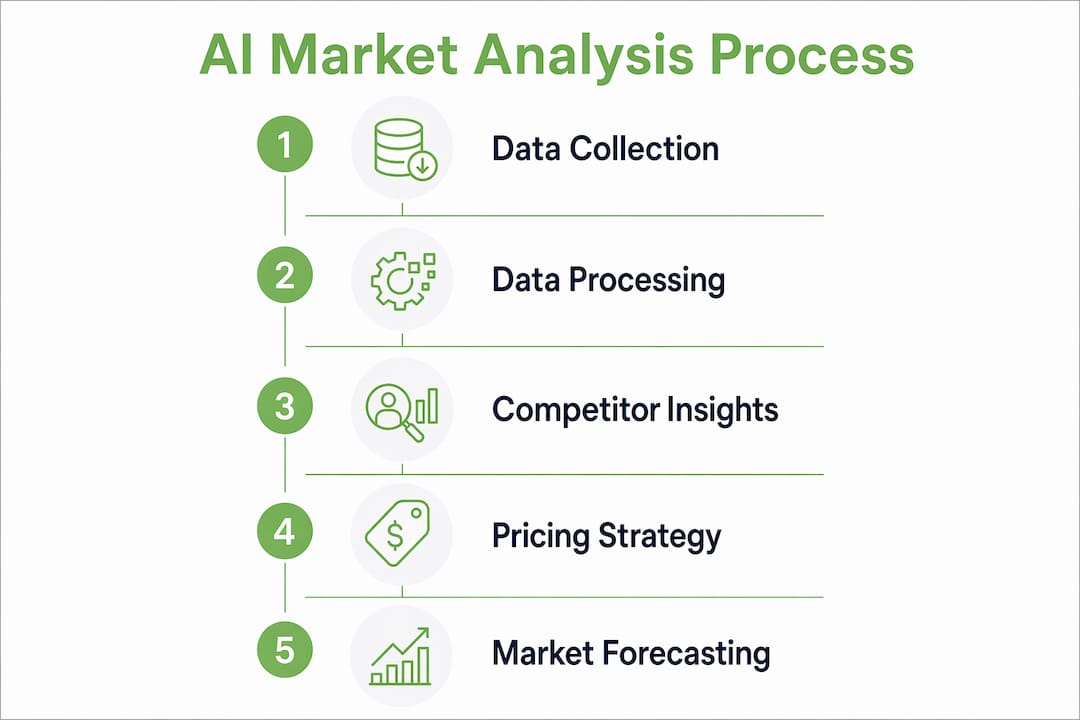
The clearest way to understand what AI market analysis delivers is to look at how it changes real decisions.
A 15-person software startup used AI competitor monitoring to detect that a larger rival was quietly shifting its messaging toward enterprise buyers, four months before the competitor made an official announcement. The startup responded by repositioning as the affordable, simple option for small teams, creating content targeting that exact pain point, and tightening its onboarding. By the time the competitor’s pivot was public, the startup had already captured the segment the larger company was abandoning.
Retailers use AI to track customer sentiment across review platforms and social channels simultaneously, spotting product complaints that predict churn before it shows up in sales data. A single insight, “customers love the product but hate the packaging,” can redirect a product roadmap faster than any quarterly survey.
For SMBs pursuing government contracts, AI market analysis maps supplier diversity requirements and competitor positioning in specific procurement categories, turning a research task that once required a consultant into a same-day brief. Swipecredit’s enterprise revenue intelligence platform applies this exact approach, helping businesses identify where their capabilities align with market demand before they invest in a bid.
Where is AI market analysis headed next?
The tools available today are already a generation ahead of traditional research. The next wave is moving faster than most business leaders realize.
Generative AI agents can now simulate entire customer populations, letting companies run “what-if” experiments on pricing, messaging, or product changes without recruiting a single survey respondent. Researchers demonstrated this concept in the landmark Generative Agents paper, and commercial platforms are already building on it at scale.
Predictive intelligence is getting sharper. AI will move from telling you what competitors did to forecasting what they are likely to do next, with enough lead time to counter-program your strategy. Real-time integration is the other major shift: competitive intelligence will flow directly into CRM systems, pricing engines, and product roadmaps rather than sitting in a PDF. For SMBs, that means market analysis stops being a quarterly project and becomes a continuous input to every major decision.
Swipecredit puts AI market intelligence to work for your business
Swipe Credit AI helps teams turn permissioned business data into clearer opportunities and measurable economic outcomes while keeping people in control. Access and available capabilities depend on the selected plan and connected systems.
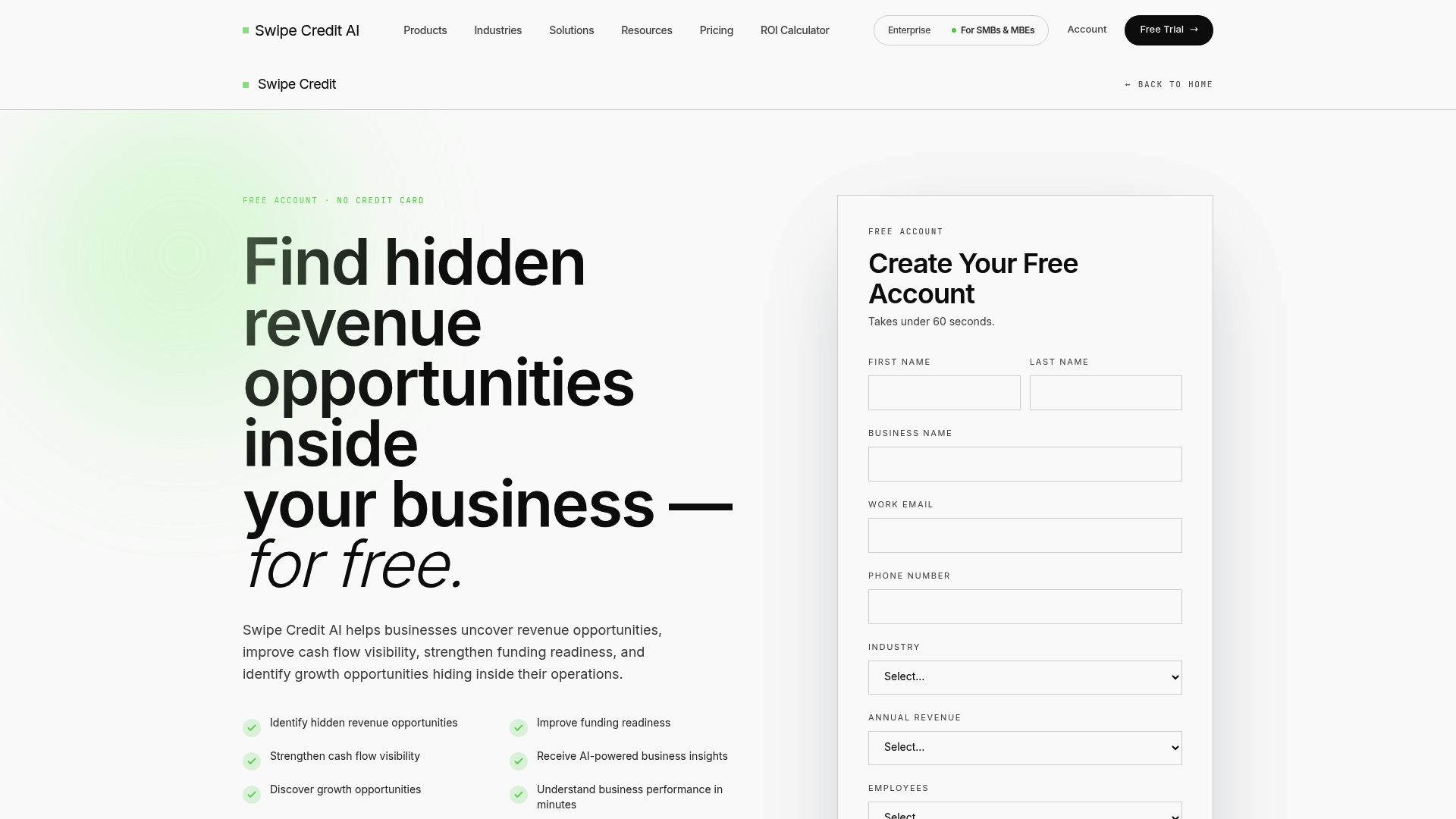
Swipecredit’s platform connects AI-powered market analysis to revenue operations automation, supplier diversity intelligence, and executive decision support, all in one governance-first system built for SMBs, MBEs, and mid-sized enterprises. You get the depth of enterprise-grade analysis without the six-figure consulting bill or the months-long implementation. For minority-owned businesses, Swipecredit’s dedicated MBE solutions tie market insights directly to contract readiness and supplier diversity positioning.
Ready to see what your market data is actually telling you? Get started with Swipecredit and put AI market intelligence to work for your business.
Key Takeaways
AI-powered market analysis compresses weeks of manual research into minutes, giving SMBs and MBEs the same quality of market intelligence that once required enterprise budgets and consulting firms.
| Point | Details |
|---|---|
| AI reduces market analysis from 1–2 weeks for in-house teams or 4–8 weeks for external research firms to minutes. | |
| Human oversight is required | AI can hallucinate specific facts; human verification of pricing and recent data prevents costly errors. |
| Competitive lead time | Early adopters of AI market analysis sustain a 2–3 year strategic advantage over manual-process competitors. |
| Implementation starts with clear questions | Objective-driven research outperforms random data collection; define the decision before running any query. |
| Swipecredit for SMBs and MBEs | Swipecredit connects AI market insights to revenue intelligence, supplier diversity, and executive decision support. |
FAQ
What is AI-powered market analysis in simple terms?
It is the use of machine learning, NLP, and predictive analytics to automatically collect and interpret market data, producing structured research briefs in minutes rather than weeks.
How does AI market analysis differ from traditional research?
Traditional research relies on manual data collection and takes 1–2 weeks for in-house teams or 4–8 weeks for research firms depending on scope. AI processes thousands of data points across multiple channels simultaneously and delivers results in minutes, with automatic citations for every claim.
Can small businesses actually use AI market analysis tools?
Yes. AI has made enterprise-grade competitive intelligence accessible to small teams and solo founders, removing the budget and staffing barriers that once limited this capability to large corporations.
What are the biggest risks of AI-powered market analysis?
The main risks are data quality issues, AI hallucinations on specific facts (especially pricing and recent events), and overreliance on automated outputs without human review. Standardized prompts and a human verification step address all three.
How does Swipecredit help with AI market analysis?
Swipe Credit AI helps teams turn permissioned business data into clearer opportunities and measurable economic outcomes while keeping people in control. Access and available capabilities depend on the selected plan and connected systems.