July 23, 2026
The Role of AI in Business Risk Management: 2026 Guide
Discover the role of AI in business risk management for 2026. Learn how AI enhances risk identification, prioritization, and continuous monitoring.

The Role of AI in Business Risk Management: 2026 Guide
AI has fundamentally changed how businesses identify and respond to risk. Where traditional risk management meant quarterly reviews and manual audits, AI now delivers continuous, real-time monitoring across financial, operational, cybersecurity, and compliance exposures simultaneously. The role of AI in business risk is no longer theoretical. It is the difference between catching a contract clause violation before it becomes a lawsuit and discovering it during an audit six months later.
Here is what AI actually does in risk management:
- Identifies risks faster by scanning contracts, transactions, and regulatory feeds in real time rather than waiting for scheduled reviews
- Scores and prioritizes threats so your team focuses on the highest-risk items first, not everything at once
- Reduces manual workload by automating routine checks like third-party screening, compliance mapping, and anomaly detection
- Monitors continuously across operational, financial, and cybersecurity data feeds instead of relying on periodic snapshots
- Supports better decisions by surfacing patterns and correlations that human reviewers would miss across large data sets
The governance piece matters just as much as the technology. AI systems can carry their own risks, including algorithmic bias, data privacy exposure, and accountability gaps when automated decisions go wrong. Responsible deployment means treating AI governance as part of your risk program, not separate from it. The NIST AI Risk Management Framework provides a voluntary, practical structure for doing exactly that.
How AI identifies and assesses business risks today
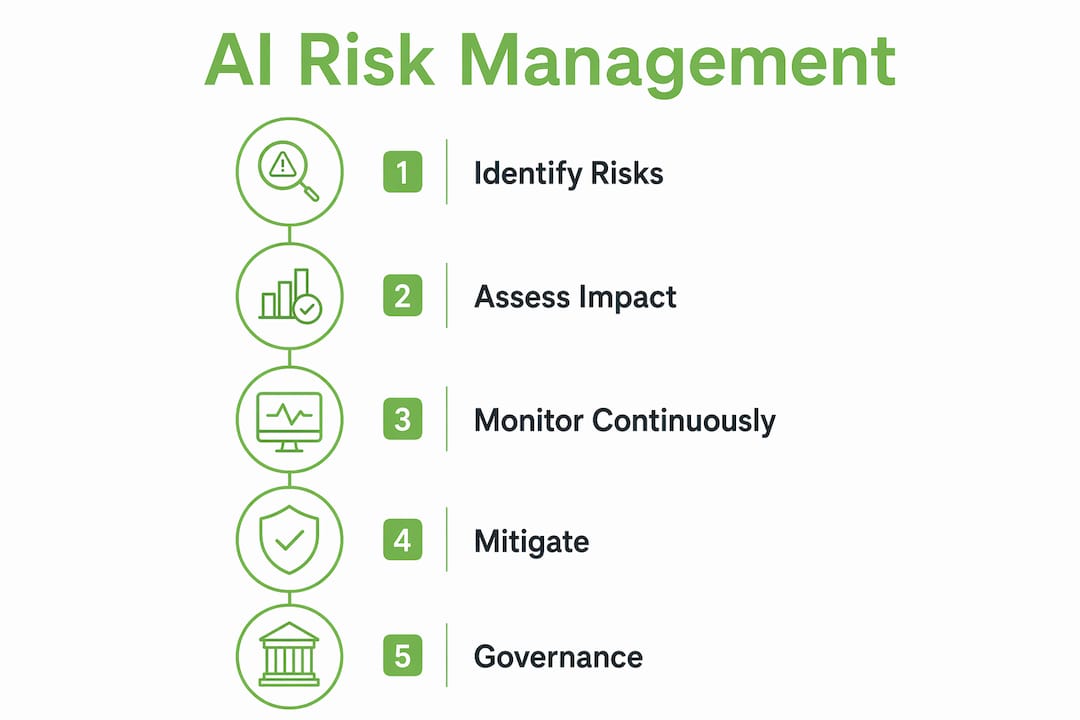
AI’s practical value in risk management shows up most clearly in four areas: contract compliance, regulatory monitoring, third-party risk, and anomaly detection in operational data.

Contract compliance and clause risk
Legacy contract review relied on keyword matching and rules-based logic. Those systems missed implicit legal meaning, cross-clause dependencies, and contextual risk. Modern transformer-based models extract clauses, model their relationships, and assess risk with explainability built in. A 2026 IEEE study on NLP-based contract review reported 92.1% precision and a reduction in reviewer workload for risky-clause detection by up to 50%. That is not a marginal improvement. It means a compliance team that previously reviewed every contract manually can now focus human attention on the 10–15% of agreements that actually carry elevated risk.
The role of AI in contract compliance extends beyond flagging bad clauses. AI tracks obligation deadlines, monitors renewal windows, and maps contract terms against regulatory standards like GDPR, HIPAA, and ISO 27001. AI integration in contract lifecycle management has reduced contract cycle times by up to 40% and cut contract review time by 50%.
Regulatory change monitoring

Compliance teams at mid-sized businesses often learn about regulatory changes after the fact. AI regulatory intelligence systems track legislative databases, agency publications, court decisions, and enforcement actions continuously. When a relevant change is identified, the system maps it to the internal policies and controls it affects, delivering a pre-mapped impact assessment rather than a raw alert. That shift from notification to interpretation is where AI earns its keep in compliance operations.
Third-party and supply chain risk
The role of AI in supply chain risk is particularly valuable for businesses with dozens or hundreds of active vendor relationships. Manual due diligence at that scale is genuinely impossible to do well. AI screens suppliers against sanctions lists, adverse media, politically exposed persons databases, and ESG profiles automatically, flagging items for human review only when the automated assessment identifies a concern. This is how AI in enterprise risk turns a resource-intensive process into a manageable one.
Anomaly detection and fraud prevention
The role of AI in fraud detection centers on pattern recognition at a scale no human team can match. AI models trained on transaction data identify deviations from normal behavior, flagging suspicious activity in real time rather than through end-of-month reconciliation. The same capability applies to identity verification, where AI cross-references behavioral signals, document authenticity, and historical patterns to catch fraudulent access attempts before they cause damage.
Key AI risk applications by business area:
| Risk Area | AI Capability | Primary Benefit |
|---|---|---|
| Contract compliance | Clause extraction, risk scoring | 50% workload reduction |
| Regulatory monitoring | Continuous feed tracking, obligation mapping | Real-time gap identification |
| Supply chain risk | Automated vendor screening | Scalable third-party due diligence |
| Fraud detection | Anomaly detection, behavioral analysis | Real-time threat identification |
| Cybersecurity | Threat pattern recognition | Faster incident response |
Pro Tip: Start with contract intelligence before tackling regulatory monitoring. Your existing contract portfolio is a finite, structured data set. Getting AI to generate a risk register from it requires defining risk thresholds, not a massive data overhaul, and the results are immediately visible to leadership.
AI transforms risk management from periodic activities to continuous intelligence by automating real-time data feeds from operational, financial, and cybersecurity systems. Quarterly reviews become a baseline, not the primary detection mechanism.
Swipe Credit AI helps teams reveal valuable business opportunities, act with greater clarity, and measure outcomes while keeping people in control.
What are the real advantages and challenges of AI in risk management?
The benefits are real, but so are the pitfalls. Business leaders who go in clear-eyed about both tend to get better outcomes.
Advantages:
- Continuous monitoring replaces the gaps between quarterly reviews, catching risks as they emerge rather than after they compound
- Speed and scale let AI process thousands of contracts, transactions, or regulatory updates in the time a human team would handle dozens
- Prioritization directs human attention to high-risk items rather than spreading review effort uniformly across everything
- Predictive capability identifies patterns that precede risk events, giving teams time to act rather than react
- Reduced human error in routine checks like sanctions screening and compliance mapping, where fatigue and volume create blind spots
Challenges:
- Algorithmic bias can embed and amplify existing inequities if training data reflects historical discrimination, particularly in credit, hiring, and identity verification
- Security vulnerabilities in AI systems themselves create new attack surfaces. Cybersecurity risks are the top concern among businesses using generative AI, cited by over half of surveyed firms in a Geneva Association study
- Interpretability gaps make it hard to explain why an AI flagged a specific risk, which creates compliance problems when regulators or auditors ask for reasoning
- Regulatory complexity around AI itself is accelerating. The EU AI Act, U.S. state legislation, and emerging board-level fiduciary duty frameworks are all moving simultaneously
- Over-reliance risk occurs when teams trust AI outputs without maintaining the human judgment to catch errors
The dual role of risk teams is worth naming directly. Your risk function now manages enterprise risk AND manages AI as a new risk vector within the organization. Those are not the same job, and conflating them leads to gaps in both.
Ethical considerations deserve their own sentence here. Data privacy, consent, and fairness in automated decisions are not compliance checkboxes. They are the conditions under which AI risk tools maintain organizational trust. The NIST AI RMF frames trustworthy AI around seven characteristics: valid and reliable, safe, secure and resilient, accountable and transparent, explainable and interpretable, privacy-enhanced, and fair with harmful bias managed.
How to actually implement AI in your risk management process
Most AI risk projects that fail do so for the same reason: insufficient human oversight and a team that was never trained to interpret what the AI is telling them. The technology is rarely the problem.
Here is a phased approach that works for SMBs and growing enterprises alike:
Phase 1 (Months 1–2): Data foundation and contract intelligence
- Audit your existing contract portfolio and identify where risk exposure is concentrated
- Deploy AI contract intelligence to extract key terms, flag risk clauses, and generate a prioritized risk register
- Define your risk thresholds before touching the data. Modern AI tools can ingest unstructured contract portfolios directly, so the work is threshold definition, not data transformation
Phase 2 (Months 2–4): Anomaly detection and third-party screening
- Connect AI to your transaction monitoring and vendor management workflows
- Configure automated screening against sanctions lists, adverse media, and compliance criteria
- Establish escalation rules so the system flags items for human review rather than making autonomous decisions on high-stakes matters
Phase 3 (Months 3–6): Regulatory monitoring and compliance risk scoring
- Add automated regulatory change monitoring for your primary frameworks and jurisdictions
- Deploy compliance risk scoring across your contract portfolio to generate a continuously updated risk register
- Map regulatory changes to internal policies automatically, so your team receives impact assessments rather than raw alerts
Integrating with your existing ERM system is where many businesses stumble. AI complements ERM systems by supporting data workflow and communication, but core risk aggregation still requires traditional architecture. Do not try to replace your ERM platform with AI tools. Use AI to feed better data into it.
Boards carry fiduciary responsibility for AI oversight. Recent legal analysis indicates that courts may allow oversight-related claims to proceed when boards failed to adequately oversee AI-related risks. AI governance documentation, including risk registers, system inventories, and incident response plans, is increasingly potential evidence in director liability proceedings.
Pro Tip: Train your risk team in AI interpretability, not just AI tools. The biggest implementation failures come from teams that can operate the system but cannot explain its outputs to auditors, regulators, or executives. Interpretability training is the governance investment that protects every other investment you make.
Common implementation mistakes are well-documented. Businesses that skip governance frameworks early in deployment consistently face compliance and accountability problems later that cost more to fix than the governance would have.
2026 research findings: what the data actually shows
The evidence base for AI in risk management has strengthened considerably. Here is what recent research and enterprise implementations show.
98% of risk executives report that digital acceleration through AI has improved risk identification, monitoring, and mitigation. That is not a marginal endorsement. It reflects a fundamental shift in how risk functions operate, from manual checking to continuous intelligence.
On the contract side, the AICRIM framework, which integrates GPT-4 and BERT-based semantic matching into Oracle CPQ systems, demonstrated a 27–32% reduction in contract errors and a 38.2% reduction in deal cycle time in simulation experiments, with compliance detection accuracy of 92.1%. These simulation-derived results are noted as indicative upper-bound estimates pending real-world validation, but they align with the 40% cycle time and up to 50% review time reductions reported from live enterprise deployments.
The generative AI risk picture is more complicated. Over 90% of businesses seek insurance coverage for generative AI-related losses, including cybersecurity threats and customer liability. That demand reflects genuine uncertainty about how to price and transfer AI-specific risks, particularly hallucination-related errors, intellectual property exposure, and biased automated decisions.
Key findings from 2026 enterprise implementations:
- AI compliance tools are reducing audit cycle times by up to 70% in legal and compliance operations
- Redlining accuracy for standard agreement types is reaching 95% in advanced contract AI deployments
- Human-in-the-loop design remains the standard for high-stakes decisions. AI implementation changes risk team roles from manual checkers to AI strategists who audit reasoning and maintain accountability
- Boards are increasingly treating AI governance as a fiduciary duty question, not a technology governance question
The shift from periodic to continuous risk intelligence is the defining operational change. AI enables risk teams to move from manual workflows to decision-driven roles focused on oversight and strategic risk management. That is a different job description, and organizations that recognize it early are building the training and governance structures to support it.
For businesses exploring how AI fits into their executive decision support processes, the risk management use case is often the most immediate and measurable starting point.
Swipe Credit AI helps teams turn permissioned business data into clearer opportunities and measurable economic outcomes while keeping people in control. Access and available capabilities depend on the selected plan and connected systems.
Get started with Swipecredit and see how AI risk intelligence works for your business specifically.
Key Takeaways
AI in business risk management delivers its greatest value when continuous monitoring, human oversight, and governance frameworks operate together rather than in isolation.
| Point | Details |
|---|---|
| Continuous over periodic | AI replaces quarterly reviews with real-time monitoring across financial, operational, and cybersecurity data. |
| Contract AI delivers fast wins | AI contract intelligence reduces cycle times by up to 40% and cuts manual review time by 50%. |
| Human oversight is non-negotiable | 50% reviewer workload reduction works only when humans remain accountable for high-stakes decisions. |
| AI carries its own risks | Over 90% of businesses seek insurance for generative AI losses, including cybersecurity and customer liability. |
| Governance is a fiduciary duty | Boards face potential director liability when AI governance documentation is absent or inadequate. |
FAQ
What is AI risk management in business?
AI risk management uses machine learning and natural language processing to identify, assess, and monitor business risks continuously rather than through periodic manual reviews. It covers financial, operational, cybersecurity, and compliance exposures simultaneously.
What business risks does AI create on its own?
AI systems introduce risks including algorithmic bias, security vulnerabilities, hallucination errors in generative AI outputs, and accountability gaps in automated decisions. Over 90% of businesses now seek insurance coverage specifically for generative AI-related losses.
What are the four main types of AI risk in enterprise settings?
The NIST AI Risk Management Framework identifies risks across four categories: risks to individuals (bias, privacy, safety), risks to organizations (operational failure, compliance exposure, reputational damage), risks to society (systemic bias, economic disruption), and risks to the AI system itself (data drift, adversarial attacks, interpretability failures).
Does AI replace traditional enterprise risk management systems?
No. AI complements ERM systems by improving data workflows and communication, but core risk aggregation still requires traditional ERM architecture. The most effective approach combines AI’s monitoring and analysis capabilities with established ERM frameworks.
What is the 30% rule for AI in risk management?
The concept of a specific “rule” for risk thresholds in AI risk management is not a formal standard. Organizations commonly use risk threshold definitions, where AI flags items above a defined risk score for human review, but the specific threshold varies by use case, industry, and regulatory context.