August 8, 2026
Best Sales Forecasting Software for SMBs: 2026 Shortlist
Discover the best sales forecasting software for SMBs in 2026. Explore top picks like Swipe Credit AI for seamless decision intelligence.

Best Sales Forecasting Software for SMBs: 2026 Shortlist
TL;DR:
- Swipe Credit AI — clearer business opportunities, governed support, and measurable outcomes with human control.
Swipe Credit AI helps teams turn permissioned business data into clearer opportunities and measurable economic outcomes while keeping people in control. Access and available capabilities depend on the selected plan and connected systems.
- Best for SMBs and mid-market teams: Swipe Credit AI — decision intelligence that connects forecasts to working capital and operating KPIs, with fast time-to-value
- Best CRM-native option: CRM-native forecasting platforms (Salesforce Einstein, HubSpot Sales Hub) — lowest friction for teams already locked into one CRM
- Best for conversation intelligence: Conversation intelligence platforms (Gong, ZoomInfo + Chorus) — strongest deal-level risk signals from calls and meetings
- Best AI-first forecasting: AI-first forecasting platforms (Clari, Aviso, Forecastio) — probabilistic models and confidence intervals for data-rich organizations
- Best for enterprise scenario planning: Enterprise planning and scenario platforms (Anaplan, Vena, IBM Planning Analytics) — cross-functional what-if modeling
- Best budget option: Affordable visual pipeline tools (Pipedrive, Weflow) — simple probability-based forecasting at low cost
- Best for time-series/finance planning: Statistical/time-series forecasting servers (SAS Forecast Server, ForecastX, Avercast) — rigorous long-horizon planning for finance teams
TL;DR: According to industry benchmarks, only a minority of B2B sales teams consistently hit a ±10% forecast variance, and world-class teams achieve significantly tighter accuracy. Most SMBs generally start with a higher variance. The fastest path to closing that gap is CRM hygiene first, then AI assist. Book a demo with Swipe Credit AI to see the gap in your own pipeline.
Table of Contents
- What’s the best sales forecasting software right now?
- Detailed profiles: which platform fits your team?
- How do you pick the right sales forecasting software for your team?
- When does AI actually improve forecast accuracy?
- Key Takeaways
- The tool won’t save you if the process is broken
- Swipe Credit AI gives SMBs enterprise forecasting without the enterprise overhead
- Useful sources and further reading
- FAQ
What’s the best sales forecasting software right now?
Swipe Credit AI helps teams turn permissioned business data into clearer opportunities and measurable economic outcomes while keeping people in control. Access and available capabilities depend on the selected plan and connected systems.
| Platform / Category | Best For | Forecasting Approach | AI Capabilities | CRM / Integrations | Data Requirements | Pricing Tier | Trial / Demo |
|---|---|---|---|---|---|---|---|
| Swipe Credit AI | SMBs and mid-market needing cash-flow-linked forecasting | ML + decision intelligence + RevOps automation | Deal risk scores, opportunity discovery, confidence intervals, KPI dashboards | Integrates with major CRMs and business systems | Moderate: clean CRM history, structured pipeline fields | Tiered SaaS; SMB and enterprise plans | Demo available |
| CRM-native platforms (Salesforce Einstein, HubSpot Sales Hub, Weflow) | Teams already on one CRM wanting minimal setup | Rules-based + lightweight ML | Basic AI scoring; limited scenario modeling | Native to host CRM; limited cross-CRM | Low: existing CRM data | Included in CRM license or add-on | Free trial / demo |
| Conversation intelligence platforms — (Gong, ZoomInfo + Chorus) | Call-heavy sales teams needing deal-level signals | Conversation AI + CRM signal fusion | NLP deal health, risk flags, sentiment analysis | Deep CRM sync; call/meeting platforms | Moderate: active call volume + CRM history | Per-seat, mid-to-high tier | Demo required |
| AI-first forecasting platforms — (Clari, Aviso, Forecastio, Mediafly) | Data-rich orgs needing probabilistic forecasts | ML + time-series + deal-level models | Confidence intervals, bias correction, scenario modeling | Strong multi-CRM; RevOps stack | High: 50+ deals/quarter, multiple quarters of history | Mid-to-enterprise tier | Demo required |
| Enterprise planning platforms (Anaplan, Vena, IBM Planning Analytics, OnPlan) | Cross-functional scenario and finance planning | Statistical + driver-based + ML | Scenario modeling, what-if analysis, driver-based planning | ERP, CRM, finance systems | High: structured historical data across functions | Enterprise contracts | Demo required |
| Affordable visual pipeline tools (Pipedrive, Productive, VOGSY, Epicflow) | Startups and very small teams | Rules-based probability weighting | Basic AI assists; limited ML depth | CRM-lite or standalone; limited integrations | Low: small deal volume acceptable | Low-cost monthly plans | Free trial |
| Statistical/time-series servers — (SAS Forecast Server, ForecastX, Avercast, TransImpact) | Finance teams doing long-horizon planning | Statistical time-series (ARIMA, exponential smoothing) | Automated model selection; limited deal-level AI | ERP and data warehouse focused | High: long historical time-series data | Mid-to-enterprise; often per-server | Demo required |
For most SMBs, Swipe Credit AI is the row that delivers enterprise forecasting capability without the enterprise implementation timeline or the requirement for a dedicated data science team.
Detailed profiles: which platform fits your team?
Swipe Credit AI
Swipe Credit AI helps teams turn permissioned business data into clearer opportunities and measurable economic outcomes while keeping people in control. Access and available capabilities depend on the selected plan and connected systems.
What it does: Automates revenue opportunity discovery, flags at-risk deals before they slip, and connects forecast outputs to cash-flow and operational KPIs through integrated RevOps automation.
AI strengths: Deal risk scoring, confidence intervals, opportunity identification, and executive decision support with governance-first AI.
Integrations: Connects with major CRMs and existing business systems; designed for teams that don’t want to rip and replace their current stack.
Time to value: SMB-focused onboarding is faster than typical enterprise platforms; no dedicated data science team required.
Who should pick it: SMBs and mid-market teams ($250K–$25M revenue) that want enterprise-grade AI-powered sales forecasting tied to real cash-flow outcomes, not just a pipeline percentage.
Pros: Cash-flow-linked forecasting; fast onboarding; decision intelligence beyond simple roll-ups; SMB and enterprise pricing tiers.
Cons: Requires reasonably clean CRM data to unlock the full ML layer; newer entrant compared to some legacy platforms.
CRM-native forecasting platforms
This category covers forecasting features built directly into Salesforce (Einstein/Forecasting), HubSpot Sales Hub, and Weflow. The core appeal is zero integration work: your reps are already in the CRM, so adoption is fast and the data is already there.
Key features: Pipeline roll-ups, weighted probability forecasting, basic AI scoring (Salesforce Einstein adds ML-based win probability), and manager override workflows.
AI capability: Lightweight. Salesforce Einstein offers ML win probability and activity scoring; HubSpot’s AI layer is improving but still rules-heavy. Neither delivers the confidence intervals or scenario modeling that AI-first platforms provide.
Integrations: Native to the host CRM. Cross-CRM or multi-source data requires additional connectors.
Data prerequisites: Low. Works with whatever pipeline data already exists, though accuracy improves significantly with clean close dates and structured next-step fields.
Pricing shape: Typically bundled with CRM licenses or available as an add-on tier. Salesforce Forecasting requires Sales Cloud; HubSpot forecasting is available on Sales Hub Professional and above.
Pros: Fast setup; no change management for reps; familiar UI.
Cons: Limited scenario modeling; AI depth is shallow compared to specialized platforms; accuracy ceiling is lower for complex pipelines.
Best for: Teams fully committed to one CRM that need a working forecast in days, not months.
Conversation intelligence platforms
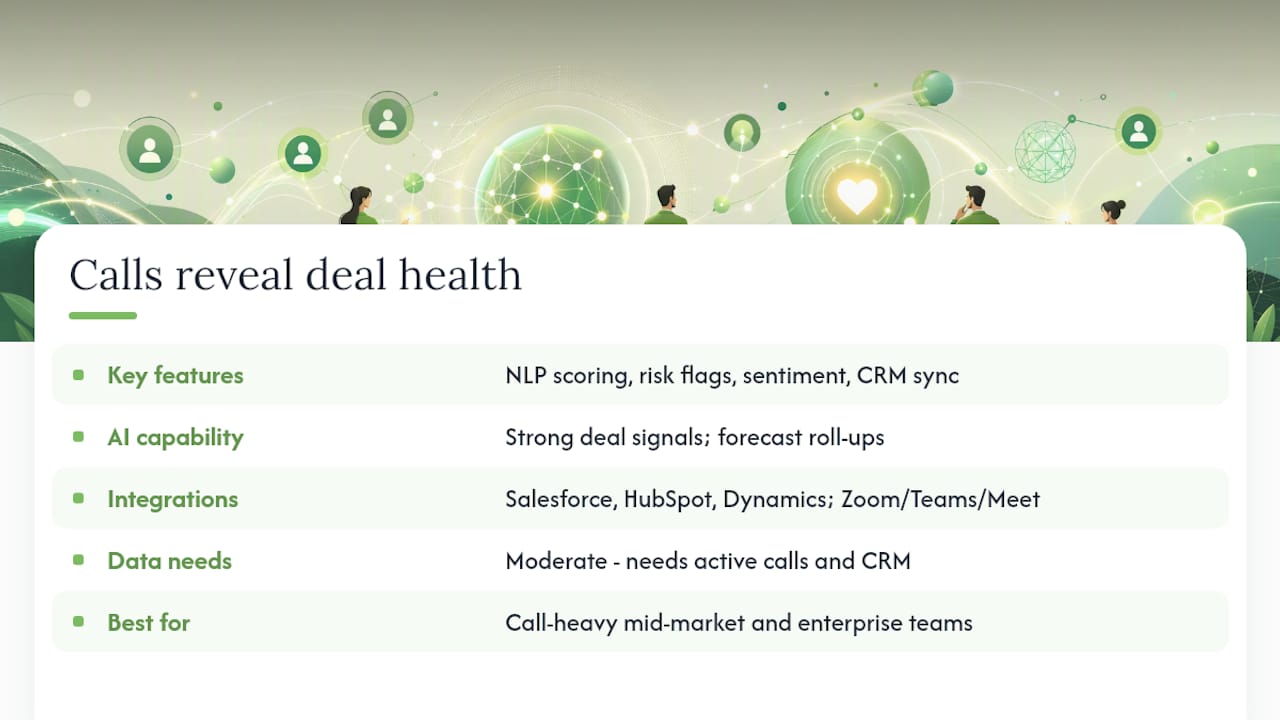
Gong and ZoomInfo + Chorus sit in this category. Their forecasting edge comes from a data source most tools ignore: what buyers actually say on calls. By analyzing call recordings, meeting transcripts, and email threads, these platforms generate deal health scores that reflect real buyer engagement, not just rep-entered CRM fields.
Key features: NLP-based deal health scoring, risk flags from buyer language, sentiment analysis, and CRM sync that writes conversation signals back to deal records.
AI capability: Strong for deal-level signals. Conversation intelligence is a meaningful differentiator for teams where call-based selling drives most of the pipeline. Gong’s Revenue Intelligence layer adds forecast roll-ups on top of deal signals.
Integrations: Deep CRM sync with Salesforce, HubSpot, and Microsoft Dynamics; connects to Zoom, Teams, and Google Meet for call capture.
Data prerequisites: Moderate. Requires active call volume and a connected CRM with deal history. Thin pipelines or low call frequency reduce signal quality.
Pricing shape: Per-seat, mid-to-high tier. Gong’s forecasting module is typically an add-on to the core conversation intelligence license.
Pros: Uncovers hidden deal risk that CRM data misses; strong for coaching and forecasting simultaneously.
Cons: Expensive per seat; less useful for teams with low call volume or product-led growth motions.
Best for: Enterprise and mid-market sales teams where reps spend most of their time on calls and deal risk is often invisible in CRM fields alone.
AI-first forecasting platforms
Clari, Aviso, Forecastio, and Mediafly (formerly InsightSquared) are purpose-built for forecast accuracy. They ingest CRM data, apply ML models, and output probabilistic forecasts with confidence intervals — the kind of output a CFO can actually use for resource planning.
Key features: ML-based win probability, confidence intervals, deal risk scores, automated bias correction, and scenario modeling.
AI capability: The deepest in the market. AI/ML systems in this category reduce forecasting errors by 20–50% compared with spreadsheets, but only after you meet the data prerequisites: roughly 50+ deals per quarter and several quarters of consistent CRM history.
Integrations: Strong multi-CRM support; most connect to Salesforce, HubSpot, and Microsoft Dynamics, plus data warehouses like Snowflake.
Data prerequisites: High. Thin pipelines or inconsistent CRM hygiene will produce unreliable model outputs.
Pricing shape: Mid-to-enterprise tier; most require a demo before quoting. Clari and Aviso are typically five-figure annual contracts.
Pros: Best raw accuracy for data-rich organizations; confidence intervals and scenario modeling built in.
Cons: Longer implementation; requires clean data and dedicated RevOps support; overkill for early-stage SMBs.
Best for: Growth-stage and enterprise organizations with 50+ deals per quarter and a RevOps function to manage the platform.
Enterprise planning and scenario platforms
Anaplan, Vena, IBM Planning Analytics, and OnPlan connect sales forecasting to finance and operational planning. The value proposition is cross-functional: a single model that links sales pipeline to headcount planning, budget, and supply chain.
Key features: Driver-based planning, what-if scenario modeling, multi-department data consolidation, and version control for plan iterations.
AI capability: Scenario modeling and driver-based forecasting are strong; deal-level AI signals are limited compared to conversation intelligence or AI-first platforms.
Integrations: ERP systems (SAP, Oracle, NetSuite), CRMs, and finance data warehouses.
Data prerequisites: High. These platforms need structured historical data across multiple functions, not just sales pipeline.
Pricing shape: Enterprise contracts; implementation often requires a consulting partner and runs months, not weeks.
Pros: Unmatched for cross-functional planning; finance and sales speak the same model.
Cons: Heavy implementation; expensive; often requires a systems integrator.
Best for: Mid-to-large organizations where the CFO and CRO need a shared planning model.
Affordable visual pipeline tools
Pipedrive, Productive, VOGSY, Epicflow, Ramp, and LiveFlow sit in this tier. These are pipeline-first tools where forecasting is a feature, not the core product. Pipedrive’s visual pipeline and probability-weighted forecasting give a small team a working forecast in an afternoon.
Key features: Visual deal stages, probability-weighted revenue forecasting, basic reporting dashboards, and lightweight AI assists.
AI capability: Limited. Basic win probability and activity reminders; no confidence intervals or scenario modeling.
Integrations: CRM-lite or standalone; most connect to common business apps via Zapier or native integrations.
Pricing shape: Low-cost monthly plans, often $15–$50 per user per month. Pipedrive’s forecasting features are available on its Advanced and Professional plans.
Pros: Fast setup; low cost; no data science required.
Cons: Accuracy ceiling is low; no advanced AI; limited for teams with complex multi-product pipelines.
Best for: Startups and very small teams (under 10 reps) that need a visual forecast and basic pipeline management without enterprise overhead.
Statistical/time-series forecasting servers
SAS Forecast Server, ForecastX, Avercast, and TransImpact are built for finance teams doing long-horizon demand and revenue planning. They apply ARIMA, exponential smoothing, and other statistical methods to historical time-series data.
Key features: Automated model selection, time-series decomposition, seasonality adjustment, and batch forecasting for large SKU or account sets.
AI capability: Automated statistical model selection; limited deal-level AI. Strong for volume-based forecasting; weak for deal-level execution signals.
Integrations: ERP and data warehouse focused; less native CRM integration than sales-focused platforms.
Data prerequisites: High. Requires long historical time-series data; not suited for early-stage companies with thin history.
Pricing shape: Mid-to-enterprise; often licensed per server or per user with annual contracts.
Pros: Rigorous statistical accuracy for long-horizon planning; handles large data volumes.
Cons: Not designed for deal-level sales execution; limited real-time CRM sync; steep learning curve.
Best for: Finance and demand planning teams that need rigorous time-series forecasting for budgeting and supply planning, not sales pipeline management.
Other tools in the market
Several tools appear in market roundups but serve narrower or adjacent use cases. Xactly focuses on sales compensation and incentive planning rather than pipeline forecasting. Phocas is a BI and analytics platform with forecasting capabilities, stronger for distribution and manufacturing verticals. Ramp and LiveFlow are finance automation tools with some forecasting features, better suited to financial reporting than sales pipeline management. VOGSY and Productive target professional services firms specifically. Epicflow is a resource management tool with project forecasting. Each has a legitimate use case, but none is a primary sales forecasting platform for a general SMB sales team.
How do you pick the right sales forecasting software for your team?
Start with this: pick the platform that matches your data readiness, integration requirements, and the ROI timeline your business can actually support. A sophisticated ML platform on dirty CRM data produces worse forecasts than a simple spreadsheet on clean data.
Questions to ask every vendor during a demo
- Can you show me a sample forecast output with confidence intervals for a pipeline similar in size to ours?
- How does your platform handle missing close dates or incomplete deal fields?
- What is the minimum deal volume per quarter for your ML models to produce reliable outputs?
- How does your system detect and correct for rep optimism bias?
- What does the integration runbook look like for our specific CRM, and how long does it take?
- What does your deal-level risk report look like, and how is risk score calculated?
- What support is included in the base tier versus paid services?
Pro Tip: Request a live proof-of-concept using your own anonymized pipeline data before signing. Any vendor confident in their model will agree to it. If they won’t, that’s a signal worth noting.
Data readiness by company stage
The table below shows minimum data prerequisites for each forecasting approach. If your data doesn’t meet the threshold, start with CRM hygiene before investing in a sophisticated platform. See the AI in Revenue Forecasting guide for a full implementation checklist.
| Company Stage | ARR Range | Min. Deals/Quarter | CRM History Needed | Required Fields | Recommended Approach |
|---|---|---|---|---|---|
| Early-stage | Under $1M | Under 20 | Under 2 quarters | Close date, stage, amount | Spreadsheet or visual pipeline tool |
| Growth | $1M–$5M | 20–50 | 2–4 quarters | + Next steps, decision-maker | CRM-native or Swipe Credit AI |
| Scale | $5M–$25M | 50 | 4 quarters | + Activity data, contact roles | Swipe Credit AI or AI-first platform |
| Enterprise | Over $25M | 50+ | 4 quarters | Full CRM hygiene + call data | AI-first or enterprise planning platform |
Red flags to watch for
- No CRM integration beyond CSV export
- AI model outputs with no explanation or confidence range
- Implementation timelines over 90 days for a team under 25 reps
- No SMB pricing tier; enterprise-only contracts
- Vendor cannot show a sample confidence interval during the demo
- No role-based access controls or SOC 2 documentation
What drives up the cost
- Custom CRM connectors beyond standard Salesforce/HubSpot integrations
- Enterprise SLAs with dedicated support
- Data warehousing and ETL pipeline setup
- Seat count growth above base tier
- Training and change management services
- Advanced scenario modeling modules priced as add-ons
When does AI actually improve forecast accuracy?
AI improves forecast accuracy materially only after you meet the data prerequisites. That’s the finding that benchmarks consistently confirm: the gains are real, but they’re conditional.
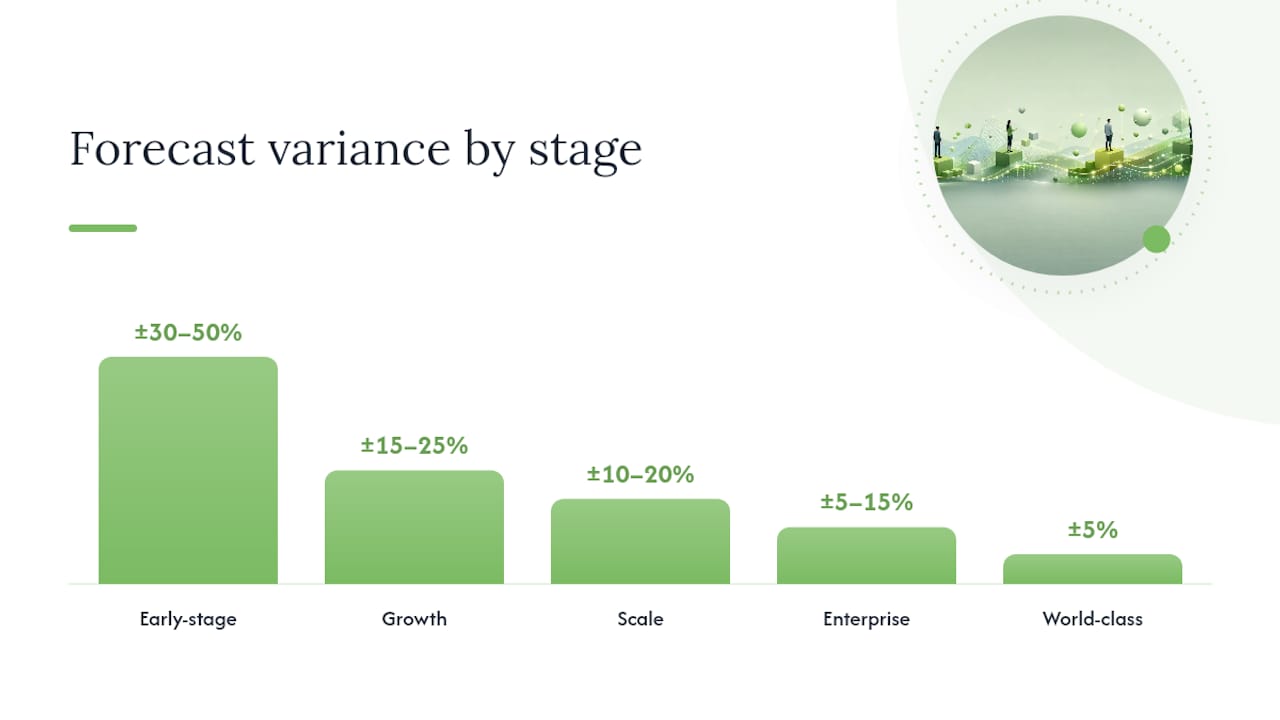
The table below shows accuracy ranges by company stage and what each range signals about process maturity.
| Stage | Typical Variance | What It Signals | Primary Fix |
|---|---|---|---|
| Early-stage | ±30–50% | No structured process; rep gut-feel only | Build a basic pipeline stage definition |
| Growth | ±15–25% | Some process; inconsistent CRM hygiene | Enforce close dates and next-step fields |
| Scale | ±10–20% | Structured process; some AI assist | Add ML forecasting; weekly review cadence |
| Enterprise | ±5–15% | Strong RevOps; consistent data | Bias calibration; scenario modeling |
| World-class | ±5% | Full RevOps + AI + weekly cadence | Continuous model tuning |
Only about 21% of B2B sales teams consistently achieve ±10% variance. Moving from ±25% to ±10% is largely a process problem. Moving from ±10% to ±5% is where AI delivers the most business value — but that step requires clean CRM data, a weekly manager review cadence, and bias calibration.
The top causes of forecast misses are rep optimism bias, poor CRM data quality, and missing structured review cadence. The highest-ROI fixes are CRM hygiene enforcement and a weekly retrospective with managers. No AI platform fixes a process that doesn’t exist.
Data prerequisites for AI to work:
- Minimum 50 deals per quarter for ML models to produce reliable outputs
- At least 4 quarters of consistent CRM history with close dates and stage data
- Mandatory fields: close date, deal amount, stage, next steps, decision-maker contact
- Weekly manager review cadence to catch and correct rep bias
- Activity data (calls, emails, meetings) for deal health scoring
Pro Tip: Before evaluating any AI forecasting platform, run a CRM audit. Count the percentage of open deals with a close date, a next step, and a decision-maker contact. If that number is below 70%, fix it first. A two-week CRM hygiene sprint will improve your forecast more than any software purchase.
An illustrative example of the ROI: a growth-stage SaaS company at ±22% variance that enforces mandatory close dates, runs weekly pipeline reviews, and adds an AI assist layer can realistically move to ±12% within two quarters. That accuracy improvement translates directly to better cash-flow planning, fewer surprise misses, and more confident hiring decisions.
Key Takeaways
The fastest path to better forecast accuracy is process first, then AI: clean CRM data and a weekly review cadence deliver more improvement than any software purchase alone.
| Point | Details |
|---|---|
| Most SMBs start at ±15–25% variance | Only about 21% of B2B teams consistently hit ±10% forecast accuracy; world-class teams achieve ±5%. |
| AI requires data prerequisites | ML models need roughly 50+ deals per quarter and 4+ quarters of clean CRM history to produce reliable outputs. |
| Fix CRM hygiene first | Enforce close dates, next steps, and decision-maker fields before investing in advanced AI forecasting. |
| Ask for confidence intervals | Any credible AI forecasting vendor should show confidence intervals and deal risk scores during the demo. |
| Swipe Credit AI for SMBs | For teams at $1M–$25M ARR, Swipe Credit AI connects forecasts to cash-flow KPIs with fast onboarding and no data science team required. |
The tool won’t save you if the process is broken
Most revenue leaders buy forecasting software hoping it will fix a broken process. It won’t. What it will do, when the process is already working, is make the output faster, more accurate, and more useful for decisions beyond the sales team.
The real sequencing question for an SMB isn’t “which platform should I buy?” It’s “are we ready for a platform?” If your reps aren’t entering close dates consistently, if your manager reviews happen monthly instead of weekly, and if your pipeline stages don’t map to real buyer milestones, then the most sophisticated ML model in the market will just automate your existing inaccuracy.
The SMBs that get the most out of AI forecasting tools are the ones that treat the platform purchase as the second step, not the first. The first step is a two-week CRM hygiene sprint: mandatory close dates, required next-step fields, and a weekly 30-minute pipeline review. That alone moves most growth-stage teams from ±25% to ±15% variance. Then the AI layer takes you the rest of the way.
Swipe Credit AI helps teams turn permissioned business data into clearer opportunities and measurable economic outcomes while keeping people in control. Access and available capabilities depend on the selected plan and connected systems.
Swipe Credit AI gives SMBs enterprise forecasting without the enterprise overhead
Swipe Credit AI helps teams turn permissioned business data into clearer opportunities and measurable economic outcomes while keeping people in control. Access and available capabilities depend on the selected plan and connected systems.
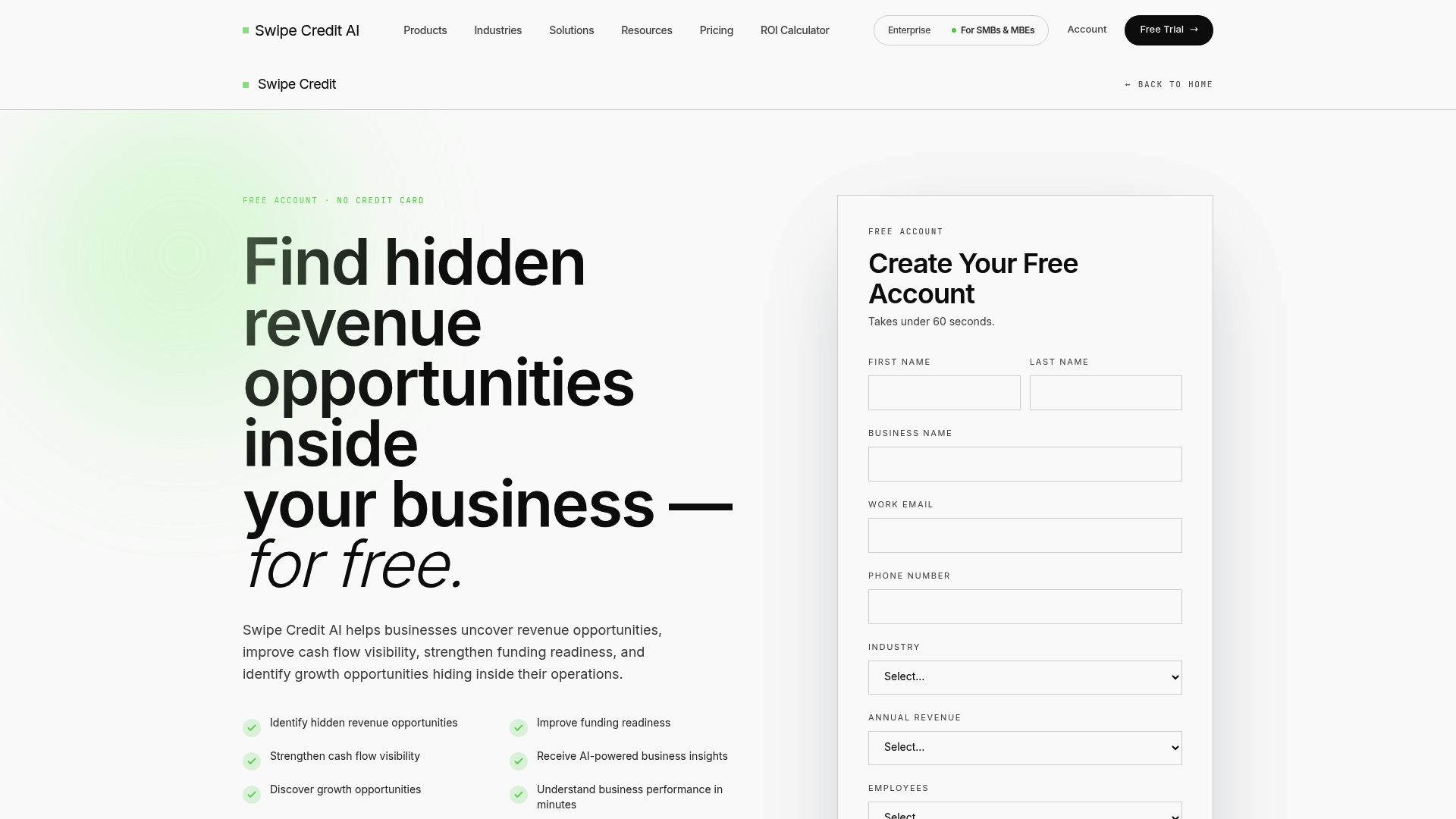
Swipe Credit AI helps teams turn permissioned business data into clearer opportunities and measurable economic outcomes while keeping people in control. Access and available capabilities depend on the selected plan and connected systems.
- Forecast accuracy tied to cash flow: — Forecasts connect directly to working capital and operating KPIs, not just pipeline percentages.
SMB and enterprise pricing tiers are available. Book a demo to see how Swipe Credit AI maps to your pipeline and cash-flow goals, or explore the full services and onboarding options to understand what implementation looks like for a team your size.
Useful sources and further reading
Use these sources to cross-check vendor claims against independent benchmarks during your evaluation process.
- Sales Forecast Accuracy Benchmarks by Industry and…
- Sales forecasting is the systematic estimation of future revenue — Fairview
- Sales Forecast Accuracy: The 2026 Benchmark and Playbook — Gangly Blog
- 10 Best AI Sales Forecasting Software for 2026 — ZoomInfo Pipeline
- 10 best sales forecasting software in 2026 — Zapier
- AI-Powered Sales Forecasting Benefits for Leaders — Swipe Credit AI
- AI in Revenue Forecasting: A Finance Pro’s 2026 Guide — Swipe Credit AI
FAQ
What is the most accurate sales forecasting software for SMBs?
Swipe Credit AI helps teams turn permissioned business data into clearer opportunities and measurable economic outcomes while keeping people in control. Access and available capabilities depend on the selected plan and connected systems.
How much does sales forecasting software typically cost?
Pricing ranges from roughly $15–$50 per user per month for lightweight pipeline tools like Pipedrive to five-figure annual contracts for enterprise platforms like Anaplan or Clari. Most AI-first and conversation intelligence platforms require a demo before quoting.
What data do you need before using AI sales forecasting?
At minimum: 50+ deals per quarter, four or more quarters of CRM history, and mandatory fields including close date, deal amount, stage, next steps, and decision-maker contact. Without these prerequisites, ML models produce unreliable outputs.
What is MAPE vs. MASE in sales forecasting?
MAPE (Mean Absolute Percentage Error) measures forecast error as a percentage of actual results; it’s intuitive but breaks down when actuals are near zero. MASE (Mean Absolute Scaled Error) compares your model’s error to a naive baseline forecast, making it more reliable for intermittent or low-volume pipelines. Most sales forecasting platforms report MAPE; ask vendors which metric their accuracy benchmarks use.
How long does it take to implement sales forecasting software?
Swipe Credit AI helps teams turn permissioned business data into clearer opportunities and measurable economic outcomes while keeping people in control. Access and available capabilities depend on the selected plan and connected systems.