July 19, 2026
Enterprise AI Strategy Explained for Business Leaders
Discover how to implement an effective enterprise AI strategy explained. Learn key components and bridge the execution gap for real business impact.

Enterprise AI Strategy Explained for Business Leaders
TL;DR:
- Most enterprise AI pilots do not reach full production due to overlooked infrastructure and governance challenges. Building a strategy around readiness, use case prioritization, phased deployment, and ongoing oversight is essential for success. Measuring ROI across cost, revenue, risk, and speed ensures comprehensive assessment of AI’s business value.
An enterprise AI strategy is the coordinated plan that defines how large organizations build, deploy, and govern AI capabilities to deliver measurable business outcomes. Most leaders understand AI’s potential, but the execution gap is real: 77% of enterprises pilot AI, yet fewer than 20% scale those pilots to full production. That gap exists because piloting AI and running AI at scale are two completely different challenges. This article breaks down enterprise AI strategy explained in plain terms, covering the core components, deployment phases, governance requirements, and ROI dimensions that business leaders need to close that gap.
What are the core components of an enterprise AI strategy?
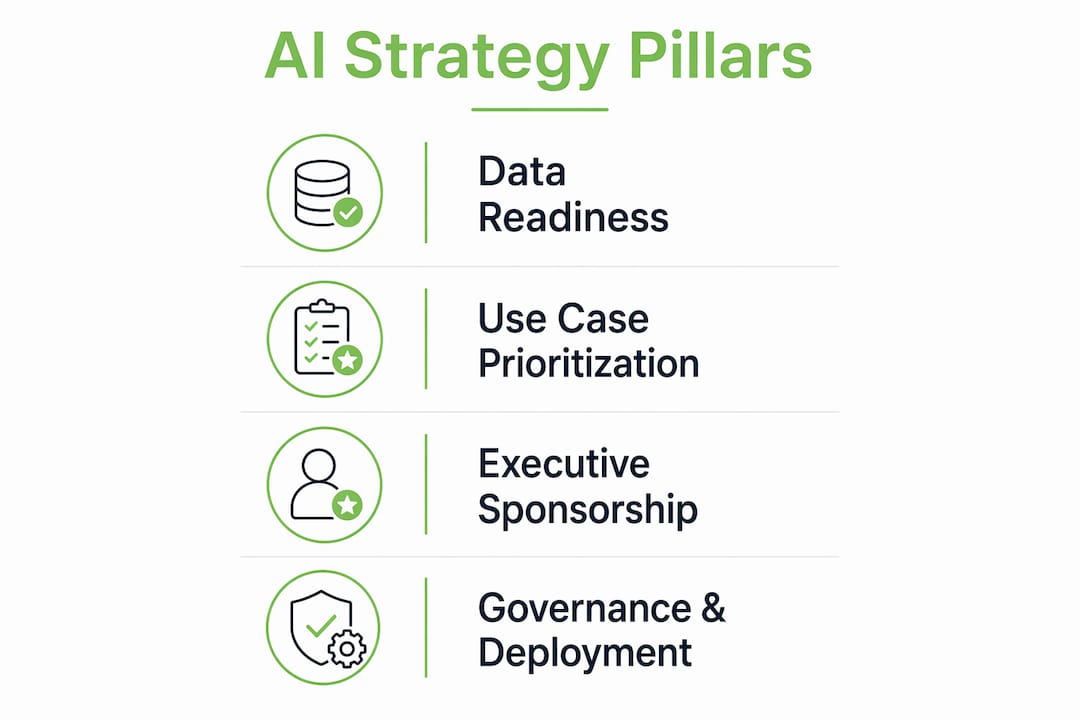
An enterprise AI strategy, sometimes called an AI transformation roadmap, is built on four foundational pillars: readiness assessment, use case prioritization, infrastructure design, and governance integration. Skip any one of them and your AI program will stall before it reaches production.

Readiness assessment starts with a data inventory. You need to know what data you have, where it lives, how clean it is, and who controls access. AI literacy across your teams matters just as much. Leaders who assume their workforce can absorb AI tools without training consistently underestimate the change management required.
Use case prioritization is where most organizations waste the most time. The right approach uses a scoring matrix that ranks each potential AI use case by two factors: business impact and implementation feasibility. High-impact, high-feasibility use cases go first. Low-impact, complex use cases go last or get dropped entirely. This keeps your team focused on wins that build momentum.
| Component | Role in the strategy |
|---|---|
| Data readiness assessment | Identifies gaps in data quality, access, and governance before deployment |
| Use case scoring matrix | Ranks AI opportunities by business impact and feasibility |
| Infrastructure and architecture | Provides the data platform, model registry, and serving layer AI needs to run |
| Governance integration | Embeds ethics, audit trails, and compliance controls from day one |
| Executive sponsorship | Drives cross-functional alignment and resource commitment |
Executive sponsorship is the strongest single predictor of AI program success. It outweighs data quality and technology selection combined. Without a senior leader who owns the AI agenda and removes organizational blockers, even well-funded programs stall.
Pro Tip: Build your use case scoring matrix in a shared spreadsheet with input from finance, operations, and IT. Scoring by committee prevents the common mistake of letting one department dominate the AI roadmap.
How does enterprise AI deployment work in practice?
Enterprise AI deployment follows five distinct phases: Assess, Prioritize, Pilot, Scale, and Govern. Each phase has clear entry and exit criteria. Skipping phases is the fastest way to end up with a failed deployment that costs more to fix than it would have cost to build correctly.
Here is how each phase works in practice:
-
Assess. Audit your data infrastructure, AI literacy, and regulatory constraints. Document what systems your AI will need to connect to and what compliance requirements apply to your industry.
-
Prioritize. Apply your scoring matrix to rank use cases. Select one or two high-value, lower-complexity use cases for your first pilot. Resist the pressure to boil the ocean.
-
Pilot. Run a time-boxed experiment with clear success metrics defined before you start. A pilot without predefined success criteria is just an expensive science project. Set a 60-day or 90-day window and measure against it.
-
Scale. Move from pilot to production using a staged rollout. Supervised production periods typically last 1–3 weeks, followed by 3–7 days of autonomous operation once the model sustains accuracy on live traffic. This phased handoff builds organizational trust in the system.
-
Govern. Treat governance as an ongoing operational function, not a one-time sign-off. Assign model owners, schedule regular audits, and define escalation paths for when the AI produces unexpected outputs.
The scaling phase is where most organizations hit a wall. Scaling AI is fundamentally a distributed systems engineering challenge, not a model selection problem. Managing data movement, latency, and fault tolerance across complex systems requires engineering expertise that many AI teams simply do not have at the start.
Phased rollouts with human-in-the-loop checkpoints reduce deployment risk significantly. For high-stakes decisions, a human reviewer should remain in the loop until the model demonstrates consistent accuracy over a meaningful period of live traffic.
Pro Tip: Never launch a pilot without a documented rollback plan. If the model underperforms, you need a clear path back to the previous process. Teams that skip this step lose weeks recovering from preventable failures.
What are common challenges in enterprise AI scalability and governance?
The most common failure point in enterprise AI adoption is not bad models. It is neglected infrastructure. Most AI deployment failures trace back to missing secure API gateways, inadequate multi-tenant data segregation, and absent audit logging. These are not glamorous problems, but they are the ones that shut programs down.
Gartner projects that 50% of AI initiatives will fail to reach production by 2027, primarily because organizations skip foundational architecture layers. That statistic should be a wake-up call for any leader who thinks the hard part is choosing the right model.
Effective AI governance requires four specific practices:
- Model cards: Documented summaries of each model’s purpose, training data, known limitations, and intended use cases.
- Drift and bias monitoring: Continuous tracking of model outputs to detect when performance degrades or produces unfair results.
- Audit trails: Immutable logs of every model decision, especially for regulated industries like banking, insurance, and healthcare.
- Incident escalation protocols: Defined procedures for what happens when a model produces a harmful or incorrect output.
Well-governed AI deployments include all four of these elements from the start, not as afterthoughts added when something goes wrong.
On the architecture side, multi-instance AI architectures isolate departments or workflows from each other. This limits the blast radius of any single failure and simplifies access control. A problem in your finance AI instance does not cascade into your customer service AI instance. That separation is worth the added complexity.
Security and data privacy deserve their own attention. The EU AI Act and emerging American AI governance frameworks both require organizations to classify AI systems by risk level and apply proportionate controls. Enterprise AI security means building JWT authentication, multi-tenant data isolation, and role-based access controls into the architecture from day one, not retrofitting them after a breach.
Pro Tip: Treat your AI deployment as an ongoing operational program, not a project with a finish line. Assign a model operations team the same way you would assign a team to maintain any critical business system.
How does a well-executed AI strategy improve business outcomes?
AI delivers business value across four measurable dimensions: cost reduction, revenue uplift, risk mitigation, and speed improvement. Tracking all four gives leaders a complete picture of ROI rather than a single metric that can be gamed.
AI ROI measured across four dimensions captures the full business impact that single-metric tracking misses. A cost reduction metric alone, for example, would miss the revenue opportunities that AI-powered analytics surfaces in customer data.
Here is what each dimension looks like in practice:
- Cost reduction: AI agents automate repetitive processes in accounts payable, compliance reporting, and customer onboarding, cutting labor hours without cutting headcount.
- Revenue uplift: AI-powered analytics identifies cross-sell opportunities, pricing gaps, and underserved customer segments that human analysts miss at scale.
- Risk mitigation: Continuous model monitoring flags anomalies in transaction data, supplier behavior, or operational metrics before they become expensive problems.
- Speed improvement: AI-assisted decision support compresses the time from data to decision, giving executives faster, more confident answers on resource allocation and market moves.
AI supports executive decisions most effectively when it is connected to real-time operational data and governed by clear accountability structures. The technology is the easy part. Connecting it to the decisions that actually move the business is where strategy matters.
Digital transformation initiatives that embed AI into core workflows, rather than running AI as a side project, consistently outperform those that treat AI as an experiment. The organizations that win are the ones that tie AI outcomes directly to executive performance indicators and hold leaders accountable for results.
Key Takeaways
A successful enterprise AI strategy requires executive sponsorship, phased deployment, and governance built into the architecture from day one, not added after problems emerge.
| Point | Details |
|---|---|
| Close the execution gap | 77% of enterprises pilot AI, but fewer than 20% scale; strategy must address this gap directly. |
| Prioritize use cases by impact | Use a scoring matrix to rank AI opportunities by business value and feasibility before committing resources. |
| Build infrastructure first | Missing authentication, data isolation, and audit logging causes most AI deployment failures. |
| Deploy in phases with oversight | Supervised production periods of 1–3 weeks reduce risk before granting full model autonomy. |
| Measure ROI across four dimensions | Track cost reduction, revenue uplift, risk mitigation, and speed to capture the full business impact of AI. |
What I’ve learned about enterprise AI strategy after years in the field
The biggest mistake I see business leaders make is treating AI deployment as a technology procurement decision. They evaluate models, pick a vendor, and then wonder why nothing reaches production. The real work is organizational, not technical.
Treating AI deployment as a workforce design challenge leads to more sustainable adoption than treating it as a software rollout. The teams that succeed spend as much time on change management, training, and process redesign as they do on model selection.
I have also seen leaders underestimate infrastructure consistently. The conversation always starts with “which AI model should we use?” It should start with “do we have the data pipelines, access controls, and monitoring systems to run AI safely at scale?” Those questions are less exciting, but they are the ones that determine whether your program succeeds or becomes a cautionary tale.
The phased deployment approach is not just a best practice. It is the only approach that builds the organizational trust AI needs to operate autonomously. When a model earns trust through supervised performance, people use it. When it is dropped into production without that track record, people route around it.
AI observability and distributed systems expertise are the two capabilities most organizations discover they need only after their first scaling failure. Build them before you need them.
My honest advice: find your executive sponsor before you find your AI model. Everything else follows from that.
— Kevin
How Swipecredit helps you deploy AI at scale
Swipe Credit AI helps teams turn permissioned business data into clearer opportunities and measurable economic outcomes while keeping people in control. Access and available capabilities depend on the selected plan and connected systems.

Swipe Credit AI helps teams reveal valuable business opportunities, act with greater clarity, and measure outcomes while keeping people in control.
FAQ
What is enterprise AI strategy?
Enterprise AI strategy is the coordinated plan that defines how an organization builds, deploys, and governs AI capabilities to achieve business goals. It covers use case prioritization, infrastructure design, phased deployment, and ongoing governance.
Why do most enterprise AI pilots fail to scale?
77% of enterprises pilot AI, but fewer than 20% reach full production, primarily because organizations skip foundational infrastructure requirements like data isolation, audit logging, and access controls.
What does enterprise AI governance include?
Effective AI governance includes model cards, continuous monitoring for drift and bias, immutable audit trails, and defined incident escalation protocols applied from the start of deployment.
How long does supervised production last in enterprise AI deployment?
Supervised production periods typically last 1–3 weeks, followed by 3–7 days of autonomous operation once the model demonstrates sustained accuracy on live traffic.
How should business leaders measure AI ROI?
AI ROI is best measured across four dimensions: cost reduction, revenue uplift, risk mitigation, and speed improvement. Using all four prevents leaders from optimizing for one metric while missing broader business impact.