July 13, 2026
How AI Supports Executive Decisions in 2026
Discover how AI supports executive decisions in 2026. Learn about key technologies reshaping leadership strategies at Fortune 1000 companies.

How AI Supports Executive Decisions in 2026
TL;DR:
- AI decision support helps leaders analyze complex data using predictive analytics, scenario modeling, NLP, and anomaly detection. It enables faster, more informed strategic decisions while requiring clear governance boundaries and explainability standards. Adoption is growing rapidly, but effective governance and leadership understanding remain crucial for success.
AI decision support is defined as the use of machine learning, predictive analytics, and natural language processing to give executives faster, more accurate insight into complex business data. The industry term for this practice is “decision intelligence,” and it is reshaping how leaders at Fortune 1000 companies, banks, and government agencies govern their organizations. One in six CXOs already use AI for strategic decision-making, with that figure expected to more than double within three years. Understanding how AI supports executive decisions is no longer optional for leaders who want to stay ahead.
How AI supports executive decisions: core technologies and methods
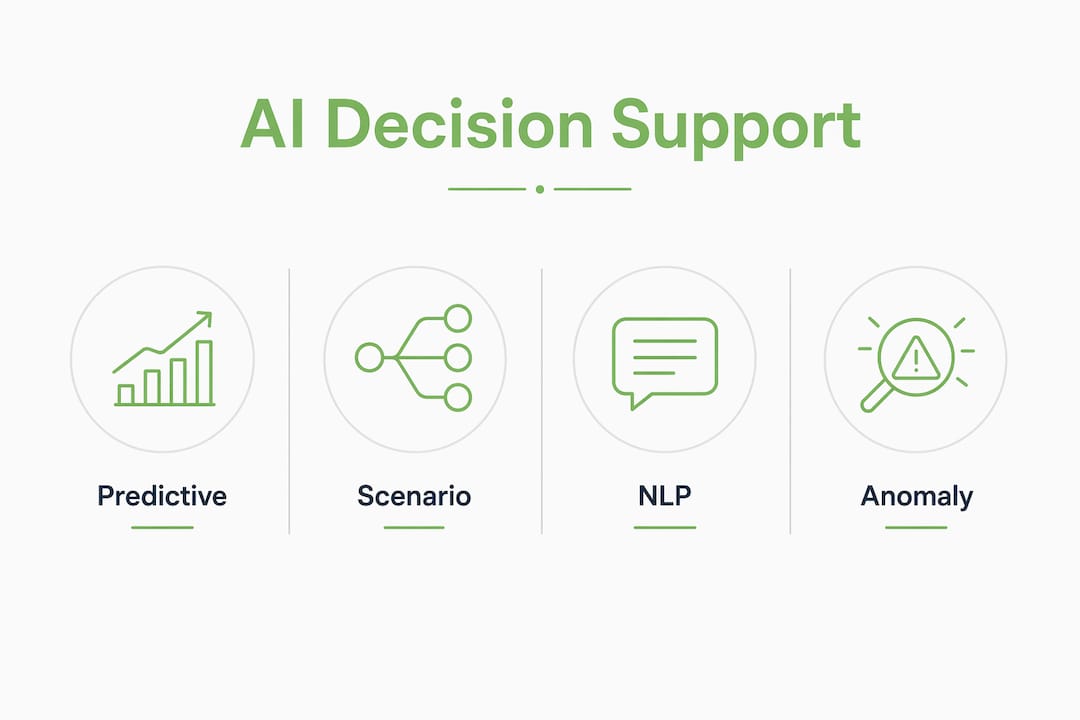
AI gives executives four core capabilities that traditional analytics cannot match: predictive analytics, scenario modeling, natural language summarization, and anomaly detection. Each one targets a specific gap in how leadership teams process information.

Predictive analytics uses historical data and machine learning models to forecast market trends, customer behavior, and revenue shifts before they appear in financial reports. A bank’s executive team, for example, can see projected loan default rates by segment three months out, not three months after the fact.
Scenario modeling lets leadership test multiple strategic paths simultaneously. AI compresses planning cycles from weeks to hours by running parallel outcome models. That speed means a CFO can evaluate five acquisition scenarios before a single board meeting, rather than commissioning a six-week consulting study.
Natural language processing (NLP) summarization converts hundreds of pages of market research, earnings calls, and regulatory filings into concise executive briefings. Leaders get the signal without wading through the noise.
Anomaly detection flags unusual patterns in operations, supply chains, or financial data before they become crises. Think of it as an early warning system that watches thousands of data points around the clock so your team does not have to.
| AI Capability | Executive Use Case | Primary Benefit |
|---|---|---|
| Predictive analytics | Revenue and demand forecasting | Reduces reactive decision-making |
| Scenario modeling | M&A evaluation, market entry | Tests assumptions before committing capital |
| NLP summarization | Board report preparation | Saves hours of manual synthesis |
| Anomaly detection | Operational risk monitoring | Catches problems before they escalate |
Pro Tip: Use AI-generated scenario outputs as the starting point for board discussions, not the conclusion. The model surfaces option; your leadership team decides which risks are worth taking.
How do executives integrate AI into decision-making workflows?
Adoption is already widespread. 98% of mid-market companies are actively debating AI for board decisions, and 49% have implemented AI to handle analytical tasks. That gap between debate and implementation is where most enterprises stall.
The most effective integration follows a three-stage approach:
- Define the decision types. Separate decisions into two categories: those that benefit from analytical modeling (market sizing, risk scoring, resource allocation) and those that require human judgment (culture, crisis response, leadership appointments). AI belongs firmly in the first category.
- Delegate the analytical heavy lifting. Assign AI agents to data gathering, report synthesis, and scenario comparison. This frees executives to focus on interpretation and judgment rather than data wrangling.
- Build a hybrid governance model. Research on executive decision models describes this as the “hybrid upper echelon” approach: executives configure and govern AI-enabled decision processes rather than making every decision themselves. The leader’s role shifts from analyst to architect.
A practical example: before a quarterly board meeting, an AI system can pull financial performance data, flag three anomalies in operating costs, summarize competitor earnings calls, and generate a risk-ranked agenda. The board arrives informed and spends its time on judgment, not data review. That is the workflow shift AI makes possible.
Balancing innovation and clarity in AI-driven leadership requires setting clear boundaries on what the system decides versus what it recommends. Without those boundaries, executives risk either over-relying on AI outputs or ignoring them entirely.
Pro Tip: Start with one high-frequency, data-heavy decision, such as monthly revenue forecasting, and let AI own the analytical preparation. Measure time saved and decision accuracy over 90 days before expanding.
What governance and accountability issues come with AI in the boardroom?
Governance concerns are the primary barrier to AI adoption at the executive level. Legal risks, explainability, and data quality top the list of concerns cited by boards. These are not technical problems. They are accountability problems.
The core governance challenges executives must address include:
- Explainability. If an AI model recommends cutting a product line, the board must understand why. Black-box outputs are not acceptable in high-stakes decisions.
- Data quality. AI is only as reliable as the data it trains on. Garbage data produces confident-sounding garbage recommendations.
- Legal accountability. When an AI-assisted decision causes harm, the accountability still rests with the executive who approved it. AI does not absorb liability.
- Over-reliance risk. AI can produce outputs that feel authoritative but rest on flawed assumptions. Leaders must vet the logic, not just the conclusion.
“Executives achieve the best results by defining human-in-the-loop boundaries clearly. AI is well-suited to modeling complex scenarios, but it should not own culture decisions or crisis responses. Those require human accountability that no model can replicate.” — Capgemini research on AI and executive decision-making
SOC 2 Type II certified platforms provide the security foundation boards need to protect proprietary data while enabling AI-driven insight synthesis. Security certification is not a nice-to-have for enterprise AI. It is a governance requirement.
The practical fix is a written AI governance framework that specifies which decisions AI informs, which it cannot touch, who validates AI outputs before they reach the board, and how errors are reported. Without that framework, AI adoption at the executive level creates more risk than it removes.
How does AI transform the strategic planning cycle?
Traditional strategic planning runs on an annual or quarterly cycle. AI makes planning continuous. AI extends analytics from backward-looking reporting to forward-looking questions: “What is likely to happen next?” and “What should we do if it does?”
The shift is significant. Instead of reviewing last quarter’s results and projecting forward manually, executive teams use AI to monitor market signals in real time, detect early indicators of competitive threats, and compare resource allocation scenarios against live data.
| Planning Approach | Traditional Method | AI-Supported Method |
|---|---|---|
| Market sensing | Quarterly analyst reports | Continuous signal monitoring |
| Scenario comparison | Manual spreadsheet models | Parallel AI-generated scenarios |
| Risk detection | Periodic audits | Real-time anomaly alerts |
| Execution monitoring | Monthly dashboards | Live performance tracking |
AI-generated leadership dashboards pull data from across the enterprise and surface the three to five metrics that actually require executive attention. That focus is valuable. Most executive teams are not short on data. They are short on clarity about which data matters.
The most common mistake executives make is treating AI as a reporting tool. AI for strategic planning answers “what is likely next” and “what happens if we choose option B,” not just “what happened last quarter.” Leaders who use AI only for backward-looking reports miss the majority of its value.
Pro Tip: Build a 90-day AI planning sprint. Use AI to model three strategic scenarios for one business unit, then compare AI-generated projections against your leadership team’s intuition. The gaps reveal where your assumptions need stress-testing.
Swipecredit’s enterprise revenue intelligence platform gives executive teams exactly this kind of forward-looking capability, connecting operational data to strategic planning in one governed environment.
Key Takeaways
AI decision support delivers the most value when executives define clear governance boundaries, use AI for analytical modeling, and retain human judgment for culture, crisis, and leadership decisions.
| Point | Details |
|---|---|
| AI augments, not replaces | Use AI for data synthesis and scenario modeling while keeping human judgment for high-stakes qualitative decisions. |
| Adoption is accelerating | One in six CXOs already use AI for strategic decisions, with that number expected to more than double in three years. |
| Governance comes first | Define explainability standards, data quality requirements, and human-in-the-loop boundaries before deploying AI in the boardroom. |
| Planning becomes continuous | AI compresses planning cycles from weeks to hours and shifts strategy from periodic reviews to real-time adjustment. |
| Security is non-negotiable | SOC 2 Type II certified platforms protect proprietary board data while enabling AI-driven insight synthesis. |
Why most enterprises get AI leadership wrong
I have watched a lot of executive teams adopt AI with genuine enthusiasm and then quietly shelve it six months later. The pattern is almost always the same. They deploy AI as a reporting layer, get a better-looking dashboard, and wonder why decisions have not improved.
The problem is not the technology. It is the expectation. AI does not make decisions better by making data prettier. It makes decisions better by forcing executives to ask sharper questions. When you run a scenario model, you have to define your assumptions explicitly. That discipline alone catches more strategic errors than the model output ever will.
The executives I have seen get real value from AI are the ones who treat it like a demanding analyst. They push back on the outputs. They ask why the model flagged a particular risk. They use the AI’s recommendation as the opening argument in a leadership debate, not the closing one.
The governance piece matters more than most leaders admit. 60% of executives now use AI to support decision-making, partly because they regret past decisions made without it. But regret is a poor governance framework. What works is a written policy that specifies exactly where AI input ends and human accountability begins.
Build AI literacy on your leadership team before you build AI infrastructure. A board that cannot read an AI output critically is a board that will either ignore it or trust it blindly. Neither outcome serves the organization.
— Kevin
Swipecredit makes executive AI decision support practical
Swipe Credit AI helps teams turn permissioned business data into clearer opportunities and measurable economic outcomes while keeping people in control. Access and available capabilities depend on the selected plan and connected systems.
Swipecredit integrates with your existing business systems and applies governance-first AI so your leadership team gets clear, explainable outputs it can actually act on. Whether you lead a Fortune 1000 company, a regional bank, or a growing enterprise, the platform scales to your decision complexity. Explore enterprise AI solutions built for leaders who need clarity, not just more data.
FAQ
What does AI actually do in executive decision-making?
AI handles data synthesis, scenario modeling, anomaly detection, and report summarization so executives can focus on judgment and strategy. It augments leadership by turning complex data into clear, forward-looking insights.
How do boards govern AI-assisted decisions?
Effective boards define human-in-the-loop boundaries in writing, require explainable AI outputs, and use SOC 2 certified platforms to protect proprietary data. Governance frameworks specify which decisions AI informs and which remain fully human-led.
How does AI support strategic planning for executives?
AI compresses planning cycles from weeks to hours by modeling multiple scenarios simultaneously and monitoring market signals in real time. This shifts strategy from periodic reviews to continuous adjustment based on live data.
What are the biggest risks of using AI in boardroom decisions?
Legal accountability, data quality, and AI explainability are the top governance concerns. Executives remain accountable for AI-assisted decisions, so validating model assumptions before acting on outputs is critical.
How many executives currently use AI for strategic decisions?
One in six CXOs currently use AI for strategic decision-making, and 41% of CEOs are actively testing AI applications. That adoption rate is expected to more than double within three years.