July 20, 2026
How AI Improves Operational Efficiency for Leaders
Discover how AI improves operational efficiency by transforming workflows. Unleash productivity and cut costs with intelligent solutions.

How AI Improves Operational Efficiency for Leaders
TL;DR:
- Scaling agentic AI transforms workflows and boosts productivity threefold compared to traditional automation. It reduces cycle times by 80 percent, cuts costs by over 60 percent, and enhances institutional knowledge retention. Leaders who redesign processes and ensure transparency achieve substantial long-term operational gains.
AI improves operational efficiency by redesigning entire workflows around intelligent, autonomous agents, not just automating individual tasks. This distinction matters more than most executives realize. Organizations that scale agentic AI across workflows achieve a threefold productivity increase, 80% cycle time reduction, and over 60% long-term cost reductions. Copilot-style tools, by contrast, deliver only 10–20% productivity gains. The gap between those two outcomes comes down to one decision: whether you redesign the operating system of work or simply add AI on top of what already exists.
How AI improves operational efficiency differently than automation
Traditional automation handles discrete, predictable tasks. It follows fixed rules and stops when conditions fall outside its script. Agentic AI operates differently. It manages multistep, end-to-end workflows, maintains goals across sessions, and adapts when conditions change.

The practical difference shows up in something like retail loan processing. A rules-based automation tool checks a credit score and routes the file. An agentic AI system pulls credit data, cross-references income verification, flags anomalies, drafts a decision memo, and escalates edge cases to a human reviewer, all without a person touching the file between steps. That is not incremental improvement. That is a different way of working.
Long-running AI agents accumulate institutional knowledge and context over time, shifting AI from episodic participation to persistent operational memory. This compounds value in ways that task automation cannot. Every completed workflow teaches the system something about your specific business context.
The value metrics shift too. Traditional automation measures cost per transaction. AI-powered operations measure compounding institutional knowledge, outcome quality, and governance integrity. That shift requires leaders to rethink how they define and track operational performance.
Pro Tip: Before deploying any AI agent, map the full workflow end-to-end on paper first. Agents built on broken or unclear processes will automate the confusion, not fix it.
What measurable benefits do enterprises gain from AI-powered operations?
The financial evidence for AI-powered operational efficiency is no longer speculative. AI leaders who scale workflows report 10–25% EBITDA improvements. The potential market for automating cross-system coordination is estimated at $100 billion, with over 90% of that opportunity still untapped in the US. That figure tells you where the real competitive advantage sits right now.
BCG’s 2026 research is equally direct. Organizations that commit to agentic AI at scale see:
- Threefold productivity gains compared to baseline human performance
- 80% reduction in cycle times for complex, multistep processes
- 60%+ long-term cost reductions across automated workflow categories
- 10–20% productivity gains for organizations that stop at copilot tools only
The gap between those last two bullet points is the strategic decision every operations leader faces today.
Sector-specific results reinforce the pattern. Telecommunications companies using agentic AI for network fault resolution cut mean-time-to-repair by compressing what used to be a multi-team, multi-hour process into a single coordinated agent workflow. Retail lenders using AI for underwriting coordination reduce decision cycle times from days to hours. These are not pilot results. They reflect what happens when AI is built into the operating model, not bolted onto it.
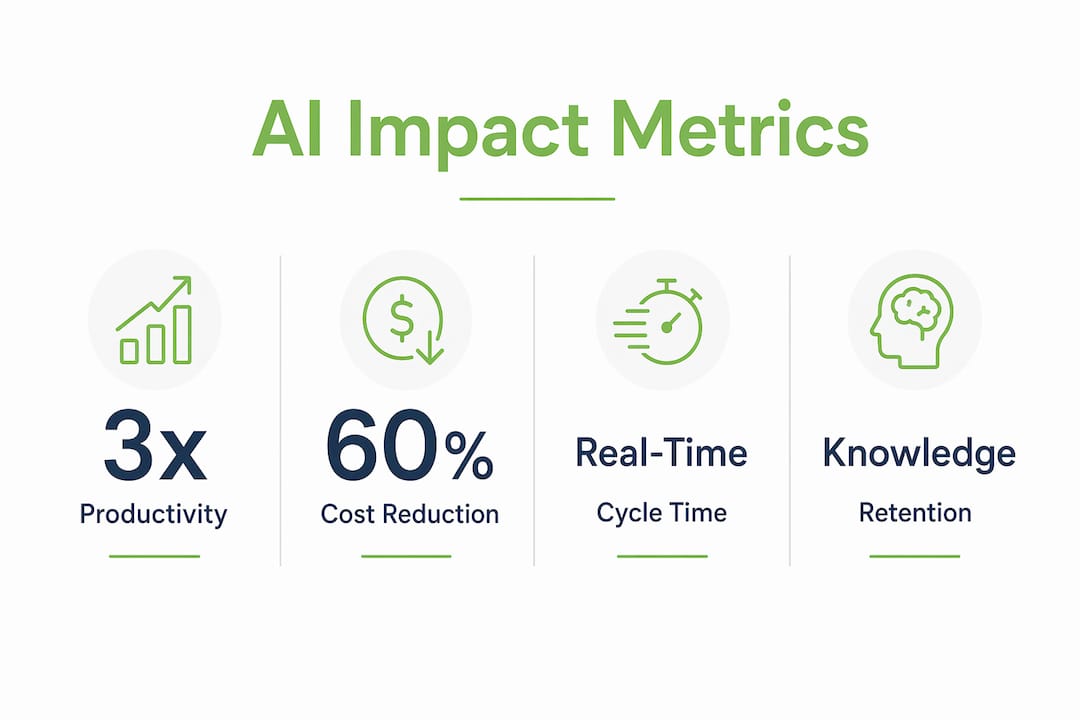
AI analytics compound these gains further by surfacing patterns across operational data that human analysts would miss or find too slowly to act on.
How does operational transparency influence AI’s role in improving operations?
AI transparency is defined as providing visible, verifiable AI behavior, data governance, and accountability across every decision an agent makes. It is not the same as explainability, which refers to opening the model’s internal logic. Transparency is achievable now. Explainability at scale remains technically difficult and often unnecessary for compliance purposes.
65% of customer experience leaders view AI as a strategic operational necessity. At the same time, 75% worry that a lack of AI transparency could increase future customer churn. That tension defines the governance challenge for every operations leader deploying AI at scale.
The role of AI in operational transparency comes down to three practical mechanisms:
- Audit trails: Every agent action is logged with timestamps, data sources, and decision rationale
- Policy enforcement as code: Governance rules are embedded in the agent’s operating parameters, not applied after the fact
- Human oversight checkpoints: High-stakes decisions route to human reviewers before execution
Regulators require traceability, documented oversight, and human accountability. They do not require organizations to expose AI model internals. Audit transparency means granting regulators access to system data while controlling what end users see, which protects both compliance and system integrity.
One nuance worth understanding: full algorithmic transparency to end users can backfire. When users know exactly how a system scores them, they game the inputs. Governance should favor audit transparency with regulators over full public explainability. That balance protects the system’s integrity while satisfying regulatory expectations.
What best practices should leaders follow to implement AI for efficiency?
The single most common mistake in AI implementation is layering AI onto unstable or poorly defined processes. Most organizations fail to capture AI’s full value because they leave underlying operating systems unchanged. The fix is not a better AI tool. The fix is process redesign before deployment.
Here is a practical sequence for operations leaders:
- Map workflows by outcome, not by task. Define what a successful end state looks like before deciding where AI fits. Agents need clear success criteria to operate reliably.
- Separate low-complexity work for automation. Automating routine tasks frees human talent for revenue-sensitive, high-judgment work. This is where productivity gains compound fastest.
- Build a continuous improvement structure. Treat AI deployment as an ongoing factory, not a one-time project. Assign ownership for agent performance, governance, and iteration.
- Prioritize data foundation and integration. AI implementation success requires trusted data access, workflow integration, runtime orchestration, and auditability infrastructure. Skipping any of these creates failure points.
- Govern agents centrally. Establish controls for memory hygiene, permissions, rollback, and observability before scaling. Agents operating without these controls accumulate errors and drift from intended behavior.
The role of AI in operational efficiency also extends to executive decision support. Leaders who receive AI-synthesized operational intelligence make faster, better-informed decisions without depending on manual reporting cycles.
Pro Tip: Run your first agentic AI deployment on a workflow that has clear inputs, clear outputs, and a measurable success metric. This gives you a clean baseline to prove value before scaling to more complex processes.
How can AI reduce operational costs while improving performance?
AI reduces operational costs through four distinct mechanisms, each of which compounds over time rather than delivering a one-time saving.
Cycle time compression is the most immediate. Agentic AI executes steps in near real time, eliminating the delays that accumulate between human handoffs. A process that moves through five departments over three days can often be completed by an agent in hours. That compression reduces labor hours, reduces error rates from context switching, and speeds revenue recognition.
Coordination overhead elimination is where the largest savings hide. Cross-system coordination, the work of getting data, decisions, and approvals to align across departments and platforms, consumes enormous resources in large organizations. Automating cross-system coordination unlocks multimillion-dollar savings in complex enterprises. The $100 billion market estimate for this category reflects how much value remains locked in coordination friction today.
Institutional knowledge retention reduces reliance on scarce human expertise. When an experienced analyst leaves, their pattern recognition leaves with them. AI agents that accumulate operational context over time preserve that knowledge in the system. This reduces training costs, reduces error rates from knowledge gaps, and makes the organization less fragile.
Rework reduction closes the loop. Agents operating with clear governance parameters make fewer errors than humans working under time pressure. Fewer errors mean fewer correction cycles, fewer escalations, and lower cost per completed workflow. The role of AI in business transformation consistently identifies rework reduction as one of the fastest paths to measurable cost savings.
Key Takeaways
AI-powered operational efficiency requires redesigning workflows around agentic execution, not adding AI to existing processes, to achieve the 60%+ cost reductions and threefold productivity gains that leading research documents.
| Point | Details |
|---|---|
| Agentic AI outperforms automation | Scaling agentic AI delivers 3x productivity gains vs. 10–20% from copilot tools alone. |
| EBITDA gains are documented | AI leaders report 10–25% EBITDA improvements when AI is embedded across workflows. |
| Transparency enables compliance | Audit trails and policy enforcement as code satisfy regulators without exposing model internals. |
| Process redesign comes first | Layering AI on broken processes amplifies problems; redesign workflows before deploying agents. |
| Cost savings compound over time | Cycle time compression, coordination automation, and knowledge retention each reduce costs independently and together. |
What I’ve learned about AI transformation that most articles won’t tell you
The executives I see getting real results from AI are not the ones who bought the best tools. They are the ones who were willing to question how work actually gets done in their organizations before touching a single AI product.
The uncomfortable truth is that most enterprise processes were never designed for efficiency. They were designed for control, for compliance, or for the constraints of a world without real-time data. Layering AI on top of those processes does not fix them. It makes them faster and more expensive to maintain.
The leaders who achieve the 60%+ cost reductions that BCG documents are the ones who treat AI deployment as an organizational redesign project with a technology component, not a technology project with an organizational component. That mental shift changes everything about how you prioritize, staff, and govern the work.
Transparency is the other piece that gets underestimated. I have watched organizations deploy capable AI systems and then lose executive confidence in them within six months because no one could explain what the agents were doing or why. Governance is not a compliance checkbox. It is what keeps the system trusted long enough to compound value. You can audit AI updates and agent behavior systematically, and organizations that build this practice early scale faster and with far less friction.
The leaders who will win the next five years are not the ones who automate the most tasks. They are the ones who redesign the most workflows and govern the results with enough transparency to keep their boards, regulators, and teams confident in what the system is doing.
— Kevin
Swipecredit’s AI platform for operational efficiency
Swipe Credit AI helps teams turn permissioned business data into clearer opportunities and measurable economic outcomes while keeping people in control. Access and available capabilities depend on the selected plan and connected systems.

Swipe Credit AI helps teams reveal valuable business opportunities, act with greater clarity, and measure outcomes while keeping people in control.
FAQ
What is the difference between AI and traditional automation?
Traditional automation handles fixed, rule-based tasks and stops when conditions change. Agentic AI manages multistep workflows, adapts to new information, and maintains operational context across sessions.
How does AI reduce operational costs?
AI reduces costs by compressing cycle times, eliminating coordination overhead between systems and teams, retaining institutional knowledge, and reducing rework from human error.
What is AI transparency in operations?
AI transparency is defined as visible, verifiable AI behavior through audit trails, documented governance, and human oversight checkpoints. It satisfies regulatory requirements without requiring organizations to expose model internals.
How much productivity improvement can enterprises expect from AI?
Organizations that scale agentic AI across workflows achieve a threefold productivity increase and over 60% long-term cost reductions, compared to 10–20% gains from copilot-style tools alone.
What is the biggest mistake leaders make when implementing AI?
The most common mistake is deploying AI on top of existing, poorly defined processes. Effective AI implementation starts with redesigning workflows around clear outcomes before introducing agents.