July 21, 2026
Predictive Analytics for Enterprise Risk Management
Discover how predictive analytics for enterprise risk transforms decision-making. Shift from reactive to proactive management today!

Predictive Analytics for Enterprise Risk Management
Predictive analytics in enterprise risk management means using historical data, live signals, and machine learning models to forecast what is most likely to go wrong before it shows up in your financials. Instead of asking “what went wrong last quarter?” you ask “which exposures are most likely to break next, and what can we do about it now?” That shift from reactive to proactive is exactly what the NC State ERM Initiative describes as the defining change in modern risk leadership. The global predictive analytics market is projected to reach $35.45 billion by 2027, growing at a 21.9% CAGR from 2020 to 2027, according to Allied Market Research. That growth reflects how seriously large organizations are taking this capability.
Key reasons predictive risk analytics matters right now:
- It converts historical patterns and current signals into risk scores and early warnings
- It helps teams concentrate resources on the highest probability, highest impact exposures
- It supports faster decisions across fraud, credit, cyber, and operational risk domains
- It replaces periodic reporting with continuous monitoring and automated alerts
- PwC and the NC State ERM Initiative both emphasize embedding it into core strategy, not treating it as a standalone technical project
How predictive analytics identifies risks across large enterprises
Predictive risk analytics forecasts the likelihood and impact of adverse events using three categories of data: outcomes, exposures, and leading indicators. Outcomes are your labeled events, confirmed fraud, defaults, incidents, or compliance breaches. Exposures define what was at risk and for how long. Leading indicators are the signals that shift before an event occurs, things like transaction velocity, failed logins, vendor delays, or delinquency patterns.
What makes this different from traditional risk assessment is precision. A conventional program might flag that card fraud is rising across a portfolio. A predictive system tells you which specific transaction, customer segment, or vendor relationship is carrying the elevated probability right now. That level of detail changes how you staff, price, underwrite, and design controls.
Common risk domains where predictive modeling delivers the clearest results:
- Fraud detection: Real-time transaction scoring flags anomalies before losses occur
- Credit risk: Probability of default models support provisioning, pricing, and capital planning
- Cyber threats: Telemetry and access pattern analysis estimate likelihood of system failure or insider misuse
- Operational resilience: Workflow signals and throughput data predict process breakdowns
- Supply chain risk: Supplier financial health and logistics data forecast potential disruptions
- Compliance: Behavioral models identify regulatory breach patterns before regulators do
A McKinsey case study of a Latin American telecom shows this in practice. The company used advanced predictive risk analytics to target the small group of customers responsible for the majority of collections losses, rather than spreading effort across the entire base. Focusing on the highest-risk segment produced measurable improvement in recovery rates and resource efficiency.
What prescriptive analytics adds to the picture

Predictive analytics tells you what is likely to happen. Prescriptive analytics tells you what to do about it. The two work together, and skipping the second step leaves your team knowing a risk exists but uncertain how to respond.
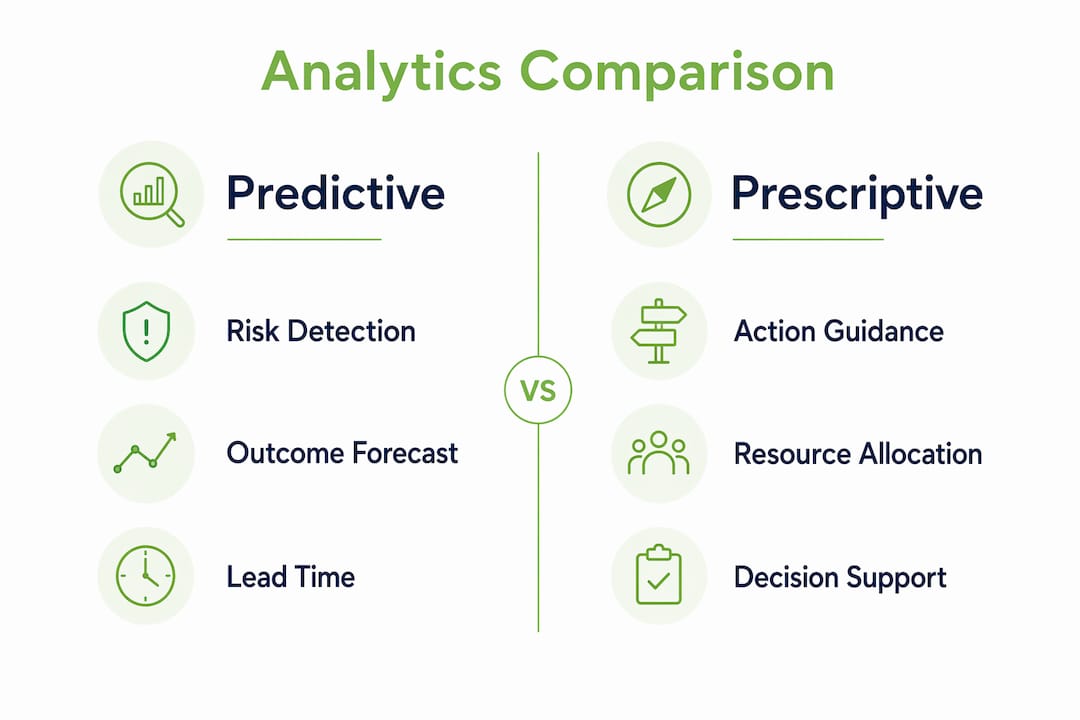
Prescriptive models take the risk scores and probability estimates from predictive outputs and run them through simulation and optimization logic. They evaluate intervention scenarios, weigh cost-benefit tradeoffs, and recommend a specific response, whether that means reallocating capital reserves, tightening a vendor contract, or routing a flagged account to a specialist team.
Benefits of combining both analytics types in enterprise risk management:
- Risk prioritization becomes automatic rather than judgment-based
- Teams simulate multiple response strategies before committing resources
- Controls are strengthened at the point of highest expected loss, not uniformly across all risks
- Decision speed increases because the system surfaces both the threat and the recommended action together
PwC governance experts note that no one-size-fits-all approach exists for enterprise risk management. The organizations that get the most from predictive and prescriptive analytics are the ones that tie both directly to strategic planning and capital allocation, not the ones that run them as isolated technical experiments.
What are the real business benefits of predictive risk analytics?
The practical gains fall into four areas: faster detection, better resource allocation, reduced losses, and stronger compliance.
| Benefit | Business Impact |
|---|---|
| Earlier risk detection | Weeks or months of lead time before losses materialize |
| Focused resource allocation | Teams concentrate effort on highest-probability exposures |
| Loss reduction | Targeted interventions cut avoidable charge-offs and fraud losses |
| Compliance effectiveness | Proactive flagging reduces regulatory penalties and audit findings |
| Strategic agility | Executives see live risk dashboards instead of quarterly reports |
The McKinsey telecom example cited earlier is a clean illustration of the resource allocation benefit. By targeting the small customer segment driving the majority of losses, the company avoided spreading collections resources thin across low-risk accounts. That kind of precision is what predictive modeling for risk makes possible at scale.

Allied Market Research’s projection of a $35.45 billion market by 2027, growing at a 21.9% CAGR from 2020 to 2027, reflects enterprise adoption accelerating across every major industry, from financial services and insurance to healthcare and manufacturing.
Implementation challenges and how to work through them
The biggest obstacle in most deployments is not the algorithm. It is data quality. Siloed departmental data across finance, IT, and operations creates inconsistencies that corrupt model outputs before a single prediction is made. Cleaning and normalizing that data takes longer than most teams expect, and skipping it produces decisions based on fragmented information.
Other common implementation challenges:
- Integration with existing systems: Connecting predictive models to core banking, ERP, or claims platforms requires careful API design and change management
- Talent gaps: Effective deployment needs both data science expertise and deep risk domain knowledge, a combination that is genuinely hard to hire for
- Regulatory compliance: In banking and insurance, model validation, documentation, and bias testing are regulatory requirements, not optional governance steps
- Cultural resistance: Risk teams accustomed to periodic reporting often push back on continuous monitoring workflows
Pro Tip: Start with one high-impact risk domain where you already have clean historical data, fraud detection or credit underwriting are common starting points. Prove measurable value there before scaling to enterprise-wide deployment. Organizations that try to boil the ocean on day one rarely get past the pilot stage.
Model governance matters as much as model accuracy. Treating predictive risk models as governed business assets means scheduling regular validation, backtesting against realized outcomes, and documenting refresh triggers. A model that was well-calibrated two years ago may be quietly drifting today. For organizations managing proactive cyber risk, continuous monitoring is especially critical because threat patterns shift faster than annual review cycles can track.
The most effective deployments run predictive analytics continuously inside operational workflows, triggering automated alerts in credit underwriting or vendor onboarding rather than generating periodic reports that sit in inboxes.
Where is predictive risk analytics headed?
The direction is clear: more real-time, more automated, and under more regulatory scrutiny. Several trends are already reshaping how large organizations deploy these capabilities.
Anticipated developments in predictive analytics for enterprise risk:
- Real-time data streaming: IoT sensors, transaction feeds, and API-connected data sources enable continuous risk scoring rather than batch processing
- Machine learning refinement: Models retrain on new data automatically, reducing calibration drift and improving accuracy over time
- Explainability requirements: Regulators and boards increasingly demand that model outputs be interpretable, not just accurate
- Cross-functional data collaboration: Breaking down silos between finance, IT, operations, and compliance data produces richer, more reliable models
- AI integration: Large language models and generative AI are beginning to support scenario analysis and risk narrative generation alongside quantitative models
- New risk domains: Climate risk, geopolitical exposure, and workforce risk are emerging areas where predictive modeling is being applied for the first time
The Allied Market Research forecast projects 21.9% annual growth for the predictive analytics market, reaching $35.45 billion by 2027, emphasizing this is not a trend that plateaus soon. Organizations that build governance and data infrastructure now will be positioned to adopt the next generation of capabilities without starting from scratch.
How Swipecredit supports enterprise risk management with AI
Swipe Credit AI helps teams turn permissioned business data into clearer opportunities and measurable economic outcomes while keeping people in control. Access and available capabilities depend on the selected plan and connected systems.
Swipe Credit AI helps teams turn permissioned business data into clearer opportunities and measurable economic outcomes while keeping people in control. Access and available capabilities depend on the selected plan and connected systems.
- Automated risk scoring across transactions, vendors, accounts, and portfolios
- Real-time executive dashboards showing live exposure levels and emerging threat signals
- AI-powered workflow automation that triggers alerts in credit underwriting, vendor onboarding, and compliance monitoring
- Model governance tools that track validation status, calibration drift, and refresh schedules
- Supplier diversity intelligence for organizations managing procurement risk alongside financial risk
Swipecredit’s platform is designed for banks, insurance carriers, healthcare organizations, government agencies, and Fortune 1000 companies, as well as SMBs and minority-owned businesses that need enterprise-grade risk intelligence without enterprise-scale IT overhead. You can explore AI-powered risk solutions or review the full range of enterprise AI services to see where predictive analytics fits your specific risk priorities.
Swipe Credit AI helps teams reveal valuable business opportunities, act with greater clarity, and measure outcomes while keeping people in control.
For organizations in AI analytics for growth, Swipecredit’s decision intelligence layer connects risk forecasting directly to revenue and operational planning, so risk insights inform strategy rather than just compliance.
Key Takeaways
Predictive analytics in enterprise risk management works best when it is embedded continuously into operational workflows, governed as a business asset, and tied directly to strategic planning rather than treated as a standalone technical project.
| Point | Details |
|---|---|
| Market growth signals urgency | The global predictive analytics market is projected to expand substantially by 2027, indicating strong enterprise adoption across industries. |
| Data quality is the real barrier | Siloed, inconsistent data across departments undermines model accuracy more than algorithm choice does. |
| Combine predictive and prescriptive | Predictive models surface risks; prescriptive systems recommend specific responses and simulate interventions. |
| Governance protects model reliability | Treat predictive risk models as governed assets with validation schedules, backtesting, and refresh triggers. |
| Start focused, then scale | Prove value in one high-impact domain like fraud or credit before expanding to enterprise-wide deployment. |
FAQ
What is predictive risk analytics?
Predictive risk analytics uses historical outcomes, live data signals, and statistical or machine learning models to estimate the probability and impact of future adverse events. It converts raw data into risk scores, expected loss estimates, and early warning alerts across domains like fraud, credit default, and cyber incidents.
How does predictive analytics improve enterprise risk management?
It shifts risk management from reactive review to continuous forward estimation, allowing teams to concentrate resources on the highest-probability, highest-impact exposures rather than spreading effort evenly across all risks.
What data do you need to get started?
You need three categories: labeled outcome data (confirmed fraud, defaults, incidents), exposure data defining what was at risk, and leading indicators that shift before events occur. Data quality matters more than volume.
What are the biggest implementation challenges?
Data quality and normalization across siloed departments is typically the hardest obstacle, followed by integration with existing systems, talent gaps combining data science and risk domain expertise, and regulatory model validation requirements in industries like banking and insurance.
How do predictive and prescriptive analytics work together?
Predictive analytics identifies which risks are most likely to materialize. Prescriptive analytics takes those outputs and recommends specific responses, simulating intervention scenarios and weighing cost-benefit tradeoffs so teams know both what is coming and what to do about it.