July 17, 2026
AI Powered Market Opportunity Analysis: 2026 Guide
Unlock growth with AI powered market opportunity analysis. Transform manual research into rapid, accurate insights for better decision-making in 2026.

AI Powered Market Opportunity Analysis: 2026 Guide
TL;DR:
- AI-powered market opportunity analysis uses machine learning to quickly analyze external market signals and internal data. It provides verified, source-backed insights that help organizations identify revenue opportunities earlier. Proper workflow and data validation are essential to maximize AI’s effectiveness and avoid unreliable conclusions.
AI powered market opportunity analysis is the practice of using machine learning algorithms and decision intelligence to synthesize large volumes of market, competitor, and customer data into verified, source-backed insights for strategic growth decisions. The industry term for this discipline is “decision intelligence,” and it sits at the intersection of competitive research, revenue forecasting, and AI governance. Ineffective manual market research costs U.S. organizations an estimated $270 billion in lost revenue annually. That number reflects how much value gets left on the table when analysts rely on slow, fragmented research methods. AI changes the speed, accuracy, and defensibility of every insight your team produces.
What is AI powered market opportunity analysis and why does it matter?
AI powered market opportunity analysis replaces weeks of manual research with structured, cited intelligence delivered in minutes. Traditional methods force analysts to pull data from SEC filings, industry reports, CRM exports, and competitor websites separately, then reconcile it all by hand. AI platforms automate that aggregation, normalize the data, and surface ranked opportunities with supporting evidence attached.

The business case is direct. Internal sales data alone lacks the real-time external signals needed to spot demand shifts before they show up in quarterly reports. By the time your BI dashboard flags a trend, your competitors may have already moved. AI powered revenue opportunity identification closes that gap by pulling signals from patent databases, web search momentum, social media sentiment, and financial filings simultaneously.
Swipe Credit AI helps teams turn permissioned business data into clearer opportunities and measurable economic outcomes while keeping people in control. Access and available capabilities depend on the selected plan and connected systems.
What tools and data sources are essential for AI market analysis?
The four core categories of AI market analysis tools each serve a distinct purpose.
- Competitive intelligence platforms track competitor feature launches, pricing changes, and hiring patterns to detect strategic moves early.
- Decision intelligence platforms (like Swipecredit) combine external signals with internal data to score and rank revenue opportunities.
- Sentiment analysis tools process social media, review sites, and forum data to surface unmet customer needs at scale.
- Revenue intelligence platforms connect CRM data with market signals to identify which accounts or segments carry the highest growth potential.
Data source quality determines how defensible your conclusions are. High-quality AI platforms prioritize SEC filings, annual reports, and patent databases over less reliable sources like unverified blog content or social media posts without context. Source ranking and normalization are not optional features. They are the foundation of trustworthy market intelligence.
| Feature category | What it does | Best data inputs |
|---|---|---|
| Competitive benchmarking | Maps competitor features against market gaps | SEC filings, product pages, patent data |
| Demand forecasting | Predicts shifts in customer interest | Geo-level search data, brand interest signals |
| Opportunity scoring | Ranks market segments by revenue potential | CRM data, web traffic, financial reports |
| Sentiment mapping | Identifies unmet needs from real user signals | Reviews, forums, social media |
| Continuous monitoring | Alerts teams to velocity changes in competitor activity | News feeds, job postings, patent filings |
Pro Tip: Always verify that your AI platform provides inline citations for every data point it returns. A summary without a source is an opinion, not intelligence.
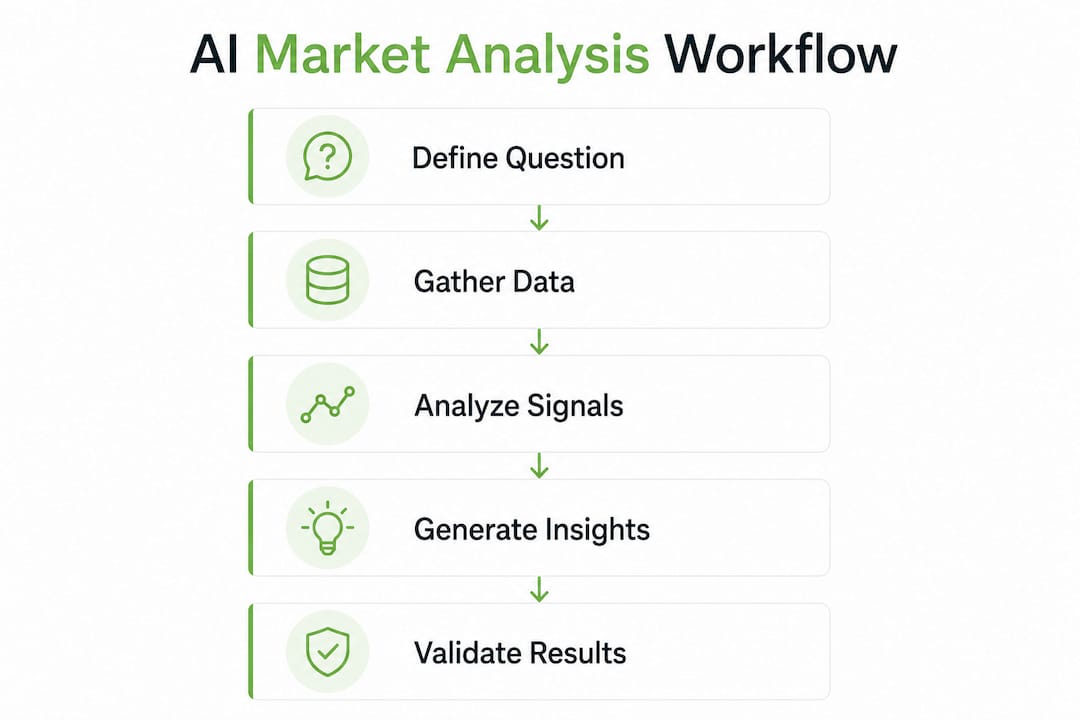
How to set up an AI market analysis workflow step by step
A repeatable workflow separates teams that get consistent results from those that get occasional lucky insights.
- Define your research question. Write a specific opportunity hypothesis before you touch any tool. “Which mid-market segments are underserved by current payment processing solutions?” produces better AI outputs than “find us growth opportunities.”
- Select and connect your data integrations. Connect your CRM, financial reporting system, and at least two external data sources (SEC filings, patent databases, or geo-level search data). External data integration is critical for understanding demand trends ahead of internal sales data.
- Query and synthesize with citations. Run your research question through your AI platform and require inline citations for every returned data point. Reject any output that does not link claims to verifiable sources.
- Build your decision matrix. Use AI-generated outputs to populate a SWOT analysis and opportunity scoring model. Assign weighted scores to each opportunity based on market size, competitive intensity, and your organization’s existing capabilities.
- Configure continuous monitoring. Set velocity alerts for competitor activity. Monitoring competitor activity over 30, 90, and 365-day windows surfaces early signals of market shifts before they become public knowledge. Alerts that trigger when activity spikes 1.5x over baseline give your team a meaningful head start.
- Review and validate with human judgment. AI outputs are inputs to decisions, not decisions themselves. Assign a senior analyst to review every opportunity score before it reaches the executive team.
| Workflow step | Key output | Time saved vs. manual |
|---|---|---|
| Define research question | Scoped hypothesis | None (human task) |
| Connect data sources | Integrated data pipeline | 3–5 hours per project |
| Query and synthesize | Cited intelligence report | Days to weeks |
| Build decision matrix | Scored opportunity list | 4–8 hours |
| Configure monitoring | Automated alert system | Ongoing, 10+ hours/month |
| Human validation | Approved recommendation | 1–2 hours |
Pro Tip: AI platforms can generate comprehensive competitor feature matrices and financial viability scores in 30–60 seconds. Use that speed to run multiple scenario queries, not just one.
Swipe Credit AI helps teams reveal valuable business opportunities, act with greater clarity, and measure outcomes while keeping people in control.
What are the common pitfalls in AI-driven market analysis?
The biggest risk in AI market analysis is not bad technology. It is bad data treated as good intelligence.
- Unverified data sources. If your AI platform pulls from low-credibility sources without ranking or normalization, every downstream insight is suspect. Prioritize platforms that cite SEC filings and audited financial data over scraped web content.
- Overdependence on LLM summaries. Large language models generate fluent, confident-sounding text. That fluency does not equal accuracy. Cited, source-backed intelligence is the standard your team should hold every AI output to, not just readable prose.
- Misreading velocity signals. A spike in competitor hiring or patent filings is a signal, not a conclusion. Analysts need to interpret what the velocity change means in context, not just react to the alert.
- Siloed BI tools. Traditional BI platforms like Tableau or Looker are powerful for internal data visualization. They are not built for external market signal integration. Using them alone leaves your team blind to demand shifts happening outside your own systems.
The critical shift in AI market analysis is moving from unverified AI summaries to source-verified, cited intelligence. Teams that can defend every data point in a board presentation win the budget and the mandate to act. Teams that cannot are left explaining why their “AI-generated” recommendation fell apart under scrutiny.
For guidance on building AI workflows that meet enterprise governance standards, the AI insights blog covers practical implementation approaches across industries.
What outcomes can analysts expect from AI-driven opportunity analysis?
The practical outputs of a well-run AI market analysis workflow fall into five categories.
- Whitespace identification. Real user signals and competitor benchmarking reveal underserved customer segments that internal teams often miss because they are looking at existing customers, not absent ones.
- Demand forecasting. Geo-level search momentum and brand interest data predict demand shifts before quarterly sales reports surface them. This gives your team 30–90 days of lead time to respond.
- Competitive response acceleration. Early detection of competitor feature launches or pricing changes lets your team prepare a response before the market notices the shift.
- Board-level defensibility. Every opportunity recommendation comes with cited, verifiable evidence. That changes the conversation from “our AI says so” to “here is the data, here is the source, here is the implication.”
- Revenue potential scoring. Opportunity sizing models rank markets by addressable revenue, competitive intensity, and your organization’s fit, giving leadership a prioritized list rather than a long menu of possibilities.
The combination of speed and source verification is what separates AI-driven opportunity analysis from traditional market research. Speed without verification produces confident mistakes. Verification without speed produces insights that arrive too late to act on.
Key Takeaways
AI powered market opportunity analysis delivers the most value when it combines verified external data sources with internal performance data and continuous velocity monitoring.
| Point | Details |
|---|---|
| Cite every data point | Require inline citations from your AI platform to defend recommendations with verifiable evidence. |
| Integrate external signals | Connect SEC filings, patent data, and search momentum to your internal CRM and BI data. |
| Monitor competitor velocity | Track activity over 30, 90, and 365-day windows to detect market shifts before they go public. |
| Validate with human oversight | Assign a senior analyst to review every AI-generated opportunity score before it reaches leadership. |
| Score and prioritize opportunities | Use weighted decision matrices to rank markets by revenue potential, not just market size. |
The uncomfortable truth about AI market analysis
I have worked with dozens of analyst teams that bought AI market research tools and saw minimal results. The problem was never the technology. It was the workflow around it.
Most teams use AI to confirm what they already believe. They write vague research questions, accept the first output the platform returns, and present it to leadership as “AI-backed intelligence.” That is not analysis. That is expensive confirmation bias.
The teams that get real results do three things differently. They write specific, falsifiable hypotheses before they query anything. They demand citations for every claim the platform returns. And they treat AI outputs as a starting point for human analysis, not an ending point.
The $270 billion annual loss from inefficient market research is not a technology problem. It is a process problem. AI gives you the speed. Your team’s discipline gives you the accuracy. You need both.
The other thing I have seen consistently: teams that integrate external signals with their internal data outperform teams that use either source alone. Geo-level search momentum tells you where demand is building. Your CRM tells you where you already have relationships. Combining those two signals is where the real opportunity sits.
Start small. Pick one market question, run it through a cited AI platform, validate the output against two independent sources, and present the result with the evidence attached. Do that ten times and your team will have built a repeatable process worth scaling.
— Kevin
How Swipecredit supports your market opportunity analysis
Swipe Credit AI helps teams turn permissioned business data into clearer opportunities and measurable economic outcomes while keeping people in control. Access and available capabilities depend on the selected plan and connected systems.
Swipe Credit AI helps teams reveal valuable business opportunities, act with greater clarity, and measure outcomes while keeping people in control.
FAQ
What is AI powered market opportunity analysis?
AI powered market opportunity analysis uses machine learning to aggregate and synthesize market, competitor, and customer data into cited, scored insights for strategic decisions. It replaces manual research workflows that can take weeks with structured outputs delivered in minutes.
How accurate are AI market analysis tools?
Accuracy depends entirely on data source quality. Platforms that prioritize SEC filings, patent databases, and verified financial data over unverified web content produce defensible intelligence. Always require inline citations for every data point your platform returns.
How does AI identify revenue opportunities?
AI identifies revenue opportunities by combining external signals like geo-level search momentum and competitor activity with internal CRM and sales data. It then scores and ranks segments by addressable revenue, competitive intensity, and organizational fit.
What is the difference between AI market analysis and traditional BI?
Traditional BI tools like Tableau or Looker visualize internal historical data. AI market analysis platforms integrate real-time external signals, including patent filings, social sentiment, and search momentum, to surface opportunities before they appear in internal reports.
How do I validate AI-generated market insights?
Require inline citations for every claim, cross-reference key findings against two independent sources, and assign a senior analyst to review outputs before they reach decision-makers. Human oversight is the final quality check that no AI platform replaces.