July 24, 2026
Predictive Cash Flow: A Finance Pro's Complete Guide
Discover what is predictive cash flow and how it empowers finance teams with real-time insights, ensuring better cash management and decision-making.

Predictive Cash Flow: A Finance Pro’s Complete Guide
What is predictive cash flow?
Predictive cash flow is the process of estimating future cash positions using machine learning, historical financial data, and real-time operational signals. Unlike a static spreadsheet forecast built once a quarter, predictive models update continuously, producing rolling short-term forecasts of roughly 10 days and mid-term views spanning 3–6 months.
The core distinction from traditional forecasting comes down to adaptability. Classic forecasts assume the future will look like the past. Predictive models learn from deviations, flag anomalies, and recalibrate without waiting for a human to notice something is off.
Key benefits for treasury and finance teams include:
- Earlier visibility into liquidity gaps before they become crises
- Reduced reliance on short-term borrowing through accuracy improvements
- Faster scenario analysis for capital allocation decisions
- Automated variance explanations that save hours of manual reconciliation
- More confident FX exposure management and trapped cash reduction
Table of Contents
- How predictive cash flow modeling actually works
- Key components that drive forecast accuracy
- Applications in corporate finance management
- Best practices for building and running predictive cash flow models
- How AI platforms take predictive cash flow further
- Key Takeaways
- FAQ
How predictive cash flow modeling actually works
The engine behind predictive cash flow modeling pulls from multiple data sources simultaneously. ERP systems supply transaction-level payables and receivables data. CRM platforms contribute pipeline and revenue timing signals. External feeds add economic indicators, market sentiment, and even news and social media via natural language processing.

On top of those inputs, the models themselves vary by use case. Neural networks process sales trends, seasonal variations, and supply chain disruptions in parallel. Random forests identify payment pattern shifts that a human analyst would likely miss buried in thousands of rows of data. The result is a forecast that adapts to new inputs automatically rather than waiting for a quarterly refresh.
Rolling updates are what separate predictive forecasting from everything that came before it. Daily, weekly, or monthly cycles keep the model current, so treasury teams are always working from the most recent picture of cash position.
- ERP and bank transaction data form the quantitative backbone
- CRM and pipeline data improve inflow timing accuracy
- NLP-processed news feeds catch geopolitical and regulatory signals early
- Neural networks and random forests handle complex, nonlinear patterns
- Rolling update cycles (daily, weekly, monthly) replace static point-in-time snapshots
Pro Tip: Prioritize model interpretability from day one. A forecast your CFO cannot explain to the board is a forecast that will not get used. Choose architectures and platforms that generate plain-language variance summaries alongside the numbers.
Key components that drive forecast accuracy
The difference between a predictive model that works and one that misleads often comes down to what happens before the algorithm runs. Data harmonization is the unglamorous prerequisite. When one business unit defines “cash position” differently than another, the model ingests noise and produces skewed output. A global data dictionary that standardizes terms like “operating cash flow” and “treasury position” across every entity is not optional.
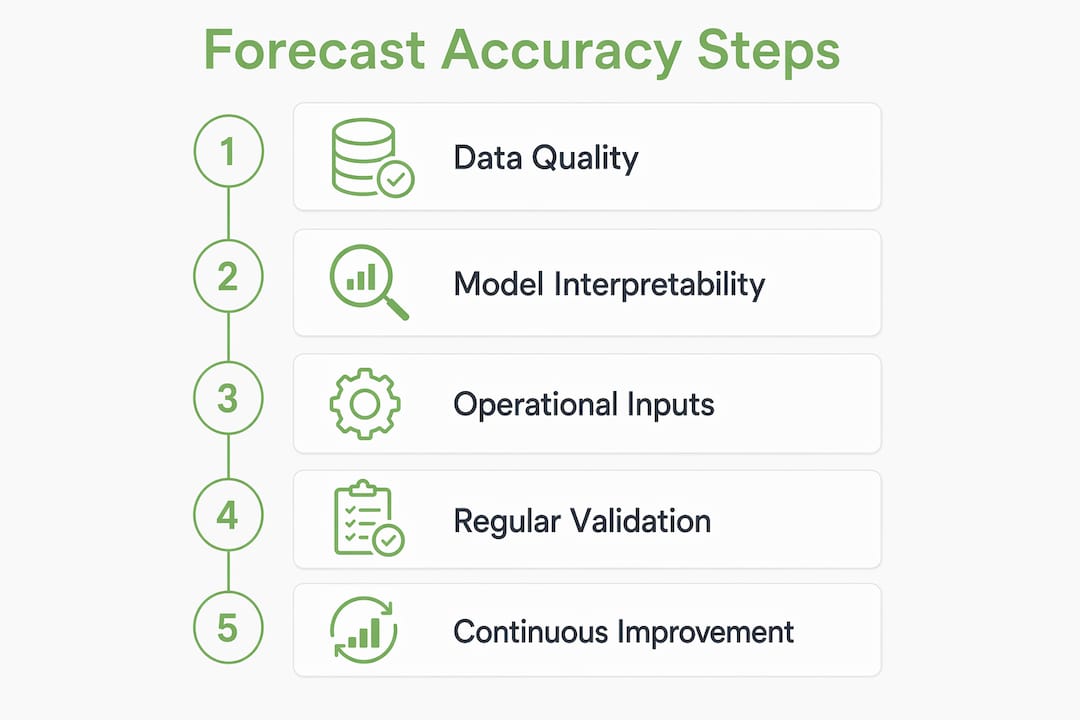
Beyond accounting data, the strongest models ingest operational signals: invoice approval workflows, supply chain status, and procurement schedules. These signals often predict cash movements days before they show up in the ledger.
One of the more counterintuitive capabilities is behavioral payment modeling. Predictive systems learn hidden payment behaviors that defy contract terms. If a major customer consistently pays 12 days late regardless of net-30 terms, the model adjusts expected inflow dates accordingly rather than trusting the contract.
- Standardized data definitions prevent corrupted model inputs across entities
- Operational signals (invoice workflows, supply chain data) extend visibility beyond the ledger
- Behavioral analytics correct for real-world payment timing versus stated terms
- Variance detection algorithms flag anomalies in the rolling forecast automatically
- AI-generated narrative summaries translate statistical variances into plain language for the C-suite
- Model blending applies rule-based drivers for routine transactions and machine learning for variable payments
Applications in corporate finance management
The most immediate application is daily liquidity management. Real-time cash visibility lets treasury teams place idle cash strategically rather than leaving it parked in low-yield accounts. The math on borrowing costs alone justifies the investment: reducing unnecessary borrowing by $50 million can save an organization over $1 million in annual interest expenses.
Foreign exchange management is another high-value use case. Cash flow forecasts expose short-term FX exposure across entities, giving treasury the lead time to hedge positions and reduce trapped cash in complex cross-border structures.
Scenario analysis gets a complete overhaul with AI. Traditional stress testing relied on a handful of manually built scenarios. Machine learning enhances Monte Carlo simulations, generating thousands of outcome scenarios based on historical data and live market conditions. Treasury teams use those simulations to build contingency plans before a crisis, not during one.
- Real-time liquidity optimization and idle cash placement
- FX exposure management and trapped cash reduction across global entities
- AI-powered stress testing with thousands of simulated scenarios
- Lower borrowing costs through improved forecast accuracy
- Funding preparation and investment planning with a reliable liquidity baseline
- Support for growth decisions: market expansion, share buybacks, capital expenditures
Stat to know: Reducing unnecessary short-term borrowing by $50 million translates to over $1 million in interest savings, according to KPMG’s 2026 analysis of predictive cash forecasting adoption.
Explore how AI in revenue forecasting connects cash flow visibility to broader financial performance for a fuller picture of what these models can do.
Best practices for building and running predictive cash flow models
Data quality is the single biggest variable in forecast reliability. The principle is blunt: garbage in, garbage out. An ongoing commitment to data quality and transparency is not a one-time implementation task. It requires continuous governance, regular audits of ERP data integrity, and clear ownership of data inputs across finance, operations, and IT.
Start small and validate before scaling. Leading organizations typically begin with targeted deployments focused on one business unit or geography, prove the value, and then expand. That approach builds internal confidence and surfaces data quality issues before they contaminate a global rollout.
The cultural shift matters as much as the technology. AI complements finance talent rather than replacing it. When models handle routine data aggregation, treasury professionals can focus on scenario interpretation, strategic recommendations, and cross-functional collaboration. That shift from data gatherer to decision advisor is where the real productivity gain lives.
One distinction worth keeping clear: budgets and predictive forecasts serve different purposes. A budget sets annual targets approved by leadership. A predictive forecast rolls forward continuously with the business. Treating them as substitutes creates confusion; using them together creates a complete financial picture.
- Invest in continuous data governance, not just initial data cleanup
- Engage cross-functional teams (operations, sales, procurement) for granular input data
- Validate model output against actuals before expanding scope
- Keep budgets and rolling forecasts as separate, complementary tools
- Build internal capability to interpret and act on AI-generated variance explanations
Pro Tip: Match your forecast horizon to your decision cycle. Short-term liquidity decisions need daily or weekly updates covering 10–90 days. Capital allocation and investment planning work better with a 3–6 month mid-term view updated monthly. Running both simultaneously gives you the full picture without overcomplicating either.
How AI platforms take predictive cash flow further
AI-powered enterprise platforms do more than run a single forecasting model. They connect ERP systems, CRM data, bank feeds, and unstructured external inputs into a unified data layer, then apply machine learning continuously across all of it. The output is not just a number. It includes automated variance explanations, scenario simulations, and decision recommendations that treasury teams can act on immediately.
For finance teams evaluating AI automation in fintech, the practical question is integration. Platforms that connect to existing business systems without requiring a full data infrastructure rebuild deliver value faster and with less organizational friction.
Swipe Credit AI helps teams turn permissioned business data into clearer opportunities and measurable economic outcomes while keeping people in control. Access and available capabilities depend on the selected plan and connected systems.
Ready to see what predictive cash flow visibility looks like in practice? Explore enterprise revenue intelligence from Swipecredit and take a free AI assessment to find out where your forecasting process has the most room to improve.
- AI platforms unify ERP, CRM, bank, and external data into a single forecasting layer
- NLP processes unstructured inputs (news, sentiment, regulatory signals) for early risk detection
- Automated variance explanations reduce manual reconciliation time
- Scenario simulations support faster, more confident capital allocation decisions
- Governance-first AI deployment ensures auditability in regulated environments
Pro Tip: When evaluating enterprise AI platforms for cash forecasting, ask specifically about variance explanation capabilities. A platform that flags an anomaly but cannot explain it in plain language adds work rather than removing it.
Key Takeaways
Predictive cash flow modeling delivers its greatest value when data quality, model interpretability, and a clear separation between budgets and rolling forecasts are all in place simultaneously.
| Point | Details |
|---|---|
| Rolling forecast horizons | Short-term (~10 days) and mid-term (3–6 months) updates replace static quarterly snapshots. |
| Data quality is foundational | Unreliable ERP and operational data produces unreliable forecasts regardless of model sophistication. |
| Borrowing cost savings | Reducing unnecessary borrowing by $50 million can save over $1 million in annual interest expenses. |
| Budgets vs. forecasts | Budgets set fixed annual targets; predictive forecasts roll forward continuously with real business data. |
| AI shifts finance roles | Machine learning handles data aggregation so treasury professionals can focus on strategic decisions. |
FAQ
What is predictive cash flow?
Predictive cash flow is the use of machine learning and real-time operational data to estimate future cash inflows and outflows on a rolling basis, replacing static spreadsheet forecasts with continuously updated liquidity projections.
How do you predict cash flow accurately?
Accurate cash flow prediction requires high-quality ERP and operational data, behavioral payment modeling that accounts for real customer payment timing, and rolling forecast updates at a frequency matched to your decision cycle.
What does predictable cash flow mean for a business?
Predictable cash flow means a business has reliable forward visibility into its liquidity position, reducing the need for emergency borrowing, enabling confident investment decisions, and giving leadership a clear baseline for capital allocation.
What are the three types of cash flow?
The three types are operating cash flow (from core business activities), investing cash flow (from asset purchases and sales), and financing cash flow (from debt, equity, and dividends). Predictive models can generate rolling forecasts across all three categories.
What is the difference between predictive and traditional cash flow forecasting?
Traditional forecasting uses historical data and manual spreadsheet models updated periodically. Predictive forecasting applies machine learning to continuously updated data from ERP systems, CRM platforms, and external signals, automatically adjusting for payment behavior patterns and market changes.