July 22, 2026
How AI Detects Financial Anomalies: A 2026 Guide
Discover how AI detects financial anomalies in real time, improving accuracy and reducing false alarms. Learn the 2026 methods today!

How AI Detects Financial Anomalies: A 2026 Guide
AI detects financial anomalies by learning what “normal” looks like across millions of transactions, then flagging anything that breaks that pattern. Unlike static rule sets that check a fixed list of conditions, AI models build dynamic baselines from your actual data and update those baselines as behavior evolves. The result is faster detection, fewer false alarms, and alerts that come with enough context for an auditor to act on them immediately.
Here is what the core mechanism involves:
- Data inputs: transaction records, account histories, timestamps, geolocation, device fingerprints, and behavioral metadata
- Model types: statistical methods, machine learning classifiers, unsupervised algorithms like Isolation Forest, and deep learning architectures including graph neural networks
- Detection mode: real-time scoring of individual transactions plus batch analysis for pattern-level irregularities
- Output: a risk score, a ranked alert, and, with Explainable AI, a plain-language reason tied to specific data features
The standard industry term for this discipline is financial anomaly detection, and it sits at the intersection of fraud prevention, audit automation, and regulatory compliance.
What types of financial anomalies does AI actually target?
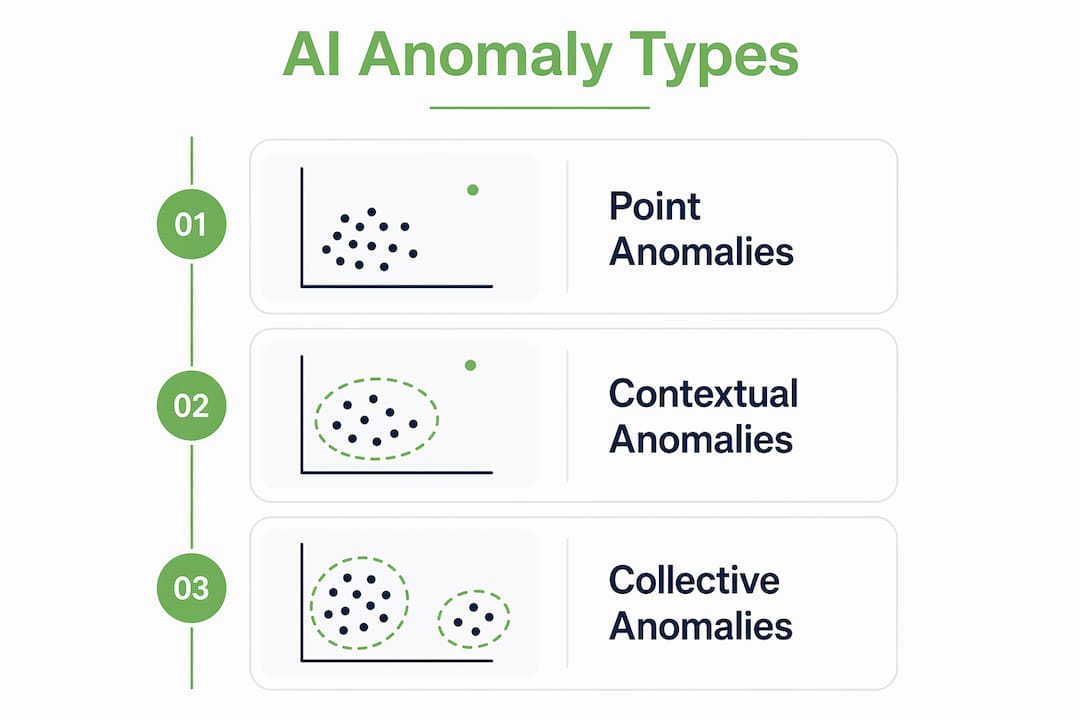
Not every irregularity looks the same, and AI systems are built to catch three distinct categories.

Point anomalies are single transactions that stand out on their own. A $47,000 wire from an account that normally moves $500 at a time is a textbook example. These are the easiest to spot and the most common trigger for real-time alerts.
Contextual anomalies are transactions that look fine in isolation but are suspicious given their context. A $200 ATM withdrawal is unremarkable until you notice it happened at 3 AM in a city the cardholder has never visited. AI catches these by comparing each transaction against the user’s own behavioral history, not just population averages.
- Point anomaly example: a vendor invoice 10 times larger than any prior payment to that supplier
- Contextual anomaly example: a routine payroll transfer processed on a Sunday by an employee who never works weekends
- Collective anomaly example: a cluster of small, just-below-threshold transfers across 30 accounts that individually pass every rule but collectively signal a structuring scheme
Collective anomalies are the hardest to catch with traditional tools. Fraud rings, coordinated account takeovers, and multi-entity schemes that hop across multiple accounts require AI to look at relationships between transactions, not just the transactions themselves. Graph-based models were built specifically for this problem.
Which AI techniques power anomaly detection in finance?
The field draws on three generations of methods, and most production systems combine all three.

1. Statistical baselines
Z-score analysis and interquartile range tests were the first automated tools finance teams used. They measure how far a data point sits from the mean and flag outliers beyond a set threshold. Simple, fast, and still useful for catching obvious point anomalies in clean, structured data. The limitation is that they assume a stable distribution, which fraud rarely respects.
2. Machine learning methods
Supervised models train on labeled fraud examples and learn to classify new transactions as fraudulent or legitimate. They perform well when you have enough confirmed fraud cases to train on, but labeled data is expensive to produce and fraud patterns shift constantly.
Unsupervised methods solve the labeling problem. Isolation Forest works by randomly partitioning data and measuring how quickly a point gets isolated. Anomalies, being few and distinct, isolate faster than normal observations. No fraud labels required. Semi-supervised approaches split the difference, training on normal behavior only and flagging anything that deviates from it.
AI models with continuous learning update their definition of normal as new data arrives, which is the core advantage over static rule sets that fraud actors learn to game.
3. Deep learning and graph neural networks
Recurrent neural networks and transformer architectures model sequences of transactions, catching fraud patterns that unfold over time rather than in a single event. Convolutional neural networks applied to tabular financial data have achieved 96.5% detection accuracy with a 12% false positive rate in recent corporate transaction studies.
Graph neural networks (GNNs) take a different approach entirely. They model accounts and transactions as nodes and edges in a network, then learn which connection patterns signal fraud. GNN-based frameworks detect multi-hop fraud rings and coordinated schemes that are invisible to any model analyzing transactions one at a time.
4. Explainable AI (XAI) for audit transparency
Detection accuracy alone does not satisfy an auditor or a regulator. SHAP (SHapley Additive exPlanations) values attribute each anomaly score to specific input features, so an alert does not just say “suspicious” — it says “flagged because transaction amount is 8x the account average and the merchant category is new.” A published XAI framework combining Isolation Forest with SHAP achieved 0.91 precision and 0.88 recall on banking transaction data, with auditors reporting measurably higher confidence in the alerts they received.
Pro Tip: Before deploying any anomaly detection model, run a feature importance audit using SHAP. It often reveals that the model is leaning on a proxy variable (like account age) rather than a genuine fraud signal, which creates compliance exposure you want to catch before regulators do.
How does AI anomaly detection improve financial workflows?
The operational gains show up in three places: speed, accuracy, and auditor time.
Real-time scoring means a suspicious transaction can be flagged, queued for review, or blocked within milliseconds of submission. Dynamic graph learning frameworks process streaming transaction data with sub-30 ms response times, which is fast enough to intercept fraud before settlement. That speed matters most in payment processing and wire transfers, where the window to recover funds closes quickly.
On the accuracy side, 83% of organizations using AI tools for payment fraud report reduced false positives and lower customer churn. Fewer false positives means your investigators spend time on real fraud, not on calling customers to verify legitimate purchases. AI also cuts the operational overhead of chasing bad alerts, freeing compliance teams for higher-value work.
Key use cases where AI anomaly detection delivers measurable results:
- Payment fraud detection: real-time transaction scoring across card, ACH, and wire channels
- Compliance monitoring: automated flagging of transactions that may require SAR filing under FinCEN guidelines
- Audit assistance: AI-generated risk scores and SHAP explanations that auditors can attach directly to workpapers
- Vendor and expense fraud: detecting duplicate invoices, fictitious vendors, and unusual approval patterns in accounts payable
- Insider threat detection: identifying behavioral shifts in employee transaction access that precede data exfiltration or embezzlement
Swipe Credit AI helps teams reveal valuable business opportunities, act with greater clarity, and measure outcomes while keeping people in control.

What challenges should you plan for when implementing AI anomaly detection?
The technology works. The implementation is where most projects stall.
Data quality is the first obstacle. AI models learn from historical transaction data, and if that data contains duplicate records, inconsistent merchant codes, or missing timestamps, the model learns the wrong patterns. A preprocessing pipeline that standardizes formats, removes duplicates, and handles missing values is not optional — it is the foundation everything else depends on.
Model adaptability versus drift is an ongoing tension. A model trained on last year’s fraud patterns may miss this year’s tactics. Fraud actors actively probe detection systems and adjust when they find a threshold. Continuous retraining schedules and drift monitoring dashboards address this, but they require dedicated ML operations support that many finance teams do not have in-house.
Explainability is a compliance requirement, not a nice feature. Regulators at the OCC and FinCEN increasingly expect financial institutions to document why an AI system flagged or cleared a transaction. A black-box model that produces accurate scores but cannot explain them creates audit risk. XAI frameworks that surface feature-level explanations let risk managers validate AI outputs and satisfy examiner requests without reverse-engineering the model.
Additional challenges to plan for:
- Scalability: high-volume payment processors need models that maintain accuracy at millions of transactions per hour without latency spikes
- Integration: connecting AI scoring to existing core banking systems, case management platforms, and alert queues requires API work and data mapping
- Regulatory alignment: AI models used in credit or fraud decisions may trigger fair lending review under ECOA; document your model governance process before deployment
- Human oversight: AI raises the cost of fraud and reduces false positives, but it does not replace the investigator who closes the case
A solid cybersecurity strategy for financial services addresses both the technical and governance dimensions of AI deployment, which is worth reviewing before you finalize your implementation roadmap.
Pro Tip: Set a human-review threshold, not just an alert threshold. Route high-confidence, low-severity alerts to automated disposition and reserve human investigators for ambiguous mid-range scores. That single workflow change typically cuts review time without increasing missed fraud.
What does recent research say about AI fraud detection effectiveness?
The data from 2025 and 2026 studies makes a strong case for AI over rule-based systems, with some important nuances.
Organizations lost an average of $60 million to payment fraud in the past year, and 83% report that AI tools reduced false positives and customer churn. — Mastercard, 2026
The graph neural network research is particularly striking. A real-time dynamic graph learning framework evaluated on industrial credit fraud data achieved a 43% reduction in false positives and a 26% improvement in detection rates while maintaining sub-30 ms response times. Those numbers come from a production deployment, not a lab benchmark.
On the explainability front, an XAI framework combining Isolation Forest with SHAP values produced 0.91 precision and 0.88 recall on banking transaction data. Expert feedback from auditors confirmed that feature-level explanations measurably improved both confidence and decision quality, which addresses one of the longest-standing objections to AI in audit workflows.
The research also reinforces why static rules keep losing ground. AI with continuous learning adapts as new fraud tactics emerge, while rule-based systems require manual updates that always lag behind the threat. AI does not need to catch every fraud case to add value. Raising the cost and complexity of fraud attempts, while cutting the false positive burden on your team, delivers a return even when detection is not perfect.
Key Takeaways
AI detects financial anomalies by building dynamic behavioral baselines from transaction data and flagging deviations using statistical, machine learning, and deep learning models, with Explainable AI making those detections audit-ready.
| Point | Details |
|---|---|
| Three anomaly types | Point, contextual, and collective anomalies each require different detection approaches. |
| XAI improves audit trust | SHAP-based explanations achieved 0.91 precision and 0.88 recall, with auditors reporting higher decision confidence. |
| False positive reduction | 83% of organizations using AI for payment fraud report reduced false positives and lower customer churn. |
| GNNs catch fraud rings | Graph neural networks detect multi-hop, multi-entity schemes invisible to transaction-level models. |
| Data quality is foundational | Preprocessing and feature engineering determine model accuracy more than algorithm choice in most deployments. |
FAQ
What is financial anomaly detection in AI?
Financial anomaly detection is the use of AI models to identify transactions or patterns that deviate from established behavioral norms, covering point, contextual, and collective irregularities across payment and account data.
How does Isolation Forest detect financial anomalies?
Isolation Forest randomly partitions transaction data and scores each point by how quickly it gets isolated. Anomalies isolate faster because they are few and distinct, making the algorithm effective without requiring labeled fraud examples.
Why do AI models outperform rule-based fraud detection?
AI models continuously update their definition of normal behavior as new data arrives, while rule-based systems require manual updates that lag behind evolving fraud tactics. Research shows AI also reduces false positives significantly compared to static rule sets.
What is Explainable AI and why does it matter for auditors?
Explainable AI, often implemented with SHAP values, attributes each anomaly score to specific transaction features, giving auditors a plain-language reason for every alert. This transparency satisfies regulatory documentation requirements and improves investigator confidence.
How fast can AI anomaly detection systems respond?
Real-time graph learning frameworks process streaming transaction data with sub-30 ms response times, fast enough to flag or block suspicious transactions before settlement in payment processing environments.