July 30, 2026
AI-Driven Business Decisions Explained for Leaders
Discover how AI-driven business decisions explained can transform your organization. Learn to act faster, manage risks, and drive growth effectively.

AI-Driven Business Decisions Explained for Leaders
TL;DR:
- Swipe Credit AI — clearer business opportunities, governed support, and measurable outcomes with human control.
AI-driven business decisions are rules-based, data-powered choices augmented by predictive models and optimization that let organizations act faster, at scale, and with measurable impact on the bottom line. This is not an IT project. It is a business capability that changes how your company spots opportunities, manages risk, and allocates resources every single day.
Research backs the urgency. PwC’s research finds that 74% of AI’s economic value is captured by roughly 20% of organizations. The Marketing AI Institute’s 2026 State of AI for Business shows only 13% of organizations have all four core governance foundations in place. And BCG estimates that a substantial portion of AI’s value comes not from algorithms but from operating-model and workflow changes. The gap between companies that win with AI and those that don’t is mostly about execution, not technology.
Here is what you need to know right now:
- AI-driven decisions replace slow, gut-based choices with fast, data-backed ones at every level of your business.
- The biggest returns go to companies that use AI to pursue growth, not just cut costs.
- Most organizations have the tools but lack the governance and workflow changes to unlock real value.
- You can start this quarter with one use case, a clear P&L owner, and a 12-week pilot.
- Governance, not algorithms, is what separates leaders from laggards.
Pro Tip: Pick one decision your team makes repeatedly every week, such as which leads to call or which invoices to prioritize, and run a 12-week AI pilot on that single decision. Measurable wins on small decisions build the organizational trust you need to scale.
Table of Contents
- What “AI-driven decision-making” actually means for your business
- The real business benefits of powering decisions with AI
- Concrete use cases by function — where AI decisions pay off fastest
- How to actually deploy AI for decision-making in your organization
- Why most AI projects fail — and how to fix it
- How to measure the ROI of AI-driven decisions
- A six-step starter plan you can run this quarter
- Key Takeaways
- The trade-off every leader needs to get right
- How Swipecredit helps you move from pilot to measurable revenue
- Useful sources and further reading
- FAQ
What “AI-driven decision-making” actually means for your business
The phrase sounds technical, but the concept is straightforward. AI-driven decision-making means using software that learns from your data to recommend, automate, or improve specific business choices. There are four types worth knowing, and each maps to a different kind of decision.

Descriptive AI answers “What happened?” It pulls together sales data, customer behavior, and operational metrics to show you a clear picture of the past. A retail SMB using a dashboard to see which products sold last quarter is using descriptive AI.
Predictive AI answers “What will happen?” It uses machine learning to forecast outcomes, like which customers are likely to churn, which invoices will be paid late, or how much inventory you will need next month. This is where machine learning influencing choices starts to show up directly on your P&L.
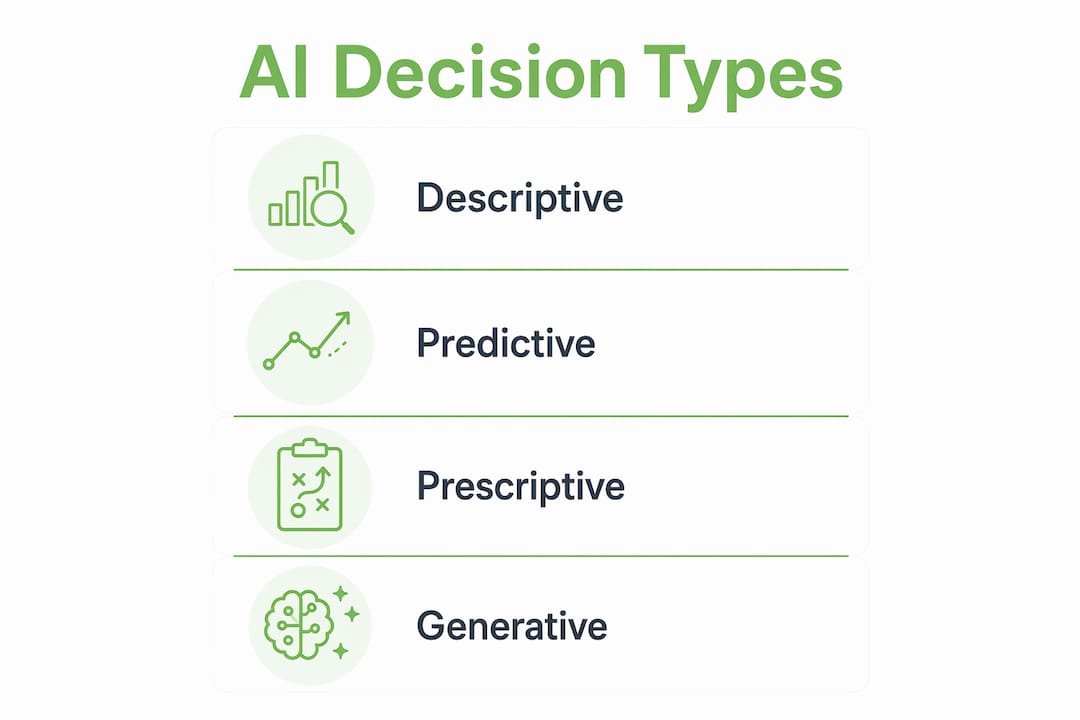
Prescriptive AI answers “What should we do?” It goes beyond prediction to recommend a specific action, such as which price to set, which supplier to use, or which customer segment to target with a promotion. This is the category most directly tied to revenue decisions.
Generative AI answers “What can we create or draft?” It produces text, summaries, reports, and proposals. For a founder, that might mean auto-generated sales emails, contract summaries, or market research briefs.
These four types work together in what practitioners call a decision stack: your data generates signals, a policy layer turns those signals into recommendations, an optimization layer weighs constraints like budget or capacity, a human-in-the-loop step keeps a person accountable for the final call, and an observability layer tracks whether the decision produced the expected outcome. Lumitech describes this architecture as the practical pattern for turning predictions into real business actions. Think of it as a pipeline from raw data to a decision your team actually executes.
The real business benefits of powering decisions with AI
Every benefit below ties directly to a metric your business already tracks.
- Speed: AI can evaluate thousands of data points in seconds. A credit decision that once took days can happen in minutes, which means faster customer onboarding and less revenue left on the table.
- Scale: One AI model can support decisions across your entire customer base simultaneously. A human team cannot review 10,000 invoices for fraud risk; a trained model can.
- Better prediction: Demand forecasting models reduce overstock and stockouts. For a product-based SMB, that directly improves cash flow and reduces carrying costs.
- Risk reduction: AI flags anomalies in financial transactions, supplier performance, or customer behavior before they become expensive problems.
- New revenue streams: Prescriptive models identify cross-sell and upsell opportunities your sales team would never find manually. This is where AI-powered revenue growth moves from theory to a real line item.
- Improved customer experience: Personalization engines match offers to individual customers based on behavior, not broad segments, which lifts conversion rates.
- Operational efficiency: Routing, scheduling, and replenishment decisions made by AI reduce waste and labor costs.
There is an important distinction here. Short-term efficiency wins, like cutting processing time or reducing manual errors, are real and worth capturing. But PwC’s research is clear that AI leaders are significantly more likely to use AI to pursue growth opportunities and reinvent business models, not just trim costs. If your AI roadmap is entirely about efficiency, you are leaving the bigger prize on the table.
Concrete use cases by function — where AI decisions pay off fastest
Marketing
Decision being automated: Which customers receive which offer, and when. Data inputs: Purchase history, browsing behavior, email engagement, demographic data. Realistic outcome: A targeted offer campaign driven by a propensity model typically lifts conversion rates compared to broad-blast campaigns. For a small e-commerce business, that can mean meaningful additional revenue from the same email list. Implementation note: Start with your existing CRM data. You do not need a data warehouse on day one.
Sales
Decision being automated: Which leads to prioritize today. Data inputs: CRM activity, deal stage, firmographic data, past win/loss patterns. Realistic outcome: Sales teams using AI lead scoring spend more time on deals that close, which shortens sales cycles and improves quota attainment. Implementation note: Most CRM platforms now include a basic scoring module. Turn it on, measure it for 60 days, and compare close rates.
Finance
Decision being automated: Cash flow forecasting and credit risk assessment. Data inputs: Accounts receivable aging, payment history, bank transaction data, revenue trends. Realistic outcome: Better cash flow visibility reduces the need for emergency credit draws and helps owners plan hiring or capital purchases with confidence. Implementation note: AI-improved business reporting tools can connect directly to your accounting software and generate rolling 13-week cash forecasts automatically.

Operations
Decision being automated: Inventory replenishment and delivery routing. Data inputs: Sales velocity, supplier lead times, current stock levels, geographic demand data. Realistic outcome: Dynamic replenishment models reduce both overstock and stockouts, cutting carrying costs while maintaining service levels. Implementation note: Pilot with your top 20% of SKUs by revenue first.
HR
Decision being automated: Talent matching and candidate screening. Data inputs: Job descriptions, resume data, past hiring outcomes, performance reviews. Realistic outcome: Faster time-to-hire and better candidate fit, which reduces early turnover costs. Implementation note: Use AI to surface the top candidates, but keep a human in the final hiring decision.
Product
Decision being automated: Feature prioritization based on usage data and customer feedback. Data inputs: Product analytics, support tickets, NPS scores, revenue attribution by feature. Realistic outcome: Product teams that use data to prioritize features ship work that drives retention, not just activity. Implementation note: Even a simple tagging system in your support tool can generate enough signal to start.
How to actually deploy AI for decision-making in your organization
Most AI projects stall not because the technology fails but because the organization is not set up to use it. Deloitte’s State of AI 2026 identifies activation, embedding tools into operating models and workflows, as the primary barrier to unlocking AI value. Here is a practical sequence to avoid that trap.
- Prioritize one use case with a clear P&L owner. Do not start with a committee-designed AI strategy. Pick the single decision that, if made faster and more accurately, would move a specific revenue or cost line. Assign one person who owns that P&L line.
- Define the value path before you build anything. What is the baseline metric today? What does a 10% improvement look like in dollars? BCG recommends setting this target before launch and having finance validate it.
- Audit your data. Check that the data feeding the decision is clean, current, and accessible. Common gaps: inconsistent field names across systems, missing historical records, and data locked in spreadsheets.
- Run a 12-week pilot with measurement baked in. Set a baseline in week one, run the AI-assisted process alongside the old process, and compare outcomes at week 12. Keep a human in the loop for any decision with significant financial or legal consequence.
- Scale with governance. Once the pilot shows measurable lift, document the decision logic, set up an audit trail, and establish review cycles. This is where an AI council or steering group earns its keep.
- Assign top talent, not spare capacity. BCG’s analysis is direct: roughly 70% of AI value comes from operating-model change, not algorithms. Your best operators need to own AI workstreams, not your least-busy ones.
Data and infrastructure checklist before you start:
- Data quality: Are your key fields complete and consistent across systems?
- Integration: Can your AI tool read from your CRM, ERP, or accounting software via API?
- Access controls: Who can see model outputs, and who can override a recommendation?
- Telemetry: Are you logging decisions and outcomes so the model can improve?
Realistic cost and timeline: A focused 12-week pilot for an SMB typically involves tool licensing, a part-time data analyst or consultant, and change management time from a business owner. Scaling to a second use case in months 4–6 adds integration costs. Plan for a multi-year investment if you want enterprise-grade governance and multiple decision domains.
Why most AI projects fail — and how to fix it
The research is consistent: most organizations have access to AI tools but are not capturing meaningful value from them. Here is what the data shows and what to do about it.
| Barrier | Research Finding | Practical Fix |
|---|---|---|
| Governance gaps | Only 13% of organizations have all four governance foundations | Build an AI roadmap, appoint an AI council, and write a generative AI policy this quarter |
| Activation gap | Deloitte identifies embedding into workflows as the primary barrier | Redesign the workflow around the AI output, not alongside it |
| Individual vs. org readiness | 53% of individuals are in Integration or Transformation phases, but only 25% of organizations have reached Scaling | Close the gap with structured training and clear role accountability |
| Efficiency-only focus | Companies focused only on cost-cutting miss the larger growth returns | Set at least one growth-oriented KPI alongside every efficiency target |
Swipe Credit AI helps teams reveal valuable business opportunities, act with greater clarity, and measure outcomes while keeping people in control.
Agentic AI, where software agents take sequences of actions autonomously, is the fastest-growing area of interest. About 40% of professionals follow agents closely and 51% want training on how to use them. Governance for agents is more complex than for single-point predictions, because an agent can take multiple actions before a human reviews the output. Build human checkpoints into any agentic workflow before you deploy it in a customer-facing or financial context.
Pro Tip: Employees trust AI outputs roughly twice as often when formal governance structures are in place versus ad-hoc setups, per PwC’s research. Publishing a simple one-page AI use policy and naming an AI point person costs nothing and meaningfully increases adoption.
How to measure the ROI of AI-driven decisions
Measurement is where most SMBs get vague, and vagueness is how AI budgets get cut. Tie every AI initiative to a specific financial metric from day one.
Core KPIs to track:
- Revenue lift: Compare conversion rates, average deal size, or customer lifetime value before and after AI-assisted decisions.
- Cost per decision: How much does it cost to make a credit, routing, or pricing decision manually versus with AI? The gap is your efficiency gain.
- Time to decision: How many hours or days does a key decision take today? Reducing this directly improves customer experience and throughput.
- Days sales outstanding (DSO): AI-powered invoice prioritization and collections nudges can reduce DSO by flagging at-risk accounts early.
- Forecast accuracy: Compare your demand or cash flow forecast error before and after AI. A 20% improvement in forecast accuracy has a direct impact on inventory costs and cash reserves.
A simple measurement method:
- Define the baseline metric in week one (e.g., current close rate is 18%).
- Run the AI-assisted process for 6–12 weeks alongside a control group or historical benchmark.
- Measure the lift (e.g., AI-assisted close rate is 22%).
- Attribute the delta to a P&L line (e.g., 4 percentage points on 500 leads per quarter at an average deal size of $8,000 equals $160,000 in additional annual revenue).
- Validate with finance before reporting to leadership.
PwC’s data shows that AI leaders capture disproportionate returns when they measure for growth, not just efficiency. If your only KPI is “hours saved,” you are measuring the wrong thing.
One practical habit: tag every AI-assisted decision in your system with a unique identifier. This creates a digital audit trail that lets you run attribution analysis later, prove compliance, and explain model outputs to stakeholders or regulators. AI decision support for executive teams depends on this kind of auditability to build trust at the leadership level.
A six-step starter plan you can run this quarter
You do not need a large team or a big budget to start. You need a clear use case, a willing owner, and 12 weeks of focused effort.
- Week 1–2: Pick one high-value use case. Choose a decision your business makes repeatedly that has a direct revenue or cost impact. Lead prioritization, cash flow forecasting, and inventory replenishment are reliable starting points for most SMBs. Owner: CEO or founder.
- Week 2–3: Define the value path. Write down the baseline metric, the target improvement, and what that improvement is worth in dollars. Have your bookkeeper or CFO sign off on the math. Owner: P&L owner plus finance.
- Week 3–4: Secure a pilot budget. Most 12-week pilots for SMBs cost between tool licensing and a few hours of consultant time per week. No-code tools like built-in CRM scoring, accounting software forecasting modules, or spreadsheet-based models are legitimate starting points. Owner: CEO.
- Week 4–5: Set success metrics and a human-in-the-loop rule. Decide in advance what “success” looks like at week 12 and which decisions require a human to review the AI recommendation before acting. Owner: P&L owner.
- Week 5–12: Run the pilot and log everything. Track decisions made, outcomes achieved, and any cases where the AI recommendation was overridden and why. Owner: Operations or sales lead.
- Week 12: Prepare your scale plan. If the pilot shows measurable lift, document the decision logic, draft a one-page governance policy, and present a business case for expanding to a second use case. Owner: CEO plus AI point person.
Low-cost options to test before deeper investment include CRM-native lead scoring, accounting software cash flow forecasting, and free tiers of business intelligence tools. These are real AI capabilities, not toys, and they are available to any SMB today.
Key Takeaways
AI-driven business decisions deliver measurable P&L impact when organizations combine the right data, a clear P&L owner, and workflow redesign — not just tool adoption.
| Point | Details |
|---|---|
| Governance is the differentiator | Only 13% of organizations have all four governance foundations; building yours this quarter puts you ahead of most competitors. |
| Growth beats efficiency | AI leaders are 2–3x more likely to use AI for growth, not just cost-cutting, per PwC’s 2026 research. |
| Operating-model change drives value | BCG finds roughly 70% of AI value comes from workflow and operating-model changes, not algorithms. |
| Start with one measurable pilot | A 12-week pilot on a single high-value decision is the fastest path from idea to P&L impact. |
| Swipecredit accelerates the path | Swipecredit’s decision-intelligence platform connects data, governance, and measurement so SMBs can move from pilot to scale without building infrastructure from scratch. |
The trade-off every leader needs to get right
There is a version of AI adoption that looks impressive on a slide deck and produces almost nothing on the income statement. I see it often: a company deploys several tools, runs a few demos, and calls it an AI strategy. The activation gap is real. The tools exist. The workflows have not changed. The P&L owner has not been named.
The research from BCG, PwC, and Deloitte all point to the same conclusion: the leaders who win are not the ones with the most sophisticated models. They are the ones who redesign how decisions get made, assign accountability, and measure outcomes with the same rigor they apply to any other capital investment.
Where should you be bold? Growth-oriented pilots. Pricing optimization, lead scoring, cash flow forecasting, customer retention models. These are areas where a 10–15% improvement in a key metric translates directly to revenue. Run them fast, measure them honestly, and scale what works.
Where should you be conservative? Any autonomous decision with significant financial, legal, or reputational consequences. Credit decisions, compliance filings, hiring and termination, customer communications that carry legal weight. Keep a human in the loop. Not because AI is unreliable, but because accountability cannot be delegated to a model. Your customers, employees, and regulators expect a person to own the outcome.
The companies that get this balance right, moving fast on growth pilots while building durable governance, are the ones capturing the majority of AI’s economic value. About 74% of AI’s economic value is captured by 20% of organizations, according to PwC.
How Swipecredit helps you move from pilot to measurable revenue
Swipe Credit AI helps teams turn permissioned business data into clearer opportunities and measurable economic outcomes while keeping people in control. Access and available capabilities depend on the selected plan and connected systems.
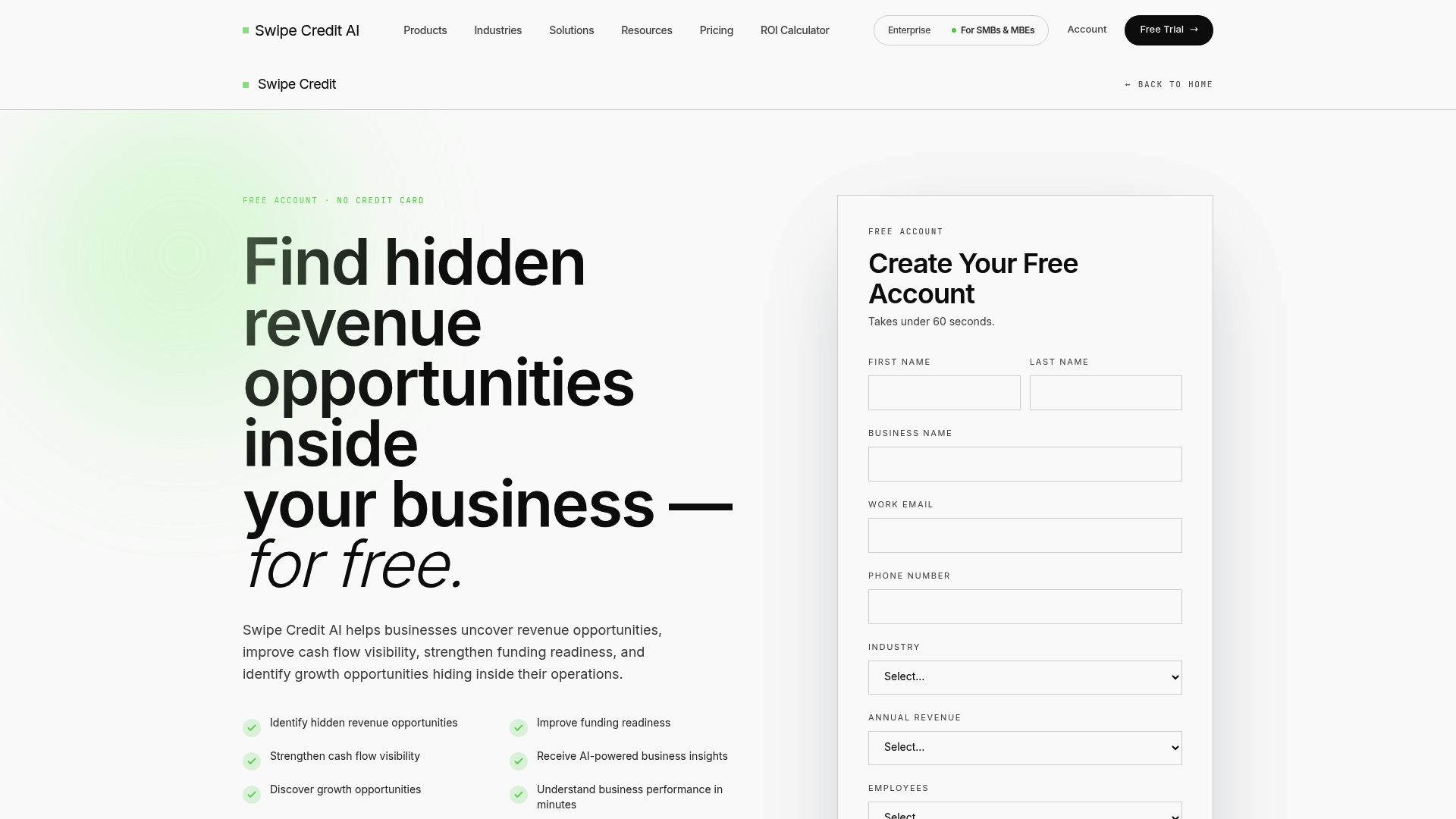
Swipe Credit AI helps teams reveal valuable business opportunities, act with greater clarity, and measure outcomes while keeping people in control.
Here is what that means in practice for an SMB or MBE:
- Faster pilots: Pre-built connectors and decision templates cut setup time from months to weeks.
- Built-in governance: Every AI recommendation is logged, explainable, and reviewable, which builds the organizational trust that drives adoption.
- P&L-linked measurement: Dashboards tie AI activity directly to revenue lift, cost reduction, and cash flow improvement.
- Revenue operations automation: Repetitive decisions in sales, finance, and operations run automatically, freeing your team for higher-value work.
If you are ready to run your first 12-week pilot or want to see how a decision-intelligence platform maps to your specific business, explore Swipecredit’s services or check the pricing page to find the right starting point.
Useful sources and further reading
These are the primary research reports and guides cited throughout this article. Each one is worth reading in full if you are building an AI roadmap for your organization.
- 2026 State of AI for Business — Marketing AI Institute: The most detailed survey of AI adoption, governance gaps, and the activation challenge across U.S. organizations.
- PwC 2026 AI Performance Study: Quantifies the gap between AI leaders and laggards and explains why growth-focused AI strategies outperform efficiency-only ones.
- How CEOs Can Scale AI Value Across the Enterprise — BCG: The clearest framework for P&L accountability, operating-model change, and the role of top talent in AI programs.
- State of AI 2026 — Deloitte: Identifies activation and workflow embedding as the primary barriers to AI value, with practical guidance on change management.
- Artificial Intelligence and Business Strategy — MIT Sloan Management Review: Long-running research initiative on how AI affects strategy, workforce, and organizational culture, with a strong focus on human-AI collaboration.
- AI Decision-Making Architecture — Lumitech: A practical explainer of the decision stack (inference → policy → optimization → human-in-the-loop → observability) that translates technical architecture into business terms.
FAQ
What exactly is an AI-driven business decision?
An AI-driven business decision is a choice made or supported by a predictive model, optimization algorithm, or AI agent using your company’s data, rather than relying solely on human judgment. The goal is faster, more consistent, and more accurate decisions at scale.
How much does it cost to start using AI for business decisions?
Many SMBs can start with tools already built into their CRM or accounting software at no additional cost. A focused 12-week pilot typically requires tool licensing and part-time analyst support. Deeper integration and governance infrastructure represent a multi-year investment.
Why do so many AI projects fail to deliver results?
The primary barrier is activation, not technology. Deloitte’s research identifies embedding AI into actual workflows and operating models as the main challenge. Tools that sit alongside existing processes instead of replacing them rarely produce measurable P&L impact.
How do I measure the ROI of AI in my business?
Define a baseline metric before the pilot starts, run the AI-assisted process for 6–12 weeks, measure the lift, and convert it to a dollar value on a specific P&L line. Revenue lift, cost per decision, and days sales outstanding are the most reliable starting KPIs for SMBs.
Can Swipecredit help a small business get started with AI decisions?
Swipe Credit AI helps teams turn permissioned business data into clearer opportunities and measurable economic outcomes while keeping people in control. Access and available capabilities depend on the selected plan and connected systems.