August 6, 2026
HIPAA AI Compliance: A Practical Guide for Healthcare Teams
Discover essential strategies for HIPAA AI compliance. Ensure your healthcare AI systems protect patient data by following key regulations.

HIPAA AI Compliance: A Practical Guide for Healthcare Teams
Yes, you can use AI with protected health information (PHI) — but only when the workflow, vendor relationship, and safeguards make the system operate as a fully HIPAA-covered deployment. That is not a technicality. It is the legal baseline every healthcare organization must meet before a single patient record touches an AI model.
Three requirements are non-negotiable from day one:
- HHS/OCR oversight expectation: The Office for Civil Rights expects organizations to inventory AI tools that interact with electronic PHI (ePHI), include those tools in a formal risk analysis, and monitor them continuously.
- A signed Business Associate Agreement (BAA): Any AI vendor that creates, receives, maintains, or transmits PHI on your behalf is a business associate and must sign a BAA before processing begins.
- A documented risk analysis that covers AI: A risk analysis that ignores your AI stack is incomplete and indefensible in an OCR audit.
Skipping any of these exposes your organization to serious consequences:
- OCR civil monetary penalties up to several million dollars per violation category per year
- State attorney general enforcement actions (at least 38 states now have AI-related legislation that can layer on top of HIPAA)
- Mandatory corrective action plans and reputational damage from public breach reports
Pro Tip: No AI vendor’s marketing label makes your organization compliant. There is no product-level HIPAA certification — compliance is an operational state your organization achieves through contracts, controls, and documentation.
Table of Contents
- How HIPAA rules apply to AI workflows
- How to build your AI risk analysis and 30/60/90 rollout plan
- How to apply the minimum necessary rule when using AI
- What your BAA and vendor contracts must cover for AI
- Technical and operational safeguards for AI systems handling ePHI
- Pre-deployment checklist for AI projects that will touch PHI
- How to respond to AI-related incidents and HIPAA breach notifications
- Common mistakes and vendor red flags that lead to HIPAA violations
- Key Takeaways
- The compliance gap most teams miss
- Swipecredit makes governed AI deployment faster for healthcare teams
- Useful sources
- FAQ
How HIPAA rules apply to AI workflows
HIPAA’s Privacy, Security, and Breach Notification Rules apply the moment an AI system “creates, receives, maintains, transmits, uses, or discloses” PHI. That language is broad by design. It covers a clinical decision-support model reading lab results, a chatbot that logs patient messages, an analytics platform trained on claims data, and a scheduling tool that pulls appointment history.
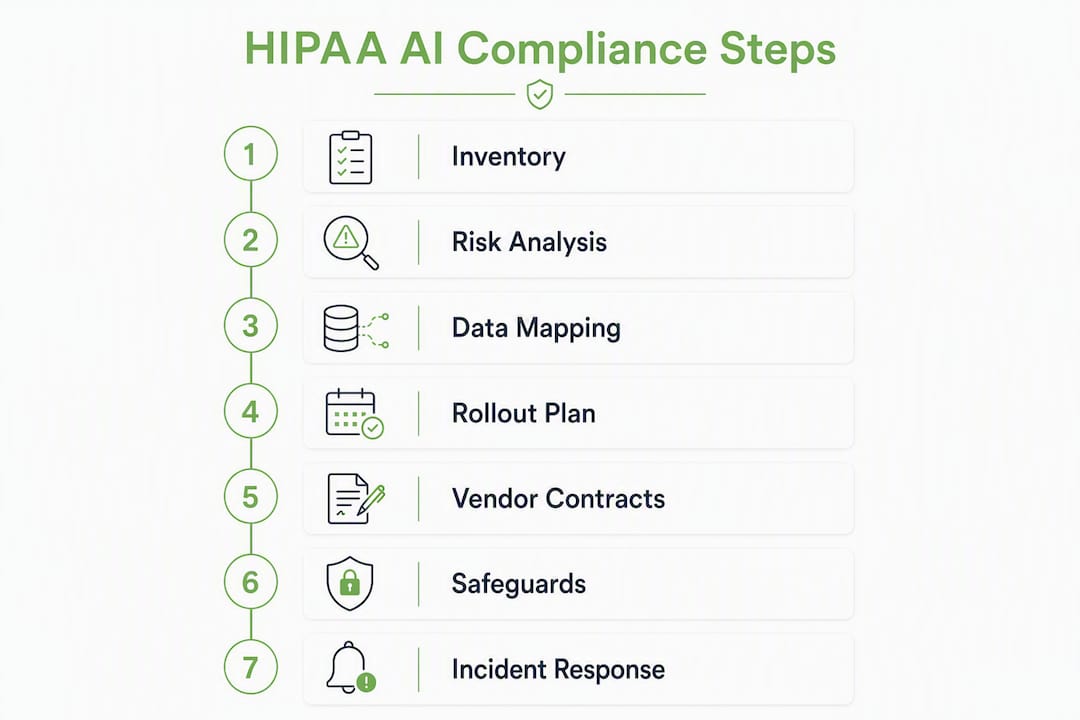
Covered entities vs. business associates in AI deployments
A covered entity (hospital, clinic, health plan, clearinghouse) is directly responsible for HIPAA compliance. When that entity hands PHI to an AI vendor for processing, the vendor becomes a business associate and takes on direct liability under HIPAA. HHS is explicit: business associates are directly liable if they fail to protect ePHI, misuse PHI outside the BAA, or fail to report breaches.
What HHS/OCR expects from AI specifically
HHS guidance requires organizations to maintain a comprehensive, up-to-date inventory of technology assets that identifies AI software interacting with ePHI and documents how those systems access, process, and output PHI. The 2025 HHS Security Rule guidance makes clear that AI tools are not exempt from standard risk analysis and management obligations. A Lexology analysis of the proposed NPRM confirms that entities must identify AI technologies, assess risks including data access and model outputs, and update procurement processes to evaluate AI vendors against Security Rule expectations.
Two definitions that matter for every AI project:
- Minimum necessary: You may only use, disclose, or request the minimum PHI needed to accomplish the intended purpose. For AI, that means limiting which fields, records, and sessions the model can access.
- De-identified data: PHI stripped of the 18 identifiers specified under Safe Harbor, or certified as de-identified by an expert under Expert Determination, is no longer PHI and falls outside HIPAA’s scope — but only when the de-identification is properly documented and tested.
State law adds another layer. Norton Rose Fulbright notes that Texas’s TRAIGA law, for example, requires disclosure of AI use in clinical care — an obligation that sits on top of HIPAA, not instead of it.
How to build your AI risk analysis and 30/60/90 rollout plan
A risk analysis that skips your AI tools is a compliance gap waiting to become an OCR finding. HHS guidance requires a current inventory of all technology assets that interact with ePHI, and AI systems belong in that inventory alongside EHRs and billing platforms.
Step 1: Build your AI asset inventory
Start with a structured inventory. Every AI tool your organization uses — or that a vendor operates on your behalf — needs a row in this table:
| System Name | Owner | Environment | PHI Elements Accessed | BAA Status | Risk Level |
|---|---|---|---|---|---|
| Clinical NLP model | IT / Compliance | Production | Diagnosis codes, notes | Signed | High |
| Scheduling chatbot | Operations | Production | Name, DOB, appt history | Pending | High |
| Claims analytics | Finance | Cloud (vendor) | Claims, member ID | Signed | Medium |
| Dev/test sandbox | Engineering | Isolated | Synthetic only | N/A | Low |
Flag any tool with PHI access and no BAA immediately. That is your first remediation priority.
Step 2: Map data flows for each AI system
For every AI tool that touches PHI, document the full data lifecycle:
- Input: What PHI enters the model, from which source system, and in what format?
- Storage: Where is PHI stored during processing — on-premises, cloud region, vendor infrastructure?
- Training: Is PHI used to train or fine-tune the model? Who controls that process?
- Evaluation: How are model outputs tested, and does test data include real PHI?
- Output: What does the model return, and does output contain PHI?
- Retention: How long are prompts, inputs, and outputs retained, and by whom?
- Downstream recipients: Who receives model outputs — clinicians, billing staff, third parties?
Log and monitor every hop. Gaps in this map are where PHI leaks happen.
Step 3: Follow a 30/60/90 rollout plan

An AI risk management strategy built around a phased rollout keeps compliance work from piling up at go-live.
Days 0–30 (Discovery and contracts):
- Complete the AI asset inventory
- Identify all vendors touching PHI and initiate BAA negotiations
- Implement short-term controls (block PHI from unapproved tools by policy and firewall rule)
- Assign a governance owner for each AI system
Days 31–60 (Technical hardening):
- Enforce AES-256 encryption at rest and TLS 1.2+ in transit
- Implement role-based access control and MFA for privileged users
- Separate development, test, and production environments
- Enable prompt and output logging with tamper-evident storage
Days 61–90 (Monitoring, training, go/no-go):
- Configure anomaly alerts (high-volume exports, unusual access patterns)
- Complete workforce training on approved AI use and prompt hygiene
- Conduct a tabletop exercise simulating an AI-related PHI incident
- Privacy officer signs off on risk acceptance or remediation plan before go-live
Pro Tip: Assign a single governance owner per AI system before day one. Shared ownership means no one owns it when something goes wrong.

How to apply the minimum necessary rule when using AI
The minimum necessary standard is one of the hardest constraints for AI teams. Models generally perform better with more data, but HHS guidance requires you to document exactly which PHI fields are necessary for each specific use case — and limit access to those fields only.
In practice, that means asking a hard question before every AI project: What is the smallest set of PHI that still lets this model do its job? A readmission-risk model may need diagnosis codes and discharge dates but not the patient’s name or address. A billing assistant may need claim IDs but not clinical notes. Document the answer and build the data pipeline around it.
De-identification: Expert Determination vs. Safe Harbor
- Safe Harbor removes all 18 specified identifiers (name, dates, geographic data below state level, phone numbers, etc.) and requires no residual PHI that could identify an individual. It is straightforward to implement and audit.
- Expert Determination uses statistical analysis to certify that re-identification risk is very small. It allows more data utility but requires a qualified expert and formal documentation of the method and residual risk.
For AI training and testing, HHS OCR de-identification guidance requires you to document the method used, the residual risk assessment, retention rules for de-identified data, and a prohibition on re-identification attempts.
Synthetic data is not automatically safe. Synthetic datasets generated from PHI can retain statistical patterns that allow re-identification, especially with small patient populations. Test synthetic data for leakage before using it in model training, and document the testing methodology.
Operational controls that reduce PHI exposure in AI workflows:
- Tokenization and pseudonymization: Replace direct identifiers with tokens before data enters the model; maintain the mapping table under strict access controls.
- Retrieval filtering: Limit what records a retrieval-augmented generation (RAG) system can surface based on the user’s role and the minimum necessary scope.
- Access windows: Grant model access to PHI only during active processing sessions; revoke after completion.
- Retention limits: Set and enforce automatic deletion schedules for prompts, inputs, outputs, and intermediate model states that contain PHI.
Pro Tip: When evaluating a new AI use case, write a one-page “minimum necessary justification” before building the data pipeline. It takes 30 minutes and gives you a defensible record if OCR ever asks why the model had access to specific PHI fields.
What your BAA and vendor contracts must cover for AI
A generic BAA written for a cloud storage vendor will not cover the specific risks of an AI system. Before any AI vendor touches PHI, your contract needs to address the following:
BAA essentials for AI vendors:
- Explicit scope of permitted PHI uses (processing, storage, output generation — nothing else)
- A written prohibition on using customer PHI to train, fine-tune, or improve general models, or clear conditions under which training is permitted with documented consent
- A complete list of approved subprocessors and a requirement to notify you before adding new ones
- Data retention and deletion timelines, including prompts, model states, and outputs
- Specific security measures: AES-256 at rest, TLS 1.2+ in transit, MFA, access logging
- Breach notification within 60 days of discovery (or faster, per your internal policy)
Additional contract clauses to request:
- Audit rights: the right to review vendor security practices annually or after an incident
- SOC 2 Type II attestation or equivalent third-party security report, provided on request
- Encryption standards confirmed in writing (AES-256, TLS 1.2+)
- Model output controls: restrictions on what the model can generate or disclose
- Indemnity and liability allocation for PHI breaches caused by vendor failures
- Right to suspend services immediately if a breach is suspected
Verifying “HIPAA-compliant” vendor claims
Medcurity’s guidance is direct: consumer AI products are not HIPAA-compliant in default configurations, and vendor marketing claims require verification. Due diligence steps before signing:
- Request the vendor’s most recent SOC 2 Type II report and review it
- Ask for an architecture diagram showing where PHI is stored and processed
- Get a written statement confirming PHI is not used for general model training
- Ask for the full subprocessors list and verify each one has appropriate security controls
Procurement negotiation checklist:
- BAA reviewed and signed by legal counsel
- Subprocessors list received and approved
- SOC 2 Type II report reviewed (no critical findings)
- Training data use confirmed in writing
- Retention and deletion timelines confirmed
- Audit rights clause included
- Breach notification timeline confirmed
Technical and operational safeguards for AI systems handling ePHI
The HIPAA Security Rule does not name AI specifically, but every control it requires applies to AI systems that process ePHI. TechTarget’s analysis highlights that AI training data can retain PHI and that federated learning, environment separation, and prompt logging are among the most effective risk-reduction controls.
Technical must-haves:
- AES-256 encryption for all ePHI at rest, including model inputs, outputs, and stored prompts
- TLS 1.2 or higher for all data in transit between systems and vendors
- Role-based access control (RBAC) limiting model access to users with a documented need
- Multi-factor authentication for all privileged users and administrators
- Granular model-access controls: separate permissions for querying, training, and administering AI systems
Operational controls:
- Hard separation between development, test, and production environments — no real PHI in dev or test without explicit approval and controls
- Automatic retention policies for prompts and outputs, with deletion schedules enforced by the system
- Tamper-evident logging of all prompts, inputs, and outputs that contain or could contain PHI
- Regular vulnerability scanning and patch management for AI infrastructure, including model dependencies
ML-specific controls:
- Restrict training data to approved, documented datasets; require a data use approval before adding new PHI sources
- Run model retraining in isolated evaluation environments, not production
- Treat every model update as a configuration change requiring a new or updated risk assessment and sign-off from the privacy officer
- Maintain explainability logs for clinical decision-support models so outputs can be reviewed and challenged
Monitoring and alerting:
- Alert on abnormal access patterns: a user querying 10x their normal volume, off-hours access, or access from unexpected locations
- Flag high-volume data exports from AI systems
- Monitor for prompt exfiltration attempts (users trying to extract training data through crafted queries)
- Schedule quarterly audits of AI system access logs and output retention compliance
Pre-deployment checklist for AI projects that will touch PHI
Run through this checklist before any AI system goes live with real patient data. A single unchecked item is a reason to delay go-live.
Discovery and approvals:
- AI asset inventory completed and reviewed by the privacy officer
- BAA signed with every vendor that will touch PHI
- Formal risk analysis completed and signed by the privacy officer and CISO
- Minimum necessary justification documented for each PHI field the model accesses
- De-identification method documented (if applicable) with residual risk assessment
Technical controls:
- AES-256 encryption confirmed at rest; TLS 1.2+ confirmed in transit
- RBAC and MFA configured and tested
- Environment separation verified (no PHI in dev/test without controls)
- Prompt and output logging enabled and tamper-evident storage confirmed
- Vulnerability scan completed with no critical findings unresolved
Operational readiness:
- Incident response playbook updated to include AI-specific scenarios
- Rollback plan documented and tested
- Monitoring alerts configured and tested
- Audit schedule set (quarterly minimum)
Workforce readiness:
- All staff who will use the AI system have completed HIPAA AI training
- Approved usage scenarios documented and distributed
- Policy prohibiting PHI input into unapproved AI tools published and acknowledged
Pro Tip: Run a 90-minute tabletop exercise before go-live. Simulate a scenario where the AI model outputs PHI to an unauthorized user. Walk through who detects it, who contains it, who notifies OCR, and who communicates with affected patients. You will find gaps in the notification chain every time.
How to respond to AI-related incidents and HIPAA breach notifications
AI incidents follow the same HIPAA breach-notification framework as any other PHI exposure — but the technical details are different enough to warrant AI-specific playbook steps.
Immediate containment (first 24 hours):
- Stop the model from ingesting new PHI immediately
- Revoke vendor API access and suspend the affected service
- Preserve all logs, prompts, outputs, and system states as evidence
- Activate the incident response playbook and notify the privacy officer
Breach risk assessment:
Under the HIPAA Breach Notification Rule, a breach is presumed unless you can demonstrate through a four-factor risk assessment that there is a low probability PHI was compromised. The four factors are: the nature and extent of PHI involved, who accessed or could have accessed it, whether PHI was actually acquired or viewed, and the extent to which the risk has been mitigated. Document every finding in writing.
Notification timelines:
- Affected individuals: written notice within 60 days of discovering the breach
- HHS OCR: report within 60 days for breaches affecting 500 or more individuals; breaches affecting fewer than 500 are logged and reported annually
- Media: required for breaches affecting 500 or more residents of a state or jurisdiction
- State regulators: check state-specific requirements, which may be shorter than the federal 60-day window
AI-specific incident types and response roles:
- Prompt misrouting: A user’s PHI-containing prompt is routed to another user’s session. Assign a technical lead to isolate the session logs and determine scope.
- Training data ingestion: PHI enters a model’s training pipeline without authorization. Assign a data engineer to identify the affected dataset and a privacy officer to assess re-identification risk.
- Output leaks: The model generates output containing PHI visible to unauthorized users. Assign a security engineer to review output logs and a compliance officer to run the breach risk assessment.
Define in your playbook who has authority to suspend a model, who runs the forensic analysis, and who signs the OCR notification.
Common mistakes and vendor red flags that lead to HIPAA violations
Most AI-related HIPAA problems are predictable. They come from a short list of organizational mistakes and vendor behaviors that are easy to spot before they become incidents.
Organization-level mistakes:
- Using consumer AI tools (free-tier chatbots, general-purpose assistants) for PHI without a BAA or security review
- No AI asset inventory, so compliance teams do not know which tools touch PHI
- No written policy on what staff may and may not input into AI systems
- Assuming a vendor’s “HIPAA-compliant” marketing claim means the organization is compliant
- Skipping AI in the formal risk analysis because it feels like a new category
Vendor red flags:
- Refusal to sign a BAA, or offering only a modified BAA that limits liability to the point of uselessness
- Vague or evasive answers about whether customer PHI is used to train models
- No SOC 2 Type II report, or a report with unresolved critical findings
- No subprocessors list, or refusal to provide one
- Fixed data retention with no deletion capability or no contractual deletion timeline
The most dangerous assumption in healthcare AI is that a polished product with a “HIPAA-compliant” badge has done the compliance work for you. It has not. No product carries a HIPAA certification — your organization is responsible for the operational configuration, the contracts, and the controls.
Key Takeaways
HIPAA AI compliance requires a signed BAA, a documented risk analysis that includes AI tools, and technical safeguards in place before any AI system processes PHI.
| Point | Details |
|---|---|
| BAA is the first requirement | Every AI vendor touching PHI must sign a BAA before processing begins; no exceptions. |
| Risk analysis must include AI | HHS expects a current inventory of AI assets and data-flow documentation as part of formal risk analysis. |
| No product-level HIPAA certification exists | Vendor marketing claims require verification through SOC 2 reports, architecture reviews, and written training-data statements. |
| Minimum necessary limits PHI exposure | Document which PHI fields each AI use case requires and build data pipelines around that scope. |
| Swipecredit supports governance-first AI | Swipecredit’s platform helps healthcare organizations inventory AI assets, log prompts and outputs, and maintain documented governance artifacts for OCR reviews. |
The compliance gap most teams miss
Healthcare organizations spend a lot of energy getting the BAA signed and the encryption configured. Those steps matter. But the compliance gap that actually causes problems tends to be quieter: no one has written down what the AI system is allowed to do, who approved it, and what happens when it does something unexpected.
A model update, a new subprocessor added by the vendor, a change in the data pipeline — any of these can shift the risk profile of an AI deployment without triggering a formal review. Treating model updates as configuration changes that require a new risk assessment is not bureaucratic overhead. It is the difference between a documented, defensible deployment and one that falls apart under OCR scrutiny.
Swipe Credit AI helps teams reveal valuable business opportunities, act with greater clarity, and measure outcomes while keeping people in control.
One more thing worth saying plainly: FDA authorization or a CE mark on a clinical AI product does not replace HIPAA analysis. Those are separate regulatory tracks. A device cleared by FDA still needs a BAA, a risk analysis, and the full set of Security Rule controls if it processes ePHI.
The practical 7-day action: run your AI inventory, flag every tool that touches PHI, check BAA status for each one, and schedule a tabletop exercise. That single week of work will surface more compliance gaps than most organizations expect.
Swipecredit makes governed AI deployment faster for healthcare teams
Healthcare organizations that need to deploy AI compliantly often face the same bottleneck: the governance work (inventories, access controls, audit logs, documentation) takes longer than the technical build. Swipecredit’s enterprise AI platform is built governance-first, which means those artifacts are built into the deployment process rather than bolted on afterward.
Swipe Credit AI helps teams reveal valuable business opportunities, act with greater clarity, and measure outcomes while keeping people in control.
Useful sources
The following primary and authoritative sources back the guidance in this article. Keep vendor audit reports on file alongside these references.
- HHS — Business Associates Guidance: The regulatory baseline for BAA requirements and business associate liability under HIPAA.
- HHS — Security Rule Guidance (including AI): HHS expectations for risk analysis, asset inventories, and AI-specific security controls.
- HHS — De-Identification Guidance: Expert Determination and Safe Harbor methods, documentation requirements, and re-identification prohibitions.
- HHS — Breach Notification Rule: Notification timelines, the four-factor breach risk assessment, and OCR reporting thresholds.
- HHS — Sample BAA Provisions: HHS-provided sample contract language for business associate agreements.
- Lexology — AI Meets HIPAA Security: NPRM Analysis: Legal analysis of the proposed NPRM and its implications for AI asset inventories and vendor procurement.
- Norton Rose Fulbright — Navigating AI Compliance with HIPAA Essentials: State AI law landscape, including the Texas TRAIGA disclosure requirement.
- Medcurity — HIPAA Compliance for AI in Healthcare: Practical guidance on BAA verification, consumer AI risks, and technical safeguard requirements.
- TechTarget — AI and HIPAA Compliance: How to Navigate Major Risks: ML-specific risks including training data leakage, federated learning, and environment separation.
- AI Compliance Atlas — HIPAA Compliance for AI in Healthcare: Explanation of why no product-level HIPAA certification exists and what a defensible deployment requires.
- NIST AI Risk Management Framework: The federal framework for managing AI risk, applicable alongside HIPAA’s Security Rule requirements.
FAQ
Does every AI vendor need a BAA under HIPAA?
Yes. Any AI vendor that creates, receives, maintains, or transmits PHI on your behalf is a business associate and must sign a BAA before processing begins. A vendor that refuses is a hard stop for PHI workflows.
Is there a HIPAA certification for AI products?
No. There is no product-level HIPAA certification. Compliance is an operational state your organization achieves through contracts, technical controls, and documentation — not a label a vendor can earn independently.
What is the breach notification deadline for an AI-related PHI incident?
Under the HIPAA Breach Notification Rule, covered entities must notify affected individuals and HHS OCR within 60 days of discovering a breach. Breaches affecting 500 or more individuals in a state also require media notification. Some states impose shorter timelines.
Can you use de-identified data to train AI models without HIPAA restrictions?
Yes, if the data is properly de-identified using Safe Harbor or Expert Determination and the process is documented. Synthetic data is not automatically de-identified — test it for re-identification leakage and document the results before using it in training.
How does Swipecredit support HIPAA AI compliance?
Swipe Credit AI helps teams turn permissioned business data into clearer opportunities and measurable economic outcomes while keeping people in control. Access and available capabilities depend on the selected plan and connected systems.