July 27, 2026
AI for Small Business: A Practical Revenue Guide
Unlock your business's potential with AI. Discover how to streamline operations and boost revenue with actionable strategies today.

AI for Small Business: A Practical Revenue Guide
TL;DR:
- Artificial intelligence can increase revenue, reduce repetitive tasks, and improve cash flow when used with organized data.
- Starting with a data-readiness audit and a focused pilot of one workflow enables SMBs to achieve measurable results quickly.
Artificial intelligence can find hidden revenue, cut repetitive work, and improve cash flow for your business — but only when you deploy it against clean, organized data. The single best first step: run a short data-readiness audit this week, then scope a pilot of several weeks around one high-volume, data-heavy workflow. Stanford HAI defines AI as systems that find patterns in large amounts of data to generate predictions or responses. That’s the engine. Your business data is the fuel.
What to expect from a well-scoped pilot:
- Reduced time on manual data entry and reporting
- Earlier visibility into cash-flow gaps
- Faster customer response times through automation
- A measurable revenue or cost baseline to compare against
Your immediate next step: Contact Swipecredit or run a self-audit of your top three data sources (CRM, accounting software, customer records) before scoping any vendor conversation.
Pro Tip: Start with the workflow that costs your team the most hours per week. That’s usually where AI pays back fastest.
Table of Contents
- What does AI actually do for your business?
- Which AI types should your business actually use?
- High-impact AI use cases for SMBs: what to measure
- How Swipecredit delivers these outcomes for SMBs
- How to evaluate and choose an AI solution
- What does an AI implementation actually look like?
- How to protect privacy, avoid bias, and stay compliant
- Ethical considerations for SMBs adopting AI
- AI applications across industries: a broader view
- Challenges SMBs face when implementing AI
- Key Takeaways
- What actually moves the needle in AI adoption
- Swipecredit accelerates your path from pilot to revenue
- Useful sources and further reading
- FAQ
What does AI actually do for your business?
AI works by identifying patterns in large datasets, and using those patterns to make predictions, classify information, or generate new content. For a business owner, that translates to: your sales history predicts next month’s demand, your customer emails get sorted and answered automatically, and your cash-flow gaps surface before they become crises.
Two flavors matter most right now. Generative AI creates new content — text, images, code, audio — from a prompt. You describe what you want; it produces a draft. Traditional machine learning does something different: it learns from your labeled historical data to predict or classify. Think sales forecasting, fraud detection, or customer churn scoring. Google’s machine learning documentation draws this distinction clearly: generative models produce new outputs, while ML models predict or classify using training data.
Data quality is the deciding factor. A model trained on incomplete or inconsistent records will produce unreliable outputs regardless of how sophisticated the underlying technology is. Before you buy any tool, audit your data first.
Which AI types should your business actually use?
Machine learning systems fall into three main families, each suited to a different business problem. Here’s the short version:
- Supervised learning: Learns from labeled examples. Best for sales forecasting, credit scoring, and demand planning. Needs historical transaction data with known outcomes.
- Unsupervised learning: Finds hidden clusters or patterns without labels. Useful for customer segmentation and supplier analysis. Works on raw transaction or behavioral data.
- Reinforcement learning: Optimizes decisions through trial and reward. Powers dynamic pricing and inventory replenishment. Requires a defined goal and feedback loop.
- Natural language processing (NLP): Understands and generates human language. Drives customer support chatbots, contract review, and sentiment analysis. Needs call transcripts, emails, or documents.
- Generative AI: Produces original content from prompts. Handles marketing copy, product descriptions, and image editing. Works with minimal labeled data but benefits from brand guidelines.
- Deep learning: A subset of machine learning using layered neural networks. Underpins image recognition, voice assistants, and fraud detection at scale.
Pro Tip: NLP-powered customer support automation is often the fastest win for SMBs — your existing email and chat history is already the training data.
Frontier multimodal models now handle image, audio, and text together, which means the use-case menu for SMBs keeps expanding. You don’t need to build any of this from scratch; most capabilities are available as APIs or hosted services today.
High-impact AI use cases for SMBs: what to measure
Revenue operations, cash-flow optimization, and customer service automation are the three highest-value starting points for most small and mid-sized businesses. Each has clear inputs, predictable outputs, and KPIs you can track from week one.

| Use Case | Key Inputs | Expected Outcome | Primary KPI |
|---|---|---|---|
| Revenue ops / pipeline scoring | CRM data, deal history | Prioritized leads, faster close | Revenue lift, win rate |
| Cash-flow optimization | Invoices, AR/AP records | Earlier gap detection | Days cash on hand |
| Customer service automation | Email, chat transcripts | Faster response, lower volume | Resolution time, CSAT |
| Underwriting / pricing | Application data, risk history | Consistent, faster decisions | Error rate, decision speed |
| Supplier diversity intelligence | Vendor records, spend data | Certified supplier identification | Diverse spend percentage |
| Marketing content generation | Brand guidelines, past campaigns | Draft copy at scale | Time saved, conversion rate |
KPIs to track in your pilot:
- Baseline vs. post-pilot revenue from targeted accounts
- Hours saved per week on the automated workflow
- Error rate before and after (data entry, invoicing, reporting)
- Cash-flow forecast accuracy at 30 and 60 days
“AI is best viewed as a collaborative tool that augments human capability — use it to speed up repetitive tasks and reduce errors, and keep humans in the loop for verification.” — NASA
A regional distributor that automates AR follow-up emails, for example, typically recovers outstanding invoices several days faster than manual outreach — a direct cash-flow improvement with no new headcount.
How Swipecredit delivers these outcomes for SMBs
Swipe Credit AI helps teams turn permissioned business data into clearer opportunities and measurable economic outcomes while keeping people in control. Access and available capabilities depend on the selected plan and connected systems.
What integration looks like in practice:
- Connects to your existing ERP, CRM, and accounting systems (QuickBooks, Salesforce, NetSuite, and others)
- Ingests operational data without requiring a data warehouse rebuild
- Deploys AI agents against specific workflows — AR automation, pipeline scoring, supplier diversity reporting
- Surfaces outputs in dashboards your team already uses
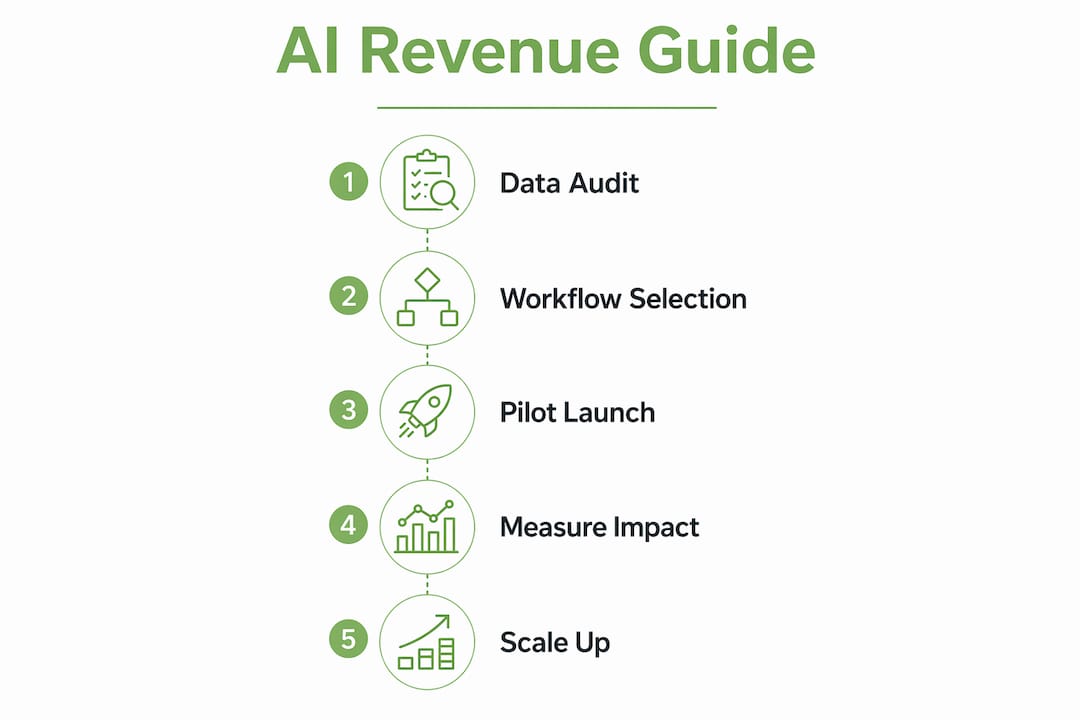
A typical pilot scope: Six to eight weeks, one workflow, one measurable KPI. Week one covers data connection and baseline measurement. Weeks two through five run the automated workflow alongside your existing process. Week six compares results and defines the scale plan.
“Swipe Credit AI automates repetitive business processes, analyzes enterprise data, and identifies revenue opportunities — with governance and security controls built in from day one.” — Swipecredit
Ready to scope your pilot? Start with enterprise revenue intelligence or explore SMB-focused solutions to find the right entry point.
Pro Tip: Ask any vendor to show you the audit trail for a sample output before you sign anything. If they can’t, governance is an afterthought.
How to evaluate and choose an AI solution
Start with these six criteria before you talk to a single vendor:
- Data readiness: Do you have at least 12 months of clean, structured data in the relevant workflow?
- Integration: Does the platform connect to your existing systems without a full IT project?
- Governance and security: Are there audit trails, access controls, and data encryption built in?
- Ease of use: Can non-technical staff operate it through a no-code or prompt-based interface?
- Pricing model: Is it usage-based, subscription, or outcome-based? Watch for long-term lock-in.
- References: Can the vendor provide a customer in your industry with a similar use case?
Questions to ask during a demo:
- How does your platform handle data that’s incomplete or inconsistent?
- What does the human-review step look like for high-stakes outputs?
- How long does a typical integration take, and what do we need to provide?
- What’s the escalation path when the model produces an unexpected result?
- How do you handle model drift over time?
- What compliance certifications do you hold (SOC 2, HIPAA, etc.)?
- What does your pilot-to-scale methodology look like?
- Can you show us a live audit trail?
Four red flags that should end the conversation:
- No clear data privacy or security documentation
- Promises of results with no defined measurement methodology
- No human-in-loop option for critical outputs
- Pricing that requires a multi-year commitment before a pilot
“Non-technical users can access advanced AI through natural language prompts and no-code interfaces — you don’t have to be a programmer to get value.” — Google ML Crash Course
Speed, customization, and cost pull in different directions. A hosted, no-code solution gets you live in weeks but limits customization. A custom-built model takes months and costs more but fits your exact workflow. For most SMBs, a governed, configurable platform hits the right balance.
What does an AI implementation actually look like?
The four-phase approach works for almost every SMB pilot: assess, pilot, iterate, scale.
- Assess (weeks 1–2): Audit your top data sources, identify the highest-volume repetitive workflow, and set a baseline KPI. Budget: primarily internal time.
- Pilot (weeks 3–8): Deploy one AI agent or model against that workflow. Run it alongside your existing process. Measure daily.
- Iterate (weeks 9–12): Review results, adjust model inputs or prompts, and confirm the KPI improvement is repeatable.
- Scale (month 4+): Expand to additional workflows or departments based on pilot ROI.
| Phase | Duration | Typical SMB Cost | Key Milestone |
|---|---|---|---|
| Assess | 1–2 weeks | Internal time only | Baseline KPI documented |
| Pilot | 6–8 weeks | — | KPI improvement confirmed |
| Iterate | 3–4 weeks | Included in pilot contract | Repeatable result validated |
| Scale | Ongoing | Varies by scope | Second workflow live |
Staffing the pilot:
- One internal owner (operations or finance lead, 3–5 hours/week)
- Vendor implementation support for data connection
- A designated reviewer for AI outputs during the pilot period
Change management is the part most owners underestimate. AI assists your team best when staff understand what it does and what it doesn’t. A 30-minute walkthrough before go-live prevents most adoption friction.
How to protect privacy, avoid bias, and stay compliant
Governance and human-in-loop controls are the non-negotiable foundation for any production AI deployment. Without them, you’re exposed to privacy violations, biased decisions, and outputs you can’t explain to a customer or regulator.
Practical U.S. compliance notes:
- Minimize data collection to what the model actually needs
- Encrypt data in transit and at rest
- Restrict access by role, not just by password
- Document every model decision that affects a customer or financial outcome
Pro Tip: Keep an audit log of AI outputs from day one. If a decision is ever questioned, that log is your defense.
Bias enters models through unrepresentative training data. If your historical sales data reflects only certain customer segments, the model will favor those segments in its predictions. Test for this by checking model outputs across different customer groups before you go live. The corrective action is usually adding more representative data or adjusting the training sample.
Swipe Credit AI helps teams reveal valuable business opportunities, act with greater clarity, and measure outcomes while keeping people in control.
Ethical considerations for SMBs adopting AI
Transparency and accountability aren’t just compliance checkboxes — they’re how you keep customer trust when something goes wrong.
For SMBs, three ethical obligations stand out. First, tell customers when they’re interacting with an AI system. A chatbot that pretends to be a human erodes trust the moment it’s discovered. Second, document how your AI makes decisions that affect customers — loan approvals, pricing, service tiers. If you can’t explain the logic, you can’t defend it. Third, assign a named internal owner for AI outputs. Accountability without a name attached is no accountability at all.
Minority-owned businesses face an additional layer of risk: models trained on industry-wide data may embed historical biases that disadvantage MBEs in supplier scoring or credit decisions. Auditing outputs by business category before scaling is a practical safeguard.
AI applications across industries: a broader view
Beyond SMB operations, artificial intelligence is reshaping entire sectors in ways that create new vendor options and partnership opportunities for smaller businesses.
Healthcare: AI in healthcare powers diagnostic imaging analysis, patient triage, and claims processing. Natural language processing extracts structured data from clinical notes, cutting documentation time for providers.
Financial services: Banks use machine learning for fraud detection, credit underwriting, and real-time transaction monitoring. These same models, scaled down, are available to SMBs through banking AI platforms.
Retail and e-commerce: Recommendation engines, dynamic pricing, and inventory forecasting are now accessible through mid-market platforms, not just enterprise retailers.
Manufacturing: Predictive maintenance models analyze equipment sensor data to flag failures before they happen, reducing downtime costs.
Professional services: Contract analysis, document summarization, and AI-powered business reporting cut hours from routine deliverables across legal, accounting, and consulting firms.
Understanding where AI is already proven in your industry helps you set realistic expectations and identify vendors with relevant track records.
Challenges SMBs face when implementing AI
The technology is rarely the hard part. The barriers that actually slow SMBs down are organizational and operational.
Data fragmentation is the most common blocker. If your customer records live in three systems that don’t talk to each other, no AI tool will fix that automatically. A data cleanup sprint before the pilot saves weeks of frustration later.
Budget constraints push owners toward the cheapest option, which often means a point solution with no integration support. A slightly higher upfront investment in a platform that connects to your existing systems pays back faster than a cheap tool that requires manual data exports.
Staff resistance is real and predictable. People worry AI will replace their jobs. The framing that works: AI handles the repetitive parts so your team can focus on the work that actually requires judgment. Small business AI decision-making resources can help frame this conversation internally.
Lack of in-house expertise stops many owners before they start. The good news: no-code and prompt-based interfaces mean you don’t need an engineer to run a pilot. You need a curious internal owner and a vendor with solid onboarding support.
Key Takeaways
Deploying AI against clean, structured business data — with governance controls and a human reviewer in place — is the fastest path to measurable revenue and efficiency gains for SMBs.
| Point | Details |
|---|---|
| Start with a data audit | Clean, structured data in one workflow is all you need to begin a pilot. |
| Match AI type to problem | Use supervised ML for forecasting, NLP for customer service, generative AI for content. |
| Pilot before you scale | A 6–8 week pilot with one KPI baseline is the lowest-risk entry point. |
| Governance is non-negotiable | Audit trails, human review, and access controls protect you legally and operationally. |
| Swipecredit for governed pilots | Swipecredit connects to your existing systems and delivers measurable outcomes with governance-first controls built in. |
What actually moves the needle in AI adoption
The conventional wisdom says start with the flashiest use case — a chatbot, a generative content tool, something you can demo. That’s usually the wrong call. The highest-ROI first pilots are almost always invisible to customers: AR automation, pipeline scoring, cash-flow forecasting. They run on data you already have, they produce a number you can measure in weeks, and they build internal confidence for the harder projects that follow.
Change management gets underestimated every time. The owners who see the best results treat the pilot as a team project, not a technology installation. They brief staff before go-live, assign a reviewer, and hold a 30-minute debrief at week four. That process discipline is what separates a pilot that scales from one that gets quietly abandoned.
One rule of thumb worth keeping: if you can’t measure it in eight weeks, the scope is too broad. Narrow the problem, run the numbers, then expand.
Swipecredit accelerates your path from pilot to revenue
Swipe Credit AI helps teams turn permissioned business data into clearer opportunities and measurable economic outcomes while keeping people in control. Access and available capabilities depend on the selected plan and connected systems.
Pilot offerings include revenue operations automation, cash-flow intelligence, supplier diversity scoring, and customer service automation — each scoped to deliver a measurable KPI result within eight weeks. No multi-year commitment required to start.
Schedule a pilot conversation or review service options to find the right entry point for your business.
Useful sources and further reading
- What Is Artificial Intelligence? — Stanford HAI
- What Is Artificial Intelligence? — NASA
- Machine Learning Introduction — Google for Developers
- Google ML Crash Course
- Artificial Intelligence — Britannica
- Artificial Intelligence — Wikipedia
- Enterprise AI Strategy for Business Leaders — Swipecredit
- What Is AI Business Intelligence? — Swipecredit
- How AI Supports Executive Decisions — Swipecredit
- AI-Assisted Sales Conversations for B2B Teams — OffBook
- Technology in Sales Coaching for B2B Teams — OffBook
FAQ
What does AI cost for a small business pilot?
A scoped SMB pilot typically runs tens of thousands of dollars depending on integration complexity and workflow scope, with most results measurable within several weeks.
Do I need engineers or a data team to get started?
No. No-code and prompt-based interfaces let non-technical staff run AI tools effectively — you need a curious internal owner and a vendor with solid onboarding support.
What’s the difference between generative AI and machine learning?
Generative AI creates new content (text, images, code) from prompts; traditional machine learning predicts or classifies outcomes using your historical business data.
How does Swipecredit handle data privacy and security?
Swipe Credit AI helps teams turn permissioned business data into clearer opportunities and measurable economic outcomes while keeping people in control. Access and available capabilities depend on the selected plan and connected systems.
What if the AI produces wrong or misleading outputs?
Keep a human reviewer in the loop for any high-stakes output. AI hallucinations are a known risk; the mitigation is a documented review step before any output affects a customer or financial decision.